
The Anatomy of Addiction: Why Is It So Hard to Stop? | ArticleCorner
Sometimes, it is difficult to understand why someone cannot stop.
“Just stop.”
“Put the phone down.”
“Do not gamble anymore.”
“Do not use it again.”
From the outside, everything can look that simple. But addiction is not something that can be explained only by willpower.
Drug addiction, gambling addiction, and phone addiction may look completely different. One involves a substance, another involves money and chance, and the other involves technology.
Yet inside the brain, they can share some important similarities.
At the center of all of them are patterns involving **reward, anticipation, repetition, and habit.**
And without understanding this cycle, it is very difficult to understand addiction.
Where Does Addiction Begin?
It can begin with something very small.
Someone may try a substance for the first time.
Someone else may place a bet for the first time.
Another person may pick up a phone just to check it for a few minutes.
At first, we are in control.
We open the phone.
We start the game.
We use the substance.
But as these experiences are repeated, the brain begins to record them.
The brain starts learning something:
“When I do this, I feel something.”
That feeling does not have to be happiness.
It can be excitement.
It can be relief.
It can be curiosity.
It can be an escape from boredom.
It can be a way to forget loneliness.
Sometimes, it can simply be the stimulation that the brain has become used to.
This is where one of the important parts of addiction begins.
Over time, a person may start waiting not only for the activity itself, but also for **the feeling that comes after it.**
What Do Gambling, Phones, and Drugs Have in Common?
A gambler does not win every time.
In fact, they may lose most of the time.
But uncertainty can keep the brain alert.
“Maybe this time?”
A person using a phone does not receive an important message every time they check it.
But maybe there is a new notification.
Maybe there is a new video.
Maybe someone has left a comment.
Maybe there is something more interesting to see.
With drugs, the experience can directly and strongly affect the brain's reward system.
These experiences are not equally powerful.
Their risks are not the same either.
But they can have something important in common:
The brain can learn a repeated cycle of reward and anticipation.
And something that was once a conscious choice can eventually become automatic.
Why Does the Brain Feel Numb?
We need to understand the word “numb” carefully here.
The brain does not literally become numb in every addiction.
What happens is that the brain tries to **adapt to repeated and intense stimulation.**
The brain is an extraordinary organ.
It constantly adapts to changing conditions.
When something happens again and again, the brain can begin to treat it as normal.
An experience that once felt extremely powerful may eventually feel ordinary.
This creates an important paradox.
Something that was once enough may no longer feel like enough.
A person may spend longer periods on their phone.
They may seek more gambling or gaming.
They may look for a stronger experience.
With some substances, developing tolerance can create very serious health and safety risks.
In a sense, the brain is trying to adjust itself to continuous stimulation.
This is why addiction is not simply a matter of “liking something too much.”
The brain's learning and adaptation systems become involved.
What Happens When the Repetition Stops?
This is one of the hardest parts of addiction.
When the brain becomes accustomed to a behavior, it may begin associating not only the behavior itself with the experience, but also the signals that come before it.
The vibration of a phone.
The light of a screen.
The image of a gambling app.
A particular place.
A group of friends.
A certain time of day.
Even boredom can become a trigger.
A person may suddenly feel a powerful urge before anything has actually happened.
Because the brain has learned not only the reward, but also **the path leading to the reward.**
So what happens when the person does not repeat the behavior?
During the early period, they may experience restlessness, boredom, strong cravings, difficulty concentrating, or emotional changes. The form and intensity can vary depending on the type of addiction and the individual.
With some substances, withdrawal can be severe and even life threatening. This is why professional medical support can be extremely important when stopping substance use.
But when the behavior is not repeated over time, the connections the brain has learned can begin to change.
Because the brain is also capable of learning again.
Can the Brain Learn Again? Yes.
Perhaps this is one of the most hopeful facts about addiction.
Addiction can develop partly because of the brain's ability to change and learn. Recovery can also make use of that same ability.
But simply saying, “I will never do it again” may not always be enough.
Because there is usually more than a behavior involved.
There is a trigger.
There is anticipation.
There is the behavior.
There is a feeling of reward or relief.
Then the cycle starts again.
The cycle has to be interrupted.
So What Can We Do?
There is no single solution.
Every addiction is different, and every person's story is different.
But some basic steps can be important.
First, the person needs to recognize that there is a problem.
Then they need to understand their triggers.
“When do I reach for my phone the most?”
“When does the urge to gamble become stronger?”
“What emotion am I trying to escape?”
“What do I feel just before I do this?”
These questions can be very valuable.
Because sometimes there is more beneath an addictive behavior than the behavior itself.
There may be an emotion the person is trying to escape.
Loneliness.
Stress.
Anxiety.
Boredom.
Failure.
Emptiness.
Anger.
Sometimes people are not really chasing the addictive behavior itself.
They are chasing the short moment of relief it provides.
What Can We Do About Phone Addiction?
Completely removing the phone from our lives may not be realistic.
But we can change the place it occupies in our lives.
We can reduce unnecessary notifications.
We can remove applications we do not really need.
We can keep the phone away from the bedroom.
We can create times when there are no screens.
We can avoid putting the phone on the table while eating.
Most importantly, we can put something else in its place.
A book.
A walk.
A conversation.
Music.
A hobby.
A real face to face conversation with another person.
Because we cannot simply say, “Put the phone down,” and expect the empty space to disappear.
We need to put life in that empty space.
Gambling Is a Different Challenge
In gambling addiction, the belief that losses can be recovered can make the cycle even stronger.
“If I play one more time, I can win back what I lost.”
But this way of thinking can lead to even greater losses.
Getting professional support, limiting access to gambling, avoiding triggering environments, and asking trusted people for support can all be important steps.
Trying to cover gambling losses with more gambling usually does not solve the problem.
It can make the problem bigger.
Asking for Help Is Not Weakness
Sometimes people think asking for help means admitting defeat.
It does not.
Addiction can be a serious health problem.
Especially with substance addiction, the process of stopping depends on the substance, the duration of use, and the person's health. Suddenly stopping certain substances can cause serious withdrawal problems, so professional medical support may be necessary.
What matters is not blaming the person.
What matters is reaching them.
Instead of asking,
“Why did you do this?”
sometimes it is much more powerful to ask,
“How can I help you?”
Addiction Is Not Only an Individual Problem
Perhaps this is the most important point.
If we see addiction only as the problem of the person who is addicted, we miss the bigger picture.
Addiction affects families.
It affects children.
It affects partners.
It affects friends.
It affects work.
It affects finances.
It affects health.
And eventually, it affects society.
One person's addiction can destroy the peace of a home.
It can leave deep marks on a child's life.
It can change the financial stability of an entire family.
It can take away a person's future.
That is why addiction should not be placed entirely on the shoulders of the individual.
Families, schools, healthcare professionals, technology companies, communities, and society all have a role to play.
Perhaps There Is Another Question We Should Ask
Today, we live surrounded by more stimulation than ever.
More notifications.
More videos.
More games.
More gambling.
More consumption.
Faster rewards.
Our brains, however, are still working with fundamental systems that developed long before the digital world existed.
So the question is not only,
“Why do people become addicted?”
Perhaps we should also ask:
“What kind of world are we creating, and what are we expecting the human brain to handle inside that world?”
The human mind is not an unlimited machine.
Our attention has limits.
Our willpower has limits.
Our time has limits.
That is why, when we talk about addiction, we should try to understand people instead of simply blaming them.
Addiction is not a summary of someone's character.
A person is not defined by their mistakes.
And perhaps most importantly:
The brain can learn. The brain can adapt. And the brain can learn again.
As a society, our responsibility is not only to tell people what they need to stop doing.
We also need to show them how they can build a healthier life after they stop.
Because fighting addiction is not simply about stopping a habit.
The real challenge is learning how to fill life again.
And that is not only one person's problem.
It is a problem we all share.
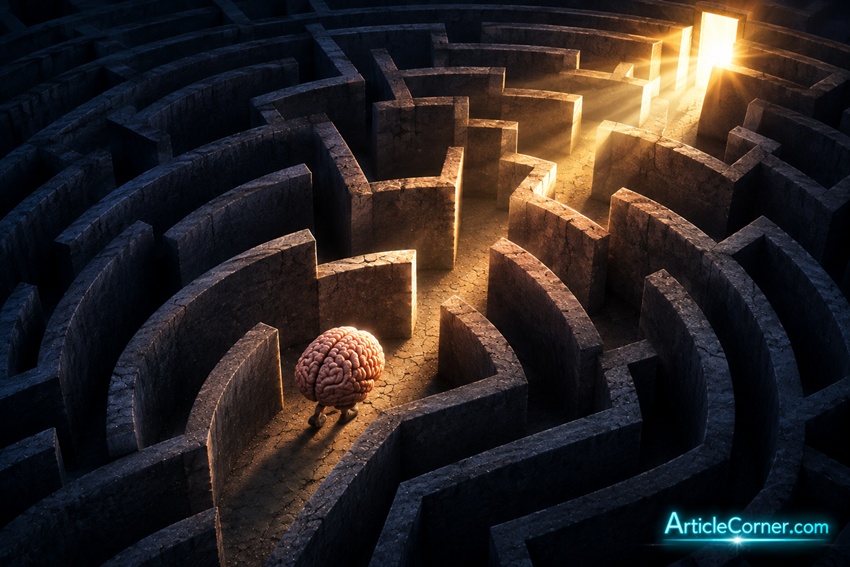
Addiction is not the end; it is a path that must be overcome to begin again.
ArticleCorner: Ignoring addiction means remaining silent in the face of a growing social problem.
Writer: articlecorner.com