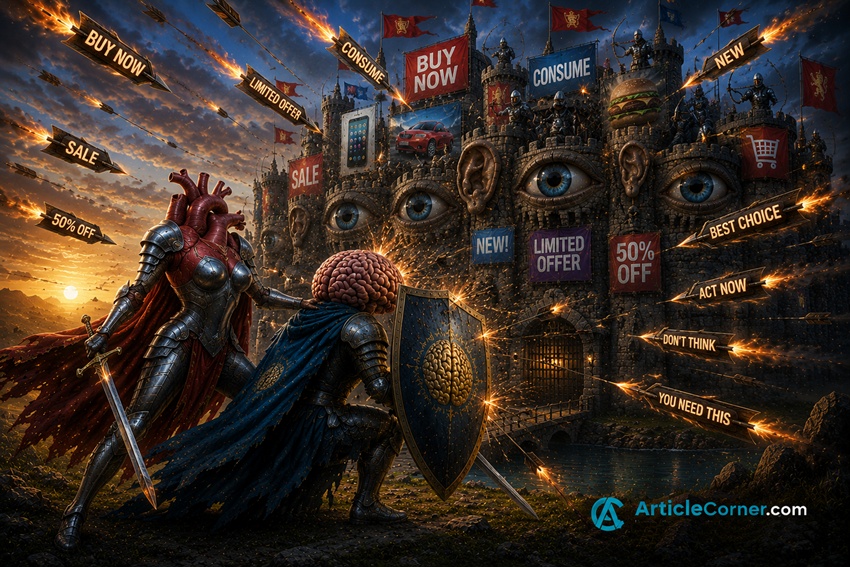
Advertising and Perception
Have you ever thought about it?
When did someone first tell another person, “You should buy this”?
Advertising is actually much older than we think.
It did not begin with television, radio, or the internet. As soon as people started trading, some form of advertising began to appear.
In ancient times, a merchant would place products in front of a shop. Sometimes they would call out what they were selling. Sometimes they would use a simple symbol to tell people what the shop offered.
This was especially important when most people could not read or write. A simple picture could tell someone what was being sold. Those symbols were among the earliest forms of what we would recognize today as signs and advertising.
As writing became more common, advertising changed.
People began writing announcements on walls and other surfaces. They advertised products, services, performances, and places.
At its heart, advertising began with a very simple message.
Notice me.
And over time, that simple message became much bigger.
The printing press appeared. Newspapers became common. Radio entered people's homes. Then came television.
After that came the internet.
And then social media.
Advertising was no longer outside a shop.
It entered our homes.
Then it entered our pockets.
Today, it can reach almost directly into our minds.
What Is Advertising Really Selling Us?
In the past, advertising was often much simpler.
“We have this product.”
Today, many advertisements say much more than that.
“If you own this product, you will be happier.”
“If you drive this car, you will look successful.”
“If you buy this phone, your life will become easier.”
“If you wear these clothes, you will feel more attractive.”
Something interesting happens here.
Advertising is no longer simply showing us a product.
It creates a life around the product.
In a coffee advertisement, we are not only seeing coffee. We see happy people, a beautiful home, friendship, comfort, and peace.
In a car advertisement, we are not only seeing a car. We are seeing freedom, power, adventure, and success.
In a perfume advertisement, sometimes we are seeing much more than perfume. We are seeing attraction and confidence.
The product becomes almost secondary.
What is really being sold is a feeling.
How Does Advertising Change Our Perception?
The human mind becomes accustomed to things it sees repeatedly.
When we constantly see beautiful homes, expensive cars, perfect faces, and seemingly perfect lives, we can gradually begin to see them as normal.
Then we look at our own lives.
Is my home beautiful enough?
Is my phone new enough?
Do my clothes look good enough?
Is my car impressive enough?
This is where one of the most powerful aspects of advertising appears.
Advertising does not always have to tell us directly:
“You are not good enough.”
It simply keeps showing us something that appears better.
Our minds do the rest.
Need or Desire?
Perhaps this is one of the most interesting parts of advertising.
How well do we really know what we need?
If our phone still works, why do we need a new one?
If our wardrobe is already full, why do we want more clothes?
If the things in our home still work, why do we want newer versions?
Because human beings do not act only according to their needs.
We also act according to our desires.
Advertising understands this very well.
It does not always have to create a completely new need.
Sometimes it only has to make an existing desire stronger.
What If There Were No Advertising?
Now let us imagine something.
We wake up one morning and advertising has disappeared from the world.
No advertisements on television.
No advertisements on the internet.
No giant billboards on the streets.
No notifications trying to sell us something.
At first, it sounds wonderful.
Then another question appears.
How would people make money?
How would television channels survive?
How would websites generate income?
How would newspapers, radio stations, applications, and many free services pay their expenses?
Advertising is not only a system that encourages people to consume.
It is also a massive economic system.
Millions of people work directly or indirectly because of advertising.
Media companies, internet platforms, publishers, and content creators often depend on advertising revenue.
So removing advertising completely would not simply mean removing advertisements.
It would mean changing a huge part of the economic system.
But We Have Reached a Different Point
Perhaps the real problem is not that advertising exists.
Perhaps the real question is how much of it surrounds us.
Once, advertising introduced us to a product.
Today, advertising can follow us throughout the day.
We pick up our phone and see an advertisement.
We watch a video and see an advertisement.
We read an article and see an advertisement.
We walk into a store and see advertisements.
We browse social media and see advertisements.
Sometimes it is even difficult to tell what is an advertisement and what is a genuine recommendation.
Maybe this is where we need to ask ourselves a simple question.
Do I really want this, or have I been told that I should want it?
It may sound like a small question.
But it is actually a very important one.
Because freedom of choice is not only about being able to choose what we want.
Sometimes freedom means understanding why we want it in the first place.
Advertising will continue to exist as long as human society exists.
It will probably become even more intelligent.
It will understand us better.
It will learn what we like, what we look at, when we shop, and which images make us react.
So perhaps the real question of the future will not be whether advertising disappears.
The real question will be whether our perception still belongs to us.
And perhaps the most important question we can ask about advertising is this.
When we buy a product, are we really buying the product?
Or are we buying the life that was presented to us along with it?
ArticleCorner: Advertising is the art of influencing perception through strategy. Control perception, and you influence choice.
Writer: articlecorner.com