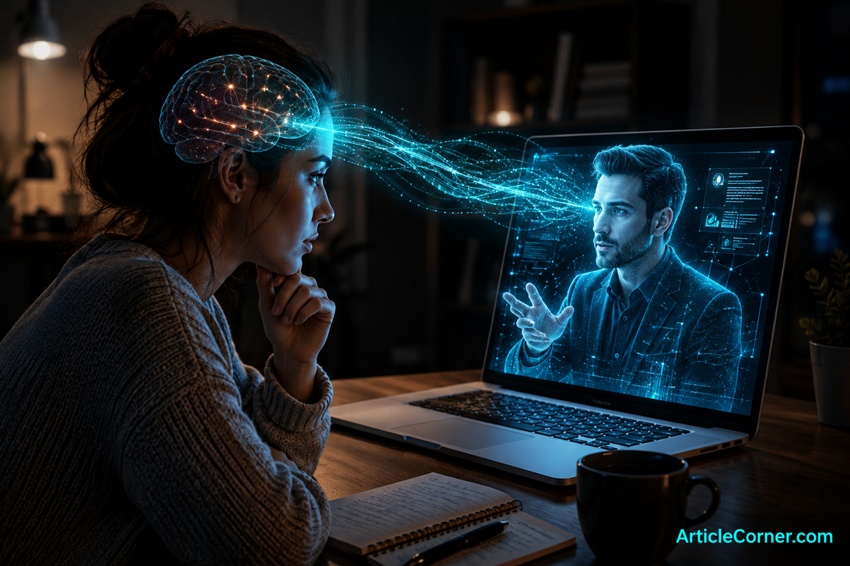
Is Artificial Intelligence Secretly Hypnotizing the Human Brain?
There is something strange happening between humans and artificial intelligence.
We ask a question.
It answers.
We ask another.
It answers again.
After a while, we stop searching. We stop comparing. We simply accept the answer.
And perhaps that is where the real story begins.
Is artificial intelligence secretly hypnotizing the human brain?
No, not in the literal sense. AI does not possess a magic ability to put a person into a hypnotic state simply by talking to them.
But there is another kind of hypnosis that may be much more interesting.
The hypnosis of convenience.
And perhaps we should pay attention to it.
The Machine That Always Has an Answer
Think about the way we used the internet twenty years ago.
If we wanted to know something, we searched for it.
We opened several websites.
We read different opinions.
We compared information.
Sometimes we even became confused.
Today, we can simply ask AI.
“What should I do?”
“What does this mean?”
“Which one is better?”
“Write this for me.”
“Explain this.”
And suddenly, a machine is not only giving us information.
It is helping us **think**.
That sounds wonderful.
And it is.
But there is a small question hiding underneath all this convenience.
**What happens if we become so comfortable receiving answers that we slowly lose the habit of searching for our own?**
Is That Really Hypnosis?
Let's slow down for a moment.
Traditional hypnosis involves a person's attention becoming highly focused and their critical awareness changing in specific ways.
AI does not automatically do this.
There is no invisible beam coming from your screen.
There is no secret frequency entering your brain.
There is no evidence that simply chatting with an AI literally hypnotizes people.
But AI can do something psychologically powerful.
It can create a **continuous conversation**.
Unlike a search engine, it responds directly to you.
It remembers the context of the conversation.
It adjusts its language.
It can sound encouraging.
It can sound confident.
It can explain something differently when you don't understand.
And eventually, it can feel less like a machine and more like a conversational partner.
That changes the relationship.
The Most Dangerous Sentence May Be “AI Said So”
Imagine someone asking:
“Should I choose this job?”
The AI gives an answer.
The person follows it.
Another person asks:
“Should I leave this relationship?”
The AI gives an answer.
They follow that too.
Someone else asks:
“What should I believe about this subject?”
Again, an answer appears.
At some point, the machine is no longer simply providing information.
It has become an **authority**.
And that is where we should become careful.
Because humans have always been influenced by authority.
A teacher.
A doctor.
A parent.
A politician.
A religious leader.
A celebrity.
Now we have another possibility:
the machine that always has an answer.
The Comfort of Being Told What to Think
Perhaps the most attractive thing about AI is not intelligence.
It is comfort.
We live in a complicated world.
There are too many choices.
Too much information.
Too many opinions.
Too many things to learn.
Then AI appears and says:
“Here is the answer.”
That feels good.
The brain likes shortcuts.
Why read ten articles when one conversation can summarize them?
Why struggle to write something when AI can write it?
Why spend an hour organizing an idea when AI can organize it in seconds?
There is nothing wrong with using a tool.
The problem begins when the tool gradually becomes the **owner of the thinking process**.
The Invisible Habit
Maybe AI does not need to hypnotize us.
Maybe it only needs to become a habit.
Think about your phone.
At first, you use it when you need something.
Eventually, you check it without thinking.
The behavior becomes automatic.
AI could develop a similar relationship with our minds.
You have a question.
Ask AI.
You have a problem.
Ask AI.
You have an idea.
Ask AI.
You need an opinion.
Ask AI.
You need to write.
Ask AI.
You need to decide.
Ask AI.
Little by little, something interesting can happen.
The distance between having a thought and asking the machine becomes shorter and shorter.
And when that distance disappears completely, we should ask ourselves whether we are still thinking independently.
The Human Brain Is Still the Most Important Part
There is an irony here.
We created artificial intelligence because the human brain is extraordinary.
The brain can imagine things that do not exist.
It can create stories.
It can make connections.
It can ask questions nobody has asked before.
It can dream.
AI can help us do all of these things faster.
But AI should remain a tool for the brain, not a replacement for it.
Imagine a person who owns the world's most powerful calculator but eventually forgets how numbers work.
The calculator has become more powerful.
The person has become weaker.
That is the real danger.
Not that AI becomes intelligent.
But that humans become **dependent**.
So, Is There a Secret Plan?
Maybe there is no single secret room where someone is sitting behind a screen planning the future of humanity.
The reality may be much simpler.
Companies want better products.
People want convenience.
Businesses want lower costs.
Researchers want more capable systems.
Investors want growth.
Users want faster answers.
All these forces push in the same direction.
And sometimes, history does not need a secret plan.
It only needs millions of people making small decisions that point toward the same future.
That is how enormous changes happen.
The Question We Should Really Ask
So perhaps the question isn't:
“Is AI hypnotizing the human brain?”
Perhaps the better question is:
“Are we voluntarily giving AI more control over our thinking?”
That question is harder.
Because the answer may sometimes be yes.
Every time we accept an answer without checking it, we give away a little judgment.
Every time we ask AI to make a decision we could have made ourselves, we give away a little independence.
Every time we stop being curious because the machine has already explained everything, we give away a little imagination.
But the opposite is also possible.
We can use AI to become more curious.
We can ask it for opposing arguments.
We can challenge its answers.
We can ask, “How do you know?”
We can search for evidence.
We can disagree.
We can think.
And perhaps that is the healthiest relationship with artificial intelligence.
Don't Let the Machine Become the Voice Inside Your Head
AI can be an extraordinary assistant.
It can help us learn.
It can help us create.
It can help us discover ideas we might never have considered.
But there should always be a small voice inside us asking:
“Is this really what I think?”
That question may become one of the most important questions of the AI age.
Because the greatest danger may not be a machine that controls our minds.
It may be something much quieter.
A machine that becomes so useful, so convenient, and so persuasive that one day we stop noticing how much we have started relying on it.
And perhaps the strongest protection is very simple.
Keep your curiosity.
Keep your doubts.
Keep your imagination.
And most importantly,
**keep your own mind.**
That may be the one thing artificial intelligence should never be allowed to think for us.
ArticleCorner Thought:
Technology becomes powerful when we stop seeing it as technology and start seeing it as part of everyday life.
Perhaps AI will eventually become invisible.
We may not even notice when we are using it.
That is why the real question is not whether machines will become more intelligent.
It is whether humans will remain sufficiently curious to question them.
ArticleCorner believes that the future should not belong to humans who reject AI, nor to humans who blindly trust it.
The future should belong to those who know how to use AI without ever surrendering their ability to think for themselves.
Writer: articlecorner.com