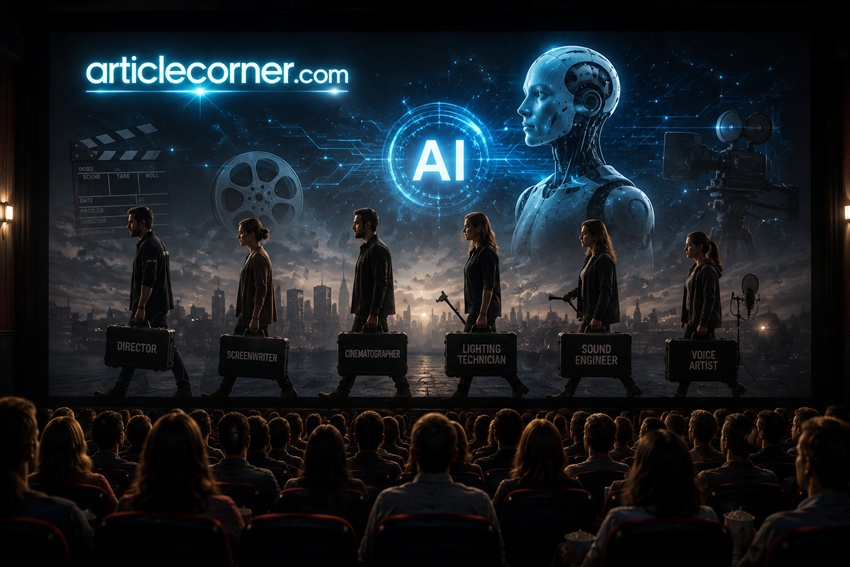
How Artificial Intelligence Is Changing the Film Industry
What did it take to shoot a movie scene in the past?
Actors, cameras, lighting, sets, costumes, makeup, directors, camera crews, special effects...
And, of course, a producer willing to pay for all of it.
Today, you can sit in front of a computer and simply describe what you want.
“An old train station in Istanbul on a rainy night. A woman is waiting alone. Cinematic lighting. The camera slowly moves toward her.”
And suddenly, a scene appears.
We are not talking about a simple cartoon or an obviously artificial image.
Sometimes, the result looks remarkably close to something taken directly from a movie.
That is what is beginning to surprise the film industry.
Artificial intelligence has not simply made filmmaking easier.
It is changing the cost of making a movie.
For decades, a filmmaker's imagination often had to compete with the budget.
“I would love to shoot this scene, but it is too expensive.”
“We cannot build that city.”
“We cannot afford a battle scene on that scale.”
“We cannot make that creature look realistic.”
Now, in some cases, the answer is different:
“Why not?”
AI is making the distance between an idea and an image incredibly small.
What About Actors?
This is where the conversation becomes more complicated.
Do you always need a real model for an advertisement?
For a catalog?
For a social media video?
For a background character?
Not necessarily anymore.
AI can create a new face.
It can show the same character at different ages.
It can change clothing, locations and environments.
And that digital character does not get tired, need a flight, or require a film set.
It can be used again and again.
For some actors, models and other creative professionals, this is a very real economic threat.
But something interesting is happening at the same time.
**As images become cheaper, stories may become more valuable.**
Why?
Because soon, almost everyone will be able to create beautiful images.
Flying a dragon may no longer be difficult.
Building a city on Mars may no longer be difficult.
Recreating ancient Rome may no longer be difficult.
Creating a giant spaceship may no longer be difficult.
The difficult part is something else:
**Telling a story that people genuinely want to watch.**
Perhaps this will be one of the biggest changes AI brings to cinema.
In the past, making a movie required a large team.
In the future, a director, a writer and a powerful AI system might be able to create something that once required an entire production company.
Is that good?
Is it bad?
We do not know yet.
But one thing seems certain.
**Cinema is no longer limited to cameras.**
And perhaps the most important thing in the future of filmmaking will not be the image.
It will still be the human being behind the story.
Because AI can give us millions of images.
But we still have to decide **which ones mean something.**
ArticleCorner.com Perspective
What About Jobs?
There is another question we cannot ignore.
If AI can create actors, locations, visual effects and even entire scenes, what happens to the people who used to do those jobs?
Some new jobs will certainly appear. But that does not mean everyone who loses their work will immediately find a new place.
AI may make filmmaking cheaper and faster.
But for some people, that efficiency may come with a price:
**Their job.**
And perhaps that is the part of the AI revolution we need to think about most carefully.
Writer: articlecorner.com