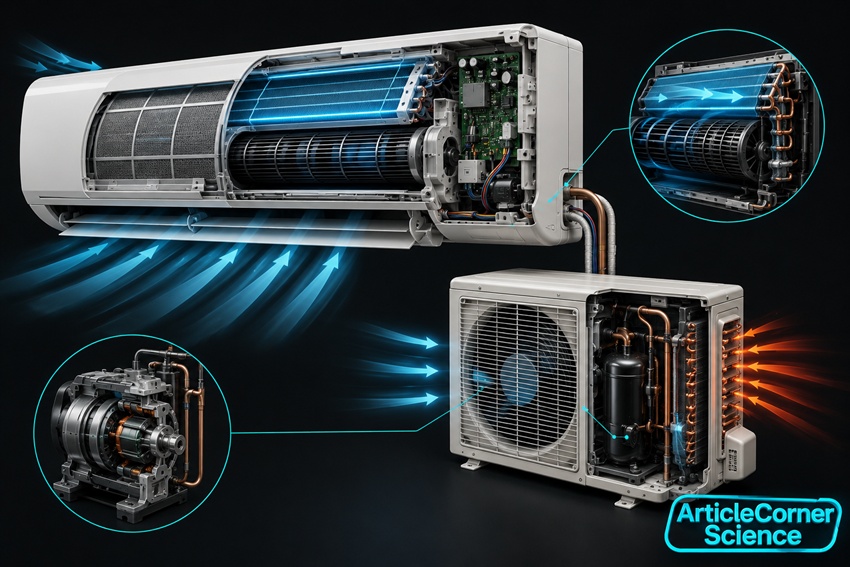
ArticleCorner Science:
How Does an Air Conditioner Work?
How Can the Same System Cool and Heat a Room?
Have you ever wondered how an air conditioner can make a room cool in summer and warm in winter?
It may seem like the machine is simply producing cold or hot air. But that is not really what is happening.
An air conditioner is actually a clever heat transfer system. It moves heat from one place to another. And when the system reverses the direction of that heat transfer, the same machine can heat the room.
Let's see how it works.
First, How Does Cooling Work?
Imagine your room is hot.
The air conditioner does not simply create cold air from nothing. Instead, it takes heat out of the room.
The process begins with a component called the evaporator coil, which is located inside the indoor unit.
A special refrigerant flows through this coil. The refrigerant is designed to absorb heat very efficiently.
Warm room air is pulled into the indoor unit by a fan. As the air passes over the cold evaporator coil, the refrigerant absorbs heat from the air.
The air becomes cooler and is blown back into the room.
So the basic process is:
Warm room air → Evaporator → Heat absorbed → Cool air returned to room
But where does all that heat go?
The Heat Has to Go Somewhere:
This is the really interesting part.
The heat removed from your room is carried by the refrigerant toward the outdoor unit.
Inside the outdoor unit is a component called the compressor.
The compressor squeezes the refrigerant, increasing its pressure and temperature.
The hot refrigerant then moves through the condenser coil.
A fan blows outdoor air across this coil, allowing the heat to escape into the outside air.
So even though your indoor unit is blowing cold air, the outdoor unit is actually releasing the heat that was removed from your room.
The complete cooling cycle looks like this:
Indoor air → Evaporator → Refrigerant absorbs heat → Compressor → Condenser → Heat released outdoors.
What Happens to the Refrigerant?
The refrigerant continuously changes between different pressure and temperature conditions.
After releasing heat outdoors, the refrigerant passes through an expansion valve or similar expansion device.
Its pressure suddenly drops.
As a result, the refrigerant becomes much colder.
It then returns to the indoor evaporator and is ready to absorb more heat from the room.
And the cycle starts again.
Absorb heat → Compress → Release heat → Expand → Absorb heat again
This happens continuously while the air conditioner is operating.
But How Can It Heat the Room?
Now comes the clever part.
A heat pump air conditioner can reverse the direction of the refrigeration cycle.
Instead of taking heat from inside the house and sending it outside, the system takes heat from outside and brings it inside.
This is possible even when the outdoor air feels very cold.
The Reversing Valve:
A component called a four-way reversing valve changes the direction in which the refrigerant flows.
In cooling mode:
Inside → Heat is removed → Outside
In heating mode:
Outside → Heat is collected → Inside
The same compressor, refrigerant and heat exchangers are still being used. The system simply changes the direction of the refrigerant flow.
Where Does the Heat Come From When It's Cold Outside?
This might sound strange.
If it's 5°C outside, how can the air conditioner find enough heat to warm your room?
The answer is that cold air still contains thermal energy.
The refrigerant inside the outdoor coil can be even colder than the outdoor air. Heat naturally moves from the relatively warmer outdoor air into the colder refrigerant.
The system then compresses the refrigerant, raising its temperature significantly.
That heat is transferred through the indoor coil into the room.
So the heating process looks like this:
Outdoor air → Outdoor coil → Refrigerant absorbs heat → Compressor → Indoor coil → Heat released into room
The Indoor and Outdoor Units Switch Jobs
This is one of the easiest ways to understand a heat pump air conditioner.
During cooling:
Indoor coil = Evaporator
Outdoor coil = Condenser
During heating:
Outdoor coil = Evaporator
Indoor coil = Condenser
The coils themselves don't physically move. The refrigerant flow changes, so their roles are reversed.
That's why one machine can perform both heating and cooling.
What Does the Compressor Actually Do?
The compressor is one of the most important components in the system.
It takes low-pressure refrigerant vapor and compresses it into a high-pressure vapor.
Compression raises the refrigerant's temperature.
You can think of the compressor as the engine that keeps the refrigeration cycle moving.
Without it, the refrigerant could not continuously circulate and transfer heat.
Why Does the Outdoor Unit Sometimes Produce Water?
You may have noticed water dripping from an air conditioner.
During cooling, moisture from the warm indoor air can condense on the cold indoor coil.
That water is collected and drained away.
But during heating, something different can happen.
The outdoor coil can become very cold, causing moisture from the outdoor air to freeze on it.
The system may then temporarily enter a defrost cycle.
It briefly reverses the operation to warm the outdoor coil and melt the accumulated ice.
You may notice the outdoor unit producing steam or water during this process. That's normal.
Is the Air Conditioner Actually Creating Heat?
Not exactly.
This is one of the most important ideas to understand.
An air conditioner working as a heat pump is primarily moving heat, rather than creating heat directly.
In cooling mode, it moves heat:
From inside → outside
In heating mode, it moves heat:
From outside → inside
Electricity is mainly used to power the compressor, fans, controls and other components that make this heat transfer possible.
The Big Picture
A modern air conditioner is essentially a reversible heat-moving machine.
When you want cooling, it takes heat out of your room and releases it outside.
When you want heating, it reverses the process and brings heat from outside into your room.
The key components are:
Compressor — circulates and compresses the refrigerant.
Evaporator — absorbs heat.
Condenser — releases heat.
Expansion valve — lowers refrigerant pressure.
Reversing valve — changes the direction of the cycle.
Fans — move air across the coils.
Refrigerant — carries heat through the system.
So the next time you switch your air conditioner from ❄️ cooling to ☀️ heating, remember what is really happening.
The machine isn't simply making cold or hot air. It's moving heat — and it knows which direction to move
ArticleCorner Science: Read. Learn. Discover.
Writer: articlecorner.com