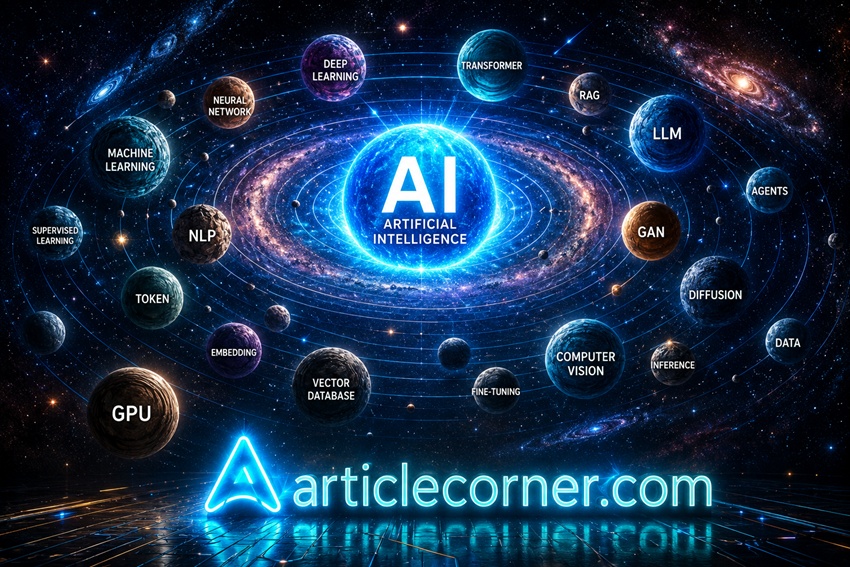
Artificial Intelligence Terms
Artificial Intelligence is transforming the way we work, learn, create, and communicate. As this technology evolves, its vocabulary grows just as rapidly, introducing new concepts that can be challenging to understand.
To help readers explore this fascinating field, **ArticleCorner.com** has created this comprehensive Artificial Intelligence Glossary. Each term is presented with a clear and concise explanation, making complex AI concepts easier to understand for students, professionals, developers, researchers and curious minds alike.
Whether you are taking your first steps into AI or expanding your technical knowledge, we hope this glossary becomes a valuable reference on your journey through the world of artificial intelligence.
| Term | Description |
|---|---|
| Artificial Intelligence (AI) | Machines performing tasks requiring human intelligence. |
| Artificial General Intelligence (AGI) | AI with human-level general reasoning. |
| Artificial Super Intelligence (ASI) | AI exceeding human intelligence. |
| Machine Learning | Algorithms that learn from data. |
| Deep Learning | Machine learning using deep neural networks. |
| Neural Network | Brain-inspired computational model. |
| Large Language Model (LLM) | AI model trained on massive text. |
| Small Language Model (SLM) | Compact language model. |
| Transformer | Neural architecture using attention. |
| Token | Small text unit processed by models. |
| Embedding | Numeric representation of data. |
| Prompt | Instruction given to an AI model. |
| Prompt Engineering | Designing effective prompts. |
| Fine-tuning | Adapting a pretrained model. |
| Training | Teaching a model using data. |
| Inference | Running a trained model. |
| Reinforcement Learning | Learning through rewards. |
| RLHF | Reinforcement Learning from Human Feedback. |
| Computer Vision | AI understanding images. |
| Natural Language Processing | AI processing human language. |
| Sentiment Analysis | Detecting emotional tone. |
| Named Entity Recognition | Finding names and entities in text. |
| Text Generation | Producing written content. |
| Image Generation | Creating images with AI. |
| Speech Recognition | Converting speech into text. |
| Text-to-Speech | Generating speech from text. |
| Diffusion Model | Generative image model. |
| GAN | Generator and discriminator network. |
| CNN | Convolutional neural network. |
| RNN | Recurrent neural network. |
| LSTM | Long short-term memory network. |
| Attention | Mechanism focusing on relevant information. |
| Context Window | Maximum input length. |
| Hallucination | Incorrect AI-generated information. |
| Overfitting | Model memorizes training data. |
| Underfitting | Model fails to learn patterns. |
| Accuracy | Overall prediction correctness. |
| Precision | Correct positive prediction rate. |
| Recall | Ability to find positives. |
| F1 Score | Balanced precision and recall. |
| Loss Function | Measures prediction error. |
| Gradient Descent | Optimization algorithm. |
| Learning Rate | Optimization step size. |
| Epoch | One full training pass. |
| Batch | Training data subset. |
| Hyperparameter | Configuration set before training. |
| Vector Database | Stores embeddings. |
| RAG | Retrieval-Augmented Generation. |
| Semantic Search | Meaning-based search. |
| AI Agent | Autonomous AI assistant. |
| Multimodal AI | Processes multiple data types. |
| Explainable AI | Interpretable AI systems. |
| AI Safety | Reducing AI risks. |
| Bias | Systematic unfairness in outputs. |
| Alignment | Matching AI with human goals. |
| TensorFlow | Machine learning framework. |
| PyTorch | Deep learning framework. |
| Keras | High-level neural network API. |
| LangChain | Framework for LLM applications. |
| LlamaIndex | Framework connecting LLMs to data. |
| Ollama | Run LLMs locally. |
| OpenAI API | API for AI models. |
| Function Calling | LLM invokes external tools. |
| Tool Calling | AI uses software tools. |
| Memory | Persistent conversational context. |
| Reasoning | Logical problem solving. |
| Agentic AI | Goal-driven autonomous AI. |
Writer: articlecorner.com