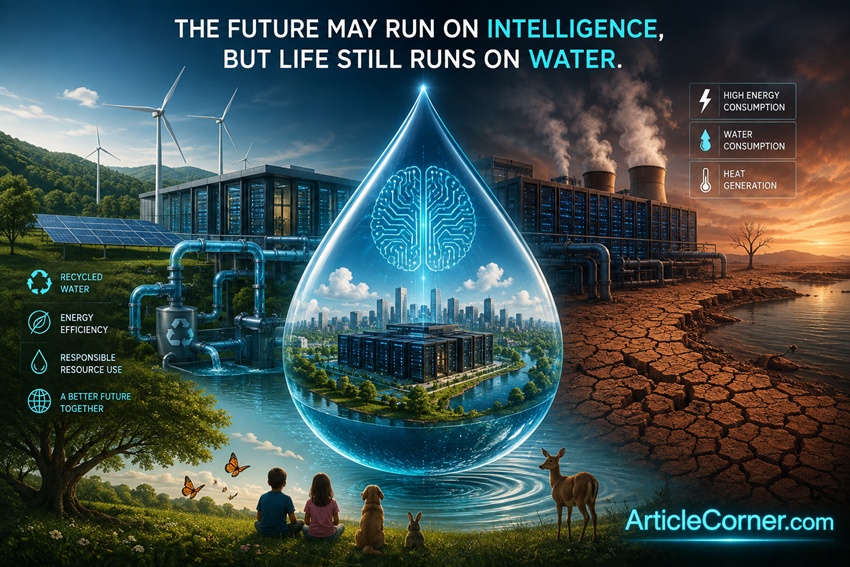
Is AI Drinking Our Water?
The Hidden Cost Behind Artificial Intelligence.
We usually imagine artificial intelligence as something invisible.
A question appears on a screen.
An answer arrives in seconds.
We generate an image, write an article, translate a sentence, and move on.
It feels almost weightless.
Yet somewhere far away, powerful computers are working around the clock. Thousands of processors are handling enormous amounts of information, generating heat and consuming electricity. That heat has to go somewhere.
And sometimes, water is part of the answer.
This is one of the hidden sides of the technology we use every day.
The Water Behind the Machine:
Artificial intelligence does not literally drink water. The infrastructure that supports it can.
Large data centers generate enormous amounts of heat. Cooling systems are designed to keep the equipment operating safely, and some facilities rely on water based cooling. In certain systems, water evaporates as it carries heat away.
There is another part of the story that is easier to miss.
Generating electricity can also require water. As a result, the environmental footprint of AI extends beyond the walls of a data center. It can include the resources involved in producing the power that keeps those servers running.
That simple interaction on a screen suddenly has a much larger physical story behind it.
One Question Is Small:
A single request is not going to empty a lake.
The real issue is scale.
Millions of people use AI every day. They ask questions, generate images, create videos, search for information, analyze data and run business applications. Behind all of this activity are increasingly powerful computing systems.
Individually, each interaction may have a relatively small environmental impact. Collectively, however, billions of interactions can create a footprint that deserves attention.
There is also no universal number for the amount of water associated with a single AI request. The figure can vary depending on the model, the data center, cooling technology, local climate, electricity source and many other factors.
So whenever we encounter a precise figure claiming that one AI question uses a certain amount of water, we should look at the context.
The broader point is much more important:
**Artificial intelligence has a water footprint.**
The Strange Contradiction:
There is something almost poetic about this.
We have created machines that can analyze climate data, study droughts, improve agricultural systems and help researchers find new solutions to environmental problems.
Yet the infrastructure behind those capabilities also requires physical resources.
That does not automatically make AI harmful.
It reminds us of something we often forget: technology is never truly weightless.
The cloud is not really a cloud.
Behind every digital service are buildings, cables, servers, power systems, cooling equipment, factories and people.
Behind every intelligent system is a very physical world.
Water Is Not Just Another Resource:
Servers can be replaced.
Software can be rewritten.
Energy systems can evolve.
Fresh water is different.
It supports ecosystems, agriculture, food production and human life. And its availability varies dramatically from one region to another.
A data center operating where water is plentiful presents a different environmental challenge from one located in a region already facing drought.
That is why perhaps the most important question is not simply:
How much water does AI use?
It is:
Where is that water coming from, and what else depends on it?
That question puts the technology into a much larger picture.
The Future Does Not Have to Be Dry:
Data centers can become more efficient. Cooling technologies can evolve. Recycled or reclaimed water can be used where appropriate. Facilities can be designed with local environmental conditions in mind.
AI models can also become more efficient, accomplishing more with less computing power.
Greater transparency can help as well. If companies clearly report their energy and water footprints, researchers, governments and the public can make better decisions about how this technology grows.
The goal is not necessarily to stop artificial intelligence.
It is to make progress more responsible.
After all, intelligence should mean more than producing a clever answer.
It should also mean understanding consequences.
Perhaps we should give them another challenge:
Help us use less.
Reduce wasted energy.
Protect fresh water.
Design more efficient cooling systems.
Build technology that works with nature rather than simply drawing from it.
The greatest achievement of AI may not be creating a machine capable of answering every question.
It may be creating technology intelligent enough to understand **which resources should never be taken for granted.**
So, Is AI Drinking Our Water?
In a sense, yes.
Not with a glass.
Not directly.
But behind the glowing screen are powerful computers producing heat, cooling systems removing it, and an enormous infrastructure requiring energy and, in some cases, water.
As artificial intelligence continues to grow, its environmental footprint deserves a place in the conversation.
The question is not whether we should fear AI.
The question is whether we can make it responsible.
Because there is something we should never forget:
**The future may run on intelligence, but life still runs on water.**
And water is not unlimited.
AI video generation is among the most resource intensive uses of artificial intelligence, requiring far more computing power and potentially more water than text based tasks.
ArticleCorner: Technology can become smarter.
Our responsibility must become smarter too.
Writer: articlecorner.com