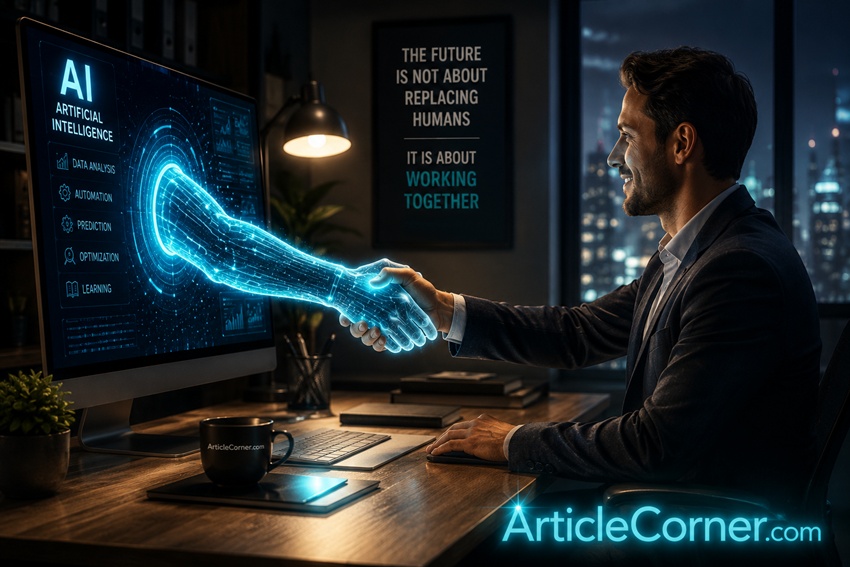
Artificial Intelligence and Unemployment: Not Just Changing Jobs, But Changing Lives
Imagine going to work one morning only to discover that the job you have performed for years can now be completed by a computer in just a few seconds.
That is not simply a story about technology.
It is the moment when someone's plans for the future begin to change.
Artificial intelligence is no longer a vision of tomorrow. It is already answering customer questions in banks, preparing reports in hospitals, managing production in factories, writing articles, reviewing legal documents, and helping software developers write code. Many tasks that were once considered uniquely human are now being performed by intelligent algorithms.
Technology has always created new opportunities. The Industrial Revolution did the same. Computers transformed the workplace as well. What makes artificial intelligence different is that it is beginning to perform not only physical work but also intellectual work.
People once believed that machines would imitate human strength.
Today they are beginning to imitate human thinking, analysis, and creativity.
This transformation has created a quiet but powerful sense of uncertainty for millions of people.
An accountant watches years of routine work become automated.
A graphic designer sees hours of creative effort compared with images generated in seconds.
A translator receives fewer projects than before.
Customer service representatives wonder about their future as AI assistants begin speaking with clients.
Journalists now compete with artificial intelligence in content creation.
Even software developers understand that they are no longer working alone.
Their greatest fear is not simply losing a job.
It is the possibility that years of knowledge, experience, and dedication may suddenly lose their value.
Human work has never been only about earning a salary.
It is about creating something meaningful.
It is about contributing to society.
It is about feeling useful.
It is about identity.
A teacher writing the first letters on a classroom board.
A skilled craftsman perfecting a technique over decades.
An administrative assistant keeping an organization running smoothly.
An editor noticing a small mistake that almost everyone else would miss.
Each represents years of learning and experience.
Artificial intelligence can now learn many of these tasks in a remarkably short time.
The impact is not only economic.
It is deeply emotional.
People do not work only to earn money.
Work gives people purpose.
It provides belonging.
It builds confidence.
It shapes identity.
Many people define themselves through what they do.
"I am a doctor."
"I am a teacher."
"I am an engineer."
"I am a journalist."
But what happens when artificial intelligence begins performing much of that work?
That is where the real question begins.
Artificial intelligence may not completely eliminate every profession.
However, it may reduce the number of people needed in many industries.
A task that once required ten employees may soon require only three.
Even successful companies may invest in AI systems instead of hiring additional staff.
The greatest challenge of the future may not simply be unemployment.
It may be a growing imbalance in opportunity and income.
While a small number of people build and own intelligent technologies, millions of workers may need to learn entirely new skills simply to remain competitive.
At the same time, artificial intelligence brings remarkable benefits.
It protects people from dangerous work.
It helps doctors detect diseases earlier.
It gives people with disabilities new ways to communicate.
It accelerates scientific research.
It creates more personalized learning experiences for students.
The problem is not artificial intelligence itself.
The real challenge is whether society is prepared for this transformation.
Many schools still educate students using methods designed decades ago.
Yet today's children will likely work in professions that have not even been invented.
Perhaps the most valuable skill in the future will no longer be memorizing information.
It will be curiosity.
Critical thinking.
Empathy.
Creativity.
These remain among the greatest strengths of being human.
Perhaps the future is not about competing with artificial intelligence.
Perhaps it is about learning to work alongside it.
Every major technological revolution has begun with uncertainty.
Yet no invention has ever replaced the human ability to dream.
Artificial intelligence may learn at extraordinary speed.
But it has never truly experienced the love of a parent.
The inspiration of an artist.
The silent comfort of a close friend.
The pride of a teacher watching a student succeed.
Some experiences cannot be measured by data.
Perhaps the most important question is not how intelligent artificial intelligence will become.
Perhaps the real question is whether humanity can remain truly human while creating something that thinks beside us.
ArticleCorner.com Perspective
Artificial intelligence will reshape many industries. Some jobs will disappear, others will evolve, and entirely new professions will emerge.
Every technological revolution has created uncertainty before creating opportunity. Artificial intelligence is no different.
Those who resist change may struggle. Those who learn, adapt, and develop new skills will discover opportunities that never existed before.
Artificial intelligence is not just changing the way we work. It is changing the way we think about work itself.
At ArticleCorner, we believe the future belongs not to those who fear technology, but to those who learn how to use it wisely.
Writer: articlecorner.com