Education, Food and Health in Ancient Times
Have you ever wondered what it was really like to grow up thousands of years ago?
Not as a king living in a palace, and not as a famous warrior whose name would later appear in history books, but as an ordinary child in an ordinary family.
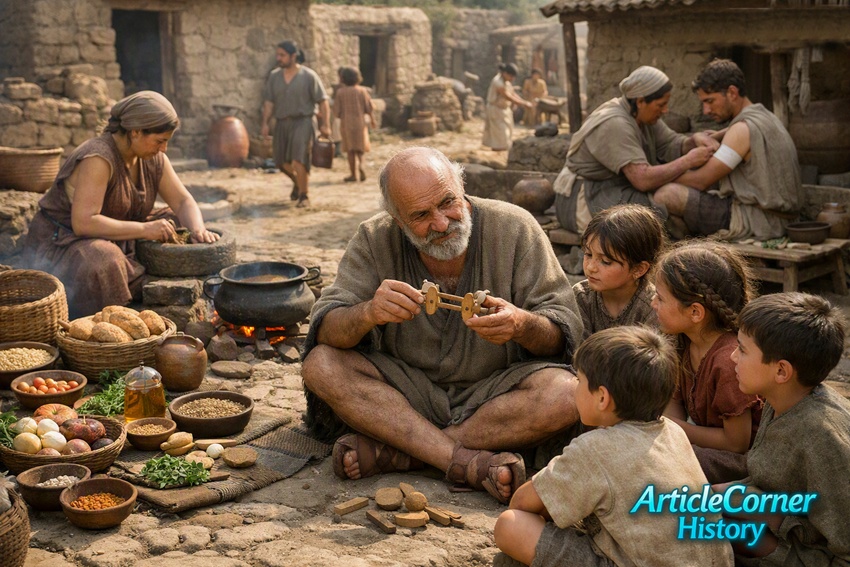
Imagine waking up in a small settlement. The people around you are already beginning their work. Someone is preparing food. Someone is carrying water. Another person is feeding the animals. You know the people around you because your world is made mostly of people you see every day. Your family, your neighbors, older members of the community, and the people who work beside you are the people from whom you learn almost everything.
You do not begin the day by asking, “What class do I have today?”
You simply begin learning.
Learning Was Part of Everyday Life:
For many ancient communities, education did not begin with a classroom. A child learned by watching.
If your father knew how to work with wood or stone, you watched his hands. If your mother knew how to prepare food, make clothing, care for children, or recognize useful plants, you watched her. If an older member of the community knew how to hunt, build, farm, make tools, or understand the seasons, you listened carefully.
At first, you probably did not understand everything.
You made mistakes.
You tried again.
Someone corrected you.
Then, one day, you were able to do the same thing by yourself.
This was education too.
Of course, some ancient civilizations eventually developed more formal systems of education. In places such as ancient Mesopotamia, Egypt, Greece, and Rome, certain children could receive organized instruction, particularly those from families with greater wealth or social position. Writing, mathematics, language, religion, law, philosophy, and practical skills could all become subjects of learning.
But formal education was not available to everyone in the same way.
For an ordinary child, much of life itself remained the classroom.
Think about that for a moment.
A child learning to recognize the weather was learning something important. A child learning which plants were safe was learning something that could protect the family. A child learning how to care for animals was preparing for adult responsibilities. A child listening to an elder tell the story of the community was learning history without opening a history book.
Knowledge was often carried by people.
And when one generation taught the next, knowledge continued to live.
Then Came the Question of Food:
Now imagine that someone asks you a very simple question:
“What are we going to eat today?”
Today, that question can have hundreds of answers. But for an ancient family, the answer depended heavily on where they lived, what season it was, what they had grown, what they had stored, what they could gather, what they could hunt, and what they could trade.
Food was closely connected to the land.
A family living near a river had different possibilities from a family living in a dry region. People living near the sea could depend on fish and other marine resources. Communities that developed agriculture learned to grow crops and store them for later.
Grain became particularly important in many ancient societies because it could be stored and turned into different kinds of food.
Imagine coming home after a long day and seeing grain being prepared for the evening meal. Someone has spent time grinding it. Someone else is preparing the fire. Another person is bringing water. Perhaps there are vegetables, fruit, milk, eggs, fish, or meat available depending on the place and the season.
The meal may look simple to us.
But it represents hours of work.
Food also had to be protected from spoilage. People developed ways of drying, salting, smoking, fermenting, and storing food. These methods were not simply culinary traditions. They could make the difference between having food later in the year and having nothing to eat.
And then there were celebrations.
Food was not only about survival.
People gathered for weddings, religious ceremonies, festivals, successful harvests, family events, and visits from friends. Sharing food created relationships. A meal could mean hospitality. Offering someone food could be a way of saying, “You are welcome here.”
Perhaps that is not so different from us.
We still invite people to dinner.
We still celebrate around tables.
We still remember certain moments because of the food we ate and the people who were sitting beside us.
But What Happened When Someone Became Sick?
Now imagine something more frightening.
Someone in the family becomes ill.
There is no modern hospital nearby. There are no advanced diagnostic machines. The family does not know exactly what is happening inside the person's body.
What do they do?
They observe.
They ask someone with experience.
They use what knowledge their community has developed.
In many ancient societies, people used plants, herbs, oils, honey, minerals, rest, changes in diet, physical treatments, and various other methods to deal with illness and injury. Some treatments had useful effects. Others were based on beliefs or ideas that we now know were incorrect.
Ancient medicine was not simply ignorance.
People observed the human body. They noticed patterns. They learned from injuries, illnesses, childbirth, plants, and experience. Some civilizations developed surprisingly sophisticated medical knowledge for their time.
And perhaps the most important people were sometimes those whose names history never recorded.
The person who knew which plant might help.
The experienced midwife who had helped many women give birth.
The older healer who knew how to clean and dress a wound.
The family member who stayed awake through the night beside someone who was sick.
Health was not only about medicine.
It was about knowledge, care, food, water, cleanliness, shelter, community, and luck.
And luck mattered.
A small wound could become dangerous. A serious infection could have consequences that modern medicine can often prevent. Childbirth could be much more dangerous. Diseases could spread through communities and sometimes leave families devastated.
Imagine being a parent and watching your child become seriously ill without knowing whether the child would recover.
That fear must have felt painfully familiar.
And Then There Was the Family:
Perhaps this is where the ancient world becomes easiest for us to understand.
At the end of the day, people returned to their families.
They talked about what had happened.
They discussed work.
They shared food.
Children played nearby.
Older people told stories.
Someone might complain about a difficult day. Someone might make everyone laugh. Two people might disagree and then sit together again later.
Life was not perfect.
People argued.
People made mistakes.
People became jealous.
People fell in love.
People lost loved ones.
People worried about tomorrow.
People hoped their children would have a better life.
The buildings may have been different. Their clothing may have been different. Their tools may have been different. Their understanding of the world may have been different.
But their emotions were not so foreign to us.
So, What Has Really Changed?
Today, education is available on a scale that ancient people could hardly have imagined. A child can learn from teachers, books, libraries, computers, and people from almost anywhere in the world.
Our food can come from thousands of kilometers away. We can preserve it, transport it, refrigerate it, and find an enormous variety of products throughout the year.
Modern medicine has transformed our lives. Doctors can examine the body in extraordinary detail. Diseases that once caused enormous suffering can often be prevented or treated. Surgery, antibiotics, vaccines, and modern medical knowledge have changed what it means to be sick.
These are extraordinary achievements.
But there is an interesting question.
Have we changed as much as our world has changed?
A child still wants to learn.
A family still wants enough food on the table.
A sick person still wants someone to stay beside them.
Parents still worry about their children.
People still gather around meals.
People still tell stories.
People still want to feel safe, loved, and understood.
Thousands of years have changed the way we live, but they have not erased the basic things we need from one another.
Perhaps an ancient child sitting beside a fire and a modern child sitting at a dinner table would have very different lives.
But if they could somehow meet, they might discover something unexpected.
They might not understand each other's clothes.
They might be amazed by each other's homes.
They might be confused by each other's tools.
But give them a little time.
Let them sit together.
Let them talk about their families.
Let them talk about what they like to eat, what scares them, what makes them laugh, and what they hope for.
Perhaps the conversation would become surprisingly easy.
Because civilizations change.
Knowledge grows.
Cities rise and disappear.
But beneath all of that, there is still a human being asking the same old questions:
Will my family be safe?
Will tomorrow be better?
Will the people I love be okay?
And perhaps that is one of the most fascinating things history can teach us.
When we look into the ancient world, we are not only looking at people who lived long ago.
In many ways, we are looking at ourselves.
The past still speaks. We only have to listen.
ArticleCorner History: Different Times. The Same Human Heart.
Writer: articlecorner.com