What Was Life Like in the Earliest Ages?
Have you ever wondered what an ordinary day felt like thousands of years ago?
Not the life of a king, a warrior, or a famous ruler, but the life of an ordinary person. Someone who woke up in a simple home, lived with their family, worked with their hands, knew the land around them, and went to sleep beneath the same sky their ancestors had watched for generations.
The day probably began quietly.
As the first light entered the home, people slowly began to move. Someone might prepare the fire while another person brought water. Children would wake up nearby, perhaps already hearing the sounds of animals outside. There was no hurry to catch a bus or arrive at an office. The day simply began, and everyone knew that there was work waiting.
Life depended heavily on the seasons.
Spring meant planting in many communities. Summer brought long days of work. Autumn was a time to gather and store what the land had produced. Winter could be difficult, especially when food became scarce and the cold settled over the settlement.
People knew their surroundings intimately.
They knew where water could be found. They knew which plants could be eaten and which should be avoided. They noticed changes in the weather. They understood the behavior of animals. They watched the clouds and the direction of the wind. Their knowledge did not usually come from books. It came from observation, experience, and stories passed from one generation to another.
A child learned by watching.
Perhaps a young boy followed his father or another experienced member of the community and slowly learned how to make a tool, tend animals, hunt, build, or work the land.
A young girl might learn from her mother, grandmother, or other members of the community how to prepare food, make clothing, care for children, gather useful plants, or manage the household.
But these were not simply lessons.
They were part of growing up.
People lived close to one another because life itself required cooperation. A family could not always manage everything alone. Neighbors helped one another. Food might be shared. A house might be repaired together. Someone with experience would teach someone younger. When a child was born, the event belonged not only to the parents but often to the whole community.
And just like today, people had feelings.
They fell in love.
They became jealous.
They argued.
They laughed.
They worried about their children.
They missed people who were gone.
They hoped tomorrow would be better.
A mother probably looked at her sleeping child with the same tenderness a mother feels today. A father probably worried when his child became sick. Two young people might have sat together somewhere outside the settlement, talking quietly and wondering what their future would be.
We sometimes imagine ancient people as if they were completely different from us.
They were not.
Their world was different, but their hearts were remarkably familiar.
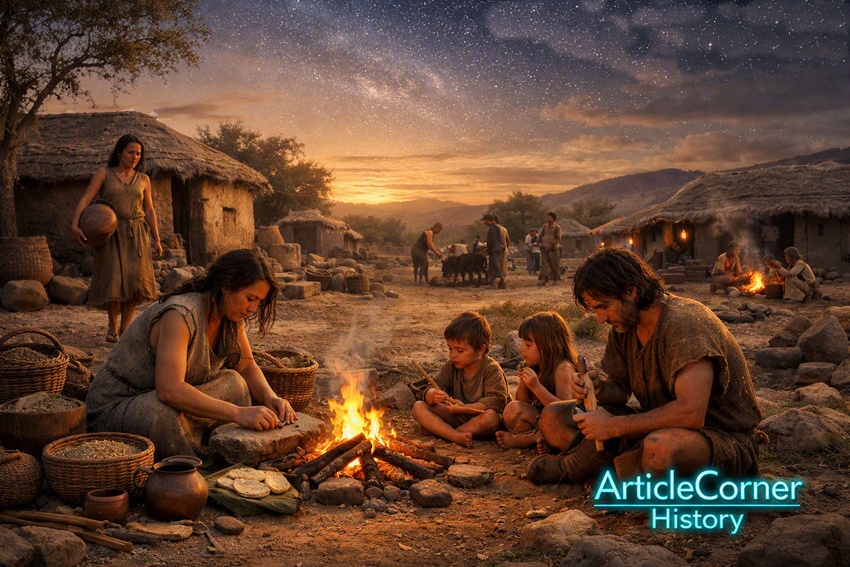
Imagine an evening in such a settlement.
The day's work is finally finished. The fire is burning. Someone is preparing food while others sit nearby. An older person begins telling a story. Perhaps it is about an ancestor, a dangerous animal, a great journey, a battle, or something that happened many years ago.
The children listen.
They may have heard the story before, but they still want to hear it again.
Someone laughs.
Someone adds a detail.
Someone disagrees with the storyteller.
For a while, nobody is thinking about tomorrow's work.
They are simply together.
The night grows darker. Above them, the sky is filled with stars.
For these people, the stars were not decorations in the background. They were part of life. The sky helped people understand the seasons, directions, and passing of time. It could also inspire wonder, fear, questions, and stories.
Perhaps someone looked upward and wondered what existed beyond those lights.
Perhaps another person looked at the same sky and thought about someone they had lost.
We will never know exactly what every person thought.
But we know that they were human.
They had hopes.
They had fears.
They had friendships.
They had families.
They had disagreements and reconciliations.
They experienced birth, love, illness, loss, celebration, hunger, comfort, loneliness, and joy.
Life was often difficult. A poor harvest could threaten an entire community. A serious injury could change a person's life. Disease could spread without the knowledge we have today. Nature could be generous one year and unforgiving the next.
Yet life was not simply a struggle.
There were ordinary moments of happiness too.
A good meal after a long day.
Rain arriving after a period of drought.
A child taking their first steps.
A successful harvest.
A warm fire on a cold evening.
A friend arriving safely after a long journey.
A story that made everyone laugh.
Perhaps these small moments mattered even more because they were so closely connected to everyday life.
And this is where the distance between their world and ours begins to disappear.
We have changed enormously.
We live longer. We understand diseases that once frightened entire communities. We can travel across continents in a matter of hours. We can speak to someone thousands of kilometers away. We can turn darkness into light with a simple movement and find information about almost anything within seconds.
Our lives are, in many ways, astonishingly comfortable compared with those of people living in the earliest ages.
But comfort has not changed everything.
We still sit beside the people we love.
We still worry about our children.
We still want to be understood.
We still search for friendship.
We still fall in love.
We still become afraid when someone we care about is in danger.
And at the end of a long day, we still want something very simple:
A safe place to return to.
A familiar face.
Something warm to eat.
A little peace.
Maybe that is why looking back at the earliest ages is so interesting.
We do not look into the past only to discover how different people were.
We look back to discover how much of us has remained the same.
The houses have changed.
The tools have changed.
The cities have changed.
The world has changed.
But when the day becomes quiet and we sit beside someone we love, perhaps we are not so different from the people who once sat beside their fires beneath the ancient night sky.
The past may be thousands of years behind us.
But sometimes, it feels surprisingly close.
**The past still speaks. We only have to listen.**
ArticleCorner History: The Past Still Speaks.
Writer: articlecorner.com