Trade and Economy in Ancient Times
Have you ever wondered how people bought what they needed thousands of years ago, long before banks, credit cards, online shopping, or even coins existed?
Today, we rarely think about what makes an economy work. We earn money, buy food, pay for a service, save for something we want, and move on with our day. But none of this appeared overnight. Long before people carried coins in their pockets, communities had already developed ways to produce, exchange, measure, save, and distribute things of value.
The story of the ancient economy begins not with money, but with a much simpler question:
“What do I have, and what do you have?”
Before Money:
Imagine an early farming community.
You have grown more grain than your family needs. Your neighbor has raised animals. Another person knows how to make strong clay pots. Someone else makes tools.
You need a pot.
The potter needs grain.
So you bring grain and receive a pot.
It sounds simple.
This is the basic idea of barter.
People could exchange food, animals, tools, clothing, pottery, salt, or other useful goods. In small communities, this could work surprisingly well because people knew one another and understood what was valuable.
But then imagine that you have grain and want a goat.
The person with the goat does not want grain.
He wants a new tool.
The toolmaker does not need a goat.
He wants something else.
Suddenly, the simple exchange becomes complicated.
This was one of the great problems that human communities gradually had to solve.
People needed something that could make exchange easier.
When Value Needed to Be Measured:
Long before coins appeared, ancient societies were already developing ways to measure value.
In Mesopotamia, for example, silver could be used as a standard of value by weight. Grain and other goods could also be measured carefully. People could record what was owed, what had been delivered, and what still needed to be paid.
This is an important part of the story because an economy does not begin when someone invents a coin.
An economy begins when people start organizing **production, exchange, labor, resources, and value**.
A farmer produces grain.
A shepherd raises animals.
A potter produces containers.
A weaver makes cloth.
A builder constructs homes.
A merchant moves goods from one place to another.
Each person contributes something.
And each person needs something from someone else.
The ancient economy was already becoming a network of relationships.
So, Who Invented Money?
This is where the story becomes particularly interesting.
Coins did not suddenly appear because one person woke up and decided to invent money.
The development happened gradually.
One of the most important steps occurred in **Lydia**, in western Anatolia, around the seventh century BCE. The Lydians are widely associated with some of the earliest standardized coins made from precious metal, particularly electrum, a natural mixture of gold and silver.
These early coins were small, but their importance was enormous.
A piece of metal could now carry an officially recognized value.
Instead of weighing metal every time an exchange took place, people could use standardized pieces whose weight and purity were supported by authority.
And that changed the marketplace.
Imagine walking through an ancient market.
You hear people calling out.
A farmer has brought grain.
A fisherman has brought his catch.
A potter has arranged clay vessels.
A merchant has traveled a long distance with goods that cannot be found locally.
People are talking, comparing prices, negotiating, buying, selling, and exchanging.
Now imagine holding a few standardized coins in your hand.
You no longer need to bring a basket of grain every time you want to buy something.
A small piece of metal can represent value.
That is a remarkable change.
Trade Begins to Connect Distant Worlds:
Once people became better at exchanging and transporting goods, trade began to stretch far beyond the local marketplace.
Ancient merchants traveled by land and sea.
Ships carried goods across the Mediterranean. Caravans crossed long distances through the Near East. Rivers became important routes for transporting heavy goods.
People traded grain, olive oil, wine, metals, timber, textiles, pottery, spices, precious stones, animals, and many other products.
A product made in one region could eventually appear in a completely different place.
Think about the journey of an object.
A piece of metal could come from a distant mining region.
A craftsman could turn it into a tool.
A merchant could carry that tool to another settlement.
A farmer could buy it.
The farmer could then use it to produce food.
The food might be traded again.
One object could therefore become part of a much larger economic story.
Ancient trade was not simply about buying and selling.
It connected communities.
It spread technologies.
It carried ideas.
It introduced people to unfamiliar foods, materials, customs, and cultures.
Who Made the Money?
Coins also raised another important question:
Who had the authority to create them?
In many ancient societies, coinage became closely connected to political authority.
Rulers and governments could issue coins and place official symbols, images, or inscriptions on them. This helped communicate authority and could make the coins recognizable beyond their place of origin.
A coin could therefore carry more than economic value.
It could carry a message.
It could say:
“This belongs to our system.”
And when merchants traveled, recognizable coins could make trade easier.
Money was becoming part of government, taxation, military organization, trade, and everyday life.
But Was Everyone Rich?
Certainly not.
An economy can function while enormous differences exist between people.
Ancient societies contained farmers, laborers, craftsmen, merchants, landowners, soldiers, officials, priests, and rulers. Their access to land, wealth, education, and political power could be dramatically different.
For an ordinary family, economic life could be very simple.
A farmer might spend most of the year producing food.
A craftsperson might depend on customers from the local community.
A merchant might take greater risks by traveling long distances.
A wealthy landowner might control large areas of agricultural land.
The economy was therefore not just about coins.
It was about **work**.
It was about who owned land.
Who produced food.
Who controlled resources.
Who traded goods.
Who collected taxes.
And who had the power to make decisions.
Taxes Were Part of Ancient Life Too:
Governments needed resources.
Cities had to be built and maintained. Armies needed food and equipment. Roads, walls, temples, ports, and administrative systems required labor and materials.
Taxes could therefore be collected in different forms.
Sometimes people paid with money.
Sometimes they paid with grain, animals, goods, or labor.
Imagine a farmer looking at part of his harvest and knowing that some of it would not remain in his home.
It would go toward the obligations imposed by the authorities.
For an ordinary person, this could be an important part of economic life.
And here again, something feels surprisingly familiar.
We still produce.
We still earn.
We still pay taxes.
We still buy what we need.
We still save what we can.
The systems are enormously more complicated today, but the basic relationship between people, work, resources, and exchange remains.
The Ancient Marketplace:
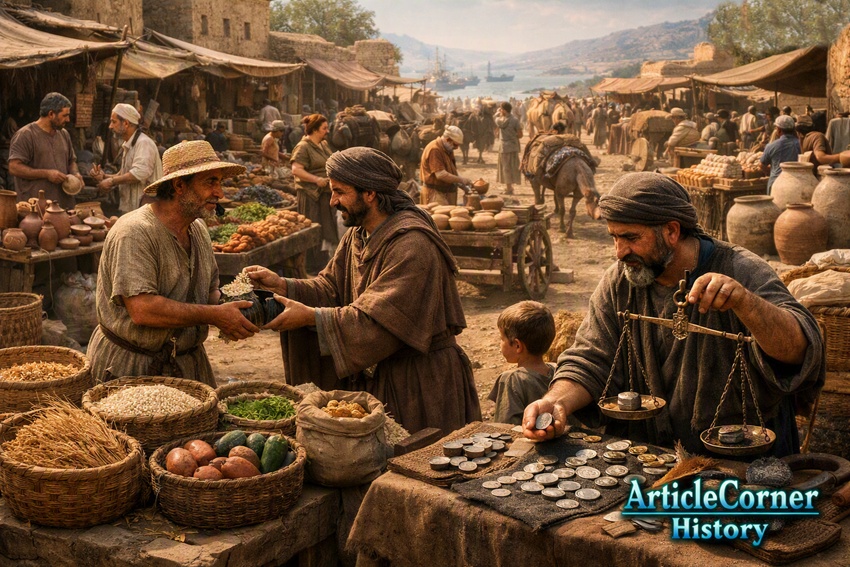
Perhaps the easiest way to understand the ancient economy is to imagine spending a morning in an ancient market.
You walk through the crowd.
A seller offers bread.
Another person has vegetables.
A craftsman displays handmade bowls.
Someone is selling cloth.
A merchant has arrived from another region with unfamiliar goods.
People are discussing prices.
Someone is bargaining.
Someone counts coins.
Someone decides that the price is too high and walks away.
A child stays close to a parent while watching everything around them.
An old man sits nearby and observes the crowd.
Nothing about this feels completely unfamiliar.
The clothes are different.
The buildings are different.
The language is different.
The coins are different.
But the marketplace itself feels strangely recognizable.
People still want something.
Someone else has it.
They negotiate.
They exchange.
They go home.
From Ancient Coins to Digital Money:
Thousands of years later, the basic idea has evolved far beyond anything an ancient merchant could have imagined.
We no longer need to carry bags of grain to buy food. We can transfer money without physically handing anything to another person. A purchase can be completed with a card, a phone, or a few movements on a screen.
Money can exist almost entirely as numbers in a bank account.
A person in one country can buy something from another country without ever meeting the seller.
The ancient merchant might find this unbelievable.
Imagine explaining online shopping to a trader from two thousand years ago.
“You choose an object without visiting the shop.”
“How do you see it?”
“On a screen.”
“And how do you pay?”
“With money that you cannot physically see.”
“And how do you receive the object?”
“Someone brings it to your home.”
He might look at you for a long moment.
Then perhaps he would ask:
“And you call this normal?”
We would probably laugh.
But after thinking about it, perhaps we would realize that his world was not so different after all.
He had a marketplace.
We have online marketplaces.
He had merchants.
We have businesses and sellers.
He had coins.
We have bank accounts and digital payments.
He traveled to trade.
We move goods across the planet.
The methods have changed almost beyond recognition.
The human purpose has not.
We produce something.
Someone needs it.
We exchange value.
And life continues.
Perhaps that is the most fascinating part of economic history.
Money is not the story.
People are.
Behind every coin was someone's work.
Behind every market was someone's need.
Behind every trade was a relationship between two people who had something to offer one another.
Thousands of years have transformed the way we trade and measure value.
But the ancient marketplace and the modern marketplace are still connected by the same simple human idea:
**“I have something you need, and you have something I need.”**
From grain to silver.
From silver to coins.
From coins to paper.
From paper to digital numbers.
The form of money has changed.
**The Way We Trade Has Changed, But the Need to Trade Has Not.**
ArticleCorner History: Trade Existed Before Money. Money Transformed It.
Writer: articlecorner.com