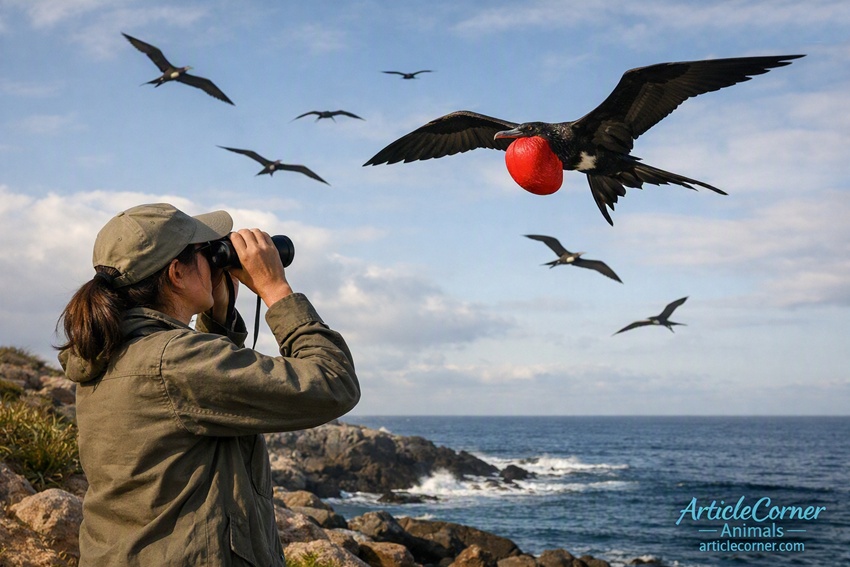
Frigatebird Through the Eyes of a Nature Activist
My name is Canan, and I am a nature activist who has spent many years observing seabirds and speaking up for the protection of marine ecosystems. Over time, I have learned that some animals do not simply live in nature. They reveal its story.
Among the birds I have observed, the frigatebird has always fascinated me. There is something almost poetic about watching one suspended high above the ocean, its enormous wings stretched against the wind. But behind that graceful image is a remarkable story of freedom, vulnerability, survival, and balance.
From an anatomical point of view, the frigatebird is extraordinary. It has one of the largest wingspans relative to its body size among birds.
Its long, narrow wings and deeply forked tail are perfectly adapted for life in the air. A frigatebird can glide for hours and sometimes remain airborne for remarkably long periods without landing. Unlike many seabirds, however, its feathers are not waterproof. This means it cannot simply land on the ocean and rest like a gull or albatross.
Instead, the frigatebird has evolved a very different way of life. The sky is its natural home.
Behaviorally, frigatebirds are masters of the wind. I have watched them soar high above the sea, barely moving their wings as they search for rising air currents. They use thermals and wind patterns with astonishing precision, turning the invisible movement of air into a source of energy.
Watching this is a reminder that survival in nature is not always about strength. Sometimes it is about understanding the environment and knowing how to move with it.
Frigatebirds are also famous for kleptoparasitism. They may chase other seabirds in midair and force them to drop their food, which the frigatebird then catches. At first, this behavior can look harsh or even aggressive. But in the difficult environment of the open ocean, it is an efficient survival strategy that allows these birds to obtain food without needing to land on the water.
Migration adds another remarkable chapter to the frigatebird's life.
These birds travel vast distances across tropical and subtropical oceans, often using prevailing winds rather than following a simple, fixed route.
Their journeys connect distant islands, coastlines, and marine ecosystems. A single bird may cross enormous stretches of ocean, carrying with it a living connection between places that seem completely separate to us.
Reproduction, however, is a much slower and more demanding part of their lives. Frigatebirds usually nest in colonies on remote islands, coastal areas, or mangrove habitats. Raising a chick requires a significant investment from the parents, and the breeding cycle is relatively long.
This makes frigatebirds particularly vulnerable when their nesting grounds are disturbed or their food sources decline. A healthy adult may be an impressive master of the sky, but even the best flyer cannot escape the consequences of a changing environment.
Males and females are also remarkably different in appearance. During the breeding season, the male develops a bright red throat pouch called a gular pouch. He inflates it dramatically, turning it into a striking red display as he attempts to attract a mate.
The female does not have this large red pouch and is generally larger than the male. She watches the males' displays and chooses a partner based on the quality of his courtship performance.
There is something fascinating about seeing this behavior in the wild. What may look like a simple splash of color from a distance is actually part of an ancient communication system shaped by evolution.
Frigatebirds can also tell us something about the condition of the ocean around them. Because their lives depend on marine food webs and suitable nesting habitats, changes in their populations, feeding behavior, or breeding success can provide clues about environmental changes.
As a nature activist, I see them as living voices of the sea. They cannot tell us in words when something is wrong, but their movements, numbers, and behavior can tell a story if we are willing to observe carefully.
For me, the frigatebird is more than a bird flying above the ocean. It is a symbol of the open sky, the immense freedom of the natural world, and the fragile ecosystems beneath it.
Whenever I watch one disappear into the distance, carried almost effortlessly by the wind, I am reminded of something simple. Nature does not exist as separate pieces. The bird, the wind, the ocean, the fish, the islands, and the people who depend on them are all part of the same living system.
To protect nature, sometimes we simply need to stop, look up, and listen to what the animals are already telling us.
ArticleCorner Animals: Observe nature and animals.
Writer: articlecorner.com