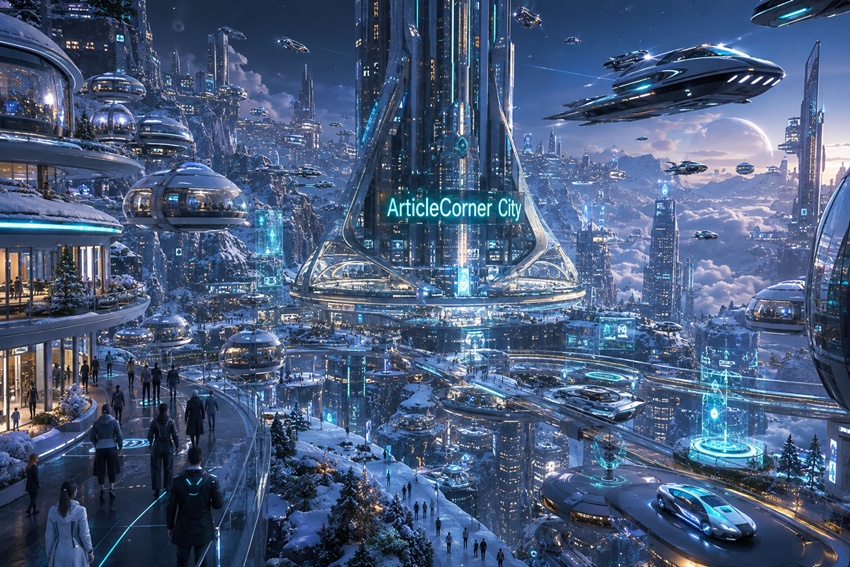
ArticleCorner City
The Future: When Technology Becomes Everyday Life
Imagine waking up one morning in the future. You open your eyes and look through the window. Outside, a quiet winter city stretches across the landscape, its futuristic buildings glowing softly beneath a blanket of fresh snow. Snow-covered gardens, frozen waterways and distant white mountains surround a city that feels peaceful, green and incredibly advanced.
There are no traffic jams filling the streets, no endless noise from engines and perhaps not even the familiar feeling that you need to hurry somewhere. Intelligent systems have already organized much of the world around you before you even leave your bed.
Transportation, energy, communication, education and many other parts of daily life work almost silently in the background. It sounds like science fiction today, but when we imagine continued human curiosity and technological development, it becomes an interesting question rather than an impossible dream.
When we think about the the future, our minds naturally go to spectacular things. We imagine enormous cities reaching toward the sky, autonomous vehicles moving through carefully designed transportation networks, robots working beside humans and spacecraft traveling between Earth, the Moon and Mars.
We imagine artificial intelligence becoming so deeply integrated into society that people may no longer think of it as a separate technology. It may simply become part of everyday life, just as electricity and the internet became ordinary parts of our world.
Perhaps the most fascinating change will be the city itself. A future city may no longer be a collection of roads, concrete buildings and crowded neighborhoods. It could become a living system in which buildings, transportation, energy production and nature work together. Tall buildings may contain forests, gardens, homes, schools and workplaces.
Solar energy could be collected from enormous structures above the city. Autonomous transportation could move people without the noise and congestion we know today. The city might understand how it is being used and continuously adjust itself according to the needs of its people.
And perhaps we will not even notice most of this technology. That may be the greatest sign of technological progress. Today we notice our phones, computers and machines because we actively use them. In the future, technology may become almost invisible.
Your home may no longer simply adjust the temperature or turn the lights on for you. It may continuously adapt to your physical state, mood, routines and surroundings, quietly shaping the environment around you without needing to be asked. Your transportation system may anticipate where you need to be and coordinate your journey before you even think about leaving.
Your doctor may detect subtle changes in your body long before they become noticeable symptoms, while your educational system may understand how your mind works and create a learning experience that evolves with you.
Artificial intelligence could become one of the most important companions of civilization. Instead of simply answering questions, AI may help scientists understand complex problems, assist doctors, manage cities, protect ecosystems and coordinate enormous energy systems.
It may help humanity make decisions by examining information on a scale no individual human could ever process. But there will still be an important question. If machines become extremely intelligent, what role will remain uniquely human?
Maybe the answer will not be intelligence. Humans may continue to be valuable because of imagination, emotion, curiosity, compassion and the ability to give meaning to experiences. A machine may calculate the most efficient route between two places, but a human being can decide why the journey matters.
A machine may analyze thousands of paintings, but a person can stand in front of one painting and suddenly remember someone they loved. Technology can process information, but meaning is something much more mysterious.
Robots may also become an ordinary part of life. We can imagine robots helping elderly people, assisting scientists, working in dangerous environments, building structures, exploring the oceans and operating in space. Some may look human, while others may be designed purely for function.
They may not be strange visitors from another world. They may simply be tools and companions that future generations grow up with, just as today's children grow up with computers.
The world of work could change dramatically as well. Many repetitive and dangerous jobs may eventually be performed by machines. This could create an opportunity that humanity has dreamed about for centuries. People might have more time for education, creativity, family, art, science and exploration.
But technology alone cannot guarantee a better life. The real question will be how society chooses to use the time and wealth created by automation. A future with advanced machines could become either a more human world or a more disconnected one. Technology will not make that decision for us.
Health and medicine could be another extraordinary part of life in the future. Imagine hospitals where artificial intelligence works together with doctors, where advanced biological technologies repair damaged organs and where diseases can be detected long before symptoms appear. Human life could become significantly longer and healthier.
Perhaps some conditions that are difficult to treat today will be remembered as historical problems. Yet even if medicine gives us more years, another question remains. What will we do with those extra years?
Perhaps one of the most beautiful possibilities is that technological progress could allow nature to return. Humanity has spent centuries transforming forests, rivers and coastlines to build civilization. In the future, advanced technology could help reverse some of that damage. Cities could contain enormous green areas. Oceans could be protected by intelligent monitoring systems. Endangered species could be given carefully managed habitats.
Agriculture could become more efficient while using less land and water. The future may not necessarily mean a world covered by machines. It could mean a world where machines finally help us protect what we almost lost.
We may even begin to live beneath the ocean. The deep sea remains one of the least explored environments on Earth. In the future, underwater research centers and carefully designed habitats could allow people to spend long periods beneath the surface.
Transparent structures could provide extraordinary views of marine life while advanced robots explore areas too dangerous for humans. The ocean could become not only a place we visit, but another environment in which humanity conducts research and perhaps eventually lives.
Then there is the Moon. If civilization continues to develop for another thousand years, permanent settlements beyond Earth may no longer sound extraordinary. The Moon could become a place for research, industry and scientific exploration.
People could wake up and see Earth hanging in the sky, a beautiful blue world far away. For someone born there, however, the Moon might simply be home.
Mars could be even more remarkable. Today we speak about Mars as a distant destination. A person in the future might speak about it in the same way we talk about another country. There could be scientific communities, greenhouses, laboratories and protected settlements beneath the red sky. Life on Mars would still be difficult, but generations of technological development could make it possible.
The first people to live there permanently would change the meaning of what it means to be human. For the first time, our species might have homes on more than one planet.
Space itself could become part of everyday civilization. Enormous orbital stations might contain laboratories, gardens, schools and residential areas. Spacecraft could travel regularly between Earth, the Moon and Mars.
Perhaps people would look up at the night sky and see transportation routes instead of only stars. What seems extraordinary to us today could become ordinary infrastructure for future generations.
Yet there is something that may not change at all. Imagine a child in the future looking at Earth from a space station. Around that child are technologies we cannot even imagine today. Artificial intelligence is everywhere. Robots work alongside humans. Cities stretch across enormous distances.
Space travel is routine. And yet that child may still look at Earth with the same feeling that a child today experiences when looking at the stars.
That is why the most interesting question about the future is not how many robots we will have or how advanced our spacecraft will become. The deeper question is whether we will still recognize ourselves.
Will people still fall in love? Will parents still worry about their children? Will friends still laugh together? Will someone still listen to music alone at night and remember a moment from childhood? Will people still search for meaning when they have everything technology can provide?
Perhaps the future will teach us something unexpected. Technology may change almost everything around us without changing the things that matter most inside us. We may live in cities that would look impossible to us today, travel between planets and communicate with machines more intelligent than any individual human.
But we may still need friendship, love, hope, belonging and a reason to wake up in the morning.
Maybe that is what the the future should really make us think about. The future is not simply a collection of machines waiting for us somewhere ahead in time. The future is the result of the choices we make today.
Every technology begins with an idea. Every city begins with a decision. Every civilization begins with a vision of what life could become.
So when we imagine Earth in the future, perhaps we should not only ask what technology will look like. We should ask what kind of people we want to become. If we can build intelligent machines, can we also build a wiser society?
If we can reach Mars, can we learn to take better care of Earth? If we can extend human life, can we learn to make that life more meaningful?
The future may be an enormous distance from the world we know today. The world of the future may be completely different from anything we can imagine today. Some of our predictions will certainly be wrong. Some technologies we consider impossible may become ordinary, while technologies we expect may never arrive.
But one thing is almost certain. Human curiosity will continue to ask what comes next.
And perhaps somewhere in that distant future, a person will look back at our time and wonder what we were thinking when we first imagined their world. They may smile at our primitive machines, our early artificial intelligence and our limited understanding of space.
But perhaps they will also recognize something familiar in us. The same curiosity. The same hope. The same desire to understand the universe and our place within it.
Because the future may change the world around us completely. But perhaps the most beautiful part of being human is that, even after a thousand years, we will still look toward the unknown and quietly ask the same question: What comes next?
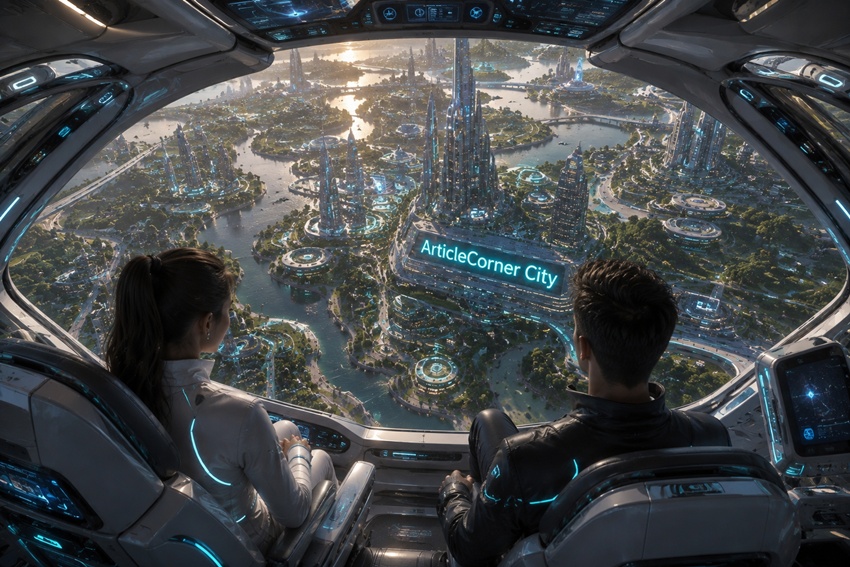
ArticleCorner
The future is not only about how advanced technology becomes. It is about what humanity chooses to do with it.
Writer: articlecorner.com