ArticleCorner Science:
How Does a Hot Air Balloon Fly?
Have you ever watched a hot air balloon slowly rise into the sky and wondered how something so large can float while carrying several people?
There is no engine pushing it upward, no wings creating lift, and no propeller turning in the air. Instead, a hot air balloon flies because of a simple but powerful idea from physics: **hot air is less dense than cooler air**. Once we understand what happens inside the balloon, its flight becomes much easier to understand.
A hot air balloon has three main parts: the large fabric balloon at the top, the burner underneath it, and the basket where the passengers and pilot sit. The burner is extremely important because it heats the air inside the balloon. The air does not need to be replaced with a lighter gas such as helium. The balloon simply uses ordinary air and changes its temperature.
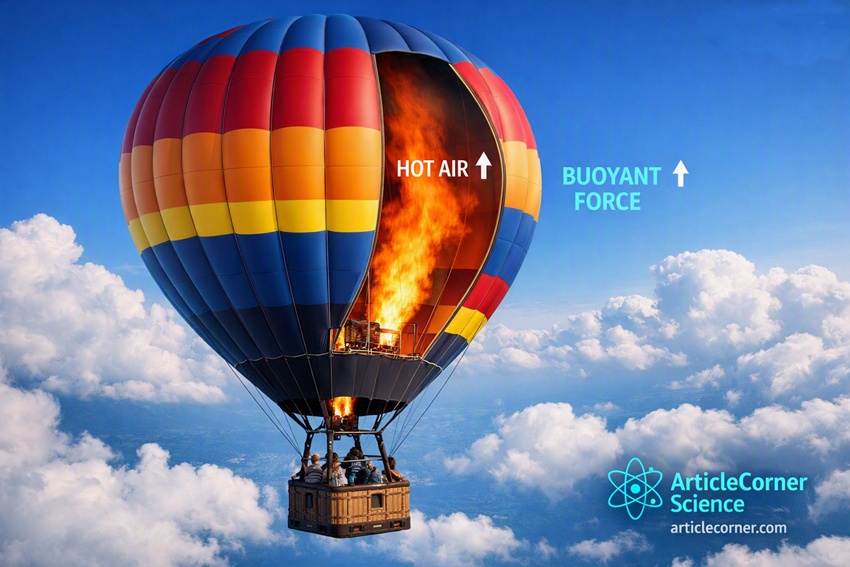
When the burner is turned on, flames heat the air inside the balloon. As air gets hotter, its molecules move faster and spread farther apart. The same amount of air therefore occupies more space and becomes less dense. In simple terms, a given volume of hot air weighs less than the same volume of cooler air outside the balloon. This difference in density is what makes the balloon capable of rising.
Now imagine the balloon sitting on the ground. It is surrounded by a huge amount of cooler, denser air. The balloon pushes some of this outside air out of the way. According to the principle of buoyancy, the surrounding air produces an upward force on the balloon. If this upward force becomes greater than the combined weight of the balloon, basket, passengers, burner and everything else being carried, the balloon begins to rise.
This is why the burner does not actually “push” the balloon into the sky. Its job is to heat the air inside the balloon. The heated air becomes less dense, and the surrounding atmosphere provides the upward buoyant force. The balloon rises because the total system becomes lighter than the volume of outside air it displaces.
The pilot controls the balloon mainly by controlling its temperature. If the pilot wants to climb, the burner is used to heat the air inside the balloon. As the temperature rises, the air becomes less dense and the buoyant force becomes greater compared with the weight of the balloon. The balloon then begins to rise. When the pilot wants to stop climbing, the burner can be used less frequently, allowing the air inside the balloon to cool gradually.
To descend, the pilot can allow the air inside the balloon to cool or can open a special vent at the top of the balloon. The vent allows some of the hot air to escape, reducing the amount of lift. As the buoyant force becomes smaller than the weight of the balloon, the balloon begins to descend. The pilot carefully controls this process rather than simply turning an engine on or off.
There is also an interesting piece of chemistry behind the burner. Hot air balloons commonly use propane as their fuel. When propane burns, it reacts with oxygen in the surrounding air and releases chemical energy as heat. The combustion produces mainly carbon dioxide and water vapor while releasing the heat needed to warm the air inside the balloon. So the process begins with a chemical reaction but ends with a physical effect: the air becomes hotter, its density decreases, and the balloon gains enough buoyancy to rise.
The balloon does not normally steer like an airplane. It moves mostly with the wind, which means the pilot cannot simply point the balloon toward any direction at will. However, winds can move in different directions at different altitudes. By climbing or descending, an experienced pilot can sometimes find a layer of air moving in a more useful direction. The pilot controls the balloon's vertical movement, while the atmosphere largely determines its horizontal movement.
So, when you see a hot air balloon floating peacefully above the landscape, there is a fascinating combination of science happening inside it. A burner converts the chemical energy of propane into heat. The heat warms the air inside the balloon. The warmer air becomes less dense than the cooler air outside. The surrounding atmosphere then provides buoyant force, and when that force is greater than the balloon's weight, the entire balloon rises.
A hot air balloon may look simple, but it is actually a beautiful demonstration of **chemistry, thermodynamics, air density, gravity and buoyancy working together**. The next time you see one floating across the sky, you can look at it differently.
It is not simply a giant balloon drifting in the air. It is a carefully balanced flying machine that uses nothing more complicated than **heat, air and the laws of physics**.
ArticleCorner Science:
Flying Balloon: Where Chemistry Meets Physics in the Sky.
Writer: articlecorner.com