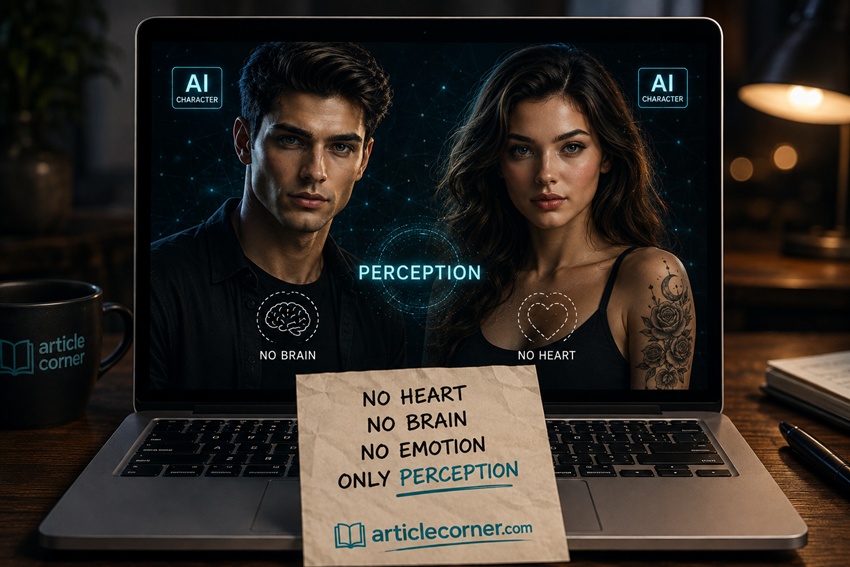
The Beauty We See in AI Videos
Have you noticed something about people in AI generated videos?
They often look beautiful.
Not just beautiful in the ordinary sense. Their skin is almost impossibly smooth. Their eyes seem perfectly placed. Their smiles appear natural but strangely perfect. Their hair always seems to fall into place. Their faces rarely show the small imperfections we see in real life.
And somehow, we accept it.
We watch these videos for a few seconds and think, “What a beautiful person.”
But then a strange question appears.
Beautiful compared to what?
For thousands of years, human beings have looked at other human beings when thinking about beauty. We compared faces, bodies, voices, expressions and movements with the people around us.
Now something has changed.
We are beginning to compare real people with people who never existed.
That may be one of the most interesting things artificial intelligence is quietly doing to us.
The Perfect Face
Look closely at many AI generated characters.
There is usually nothing obviously wrong with them. In fact, that is exactly the point.
The face is familiar enough to feel human, but polished enough to feel extraordinary.
There are fewer imperfections.
The skin is clearer.
The eyes are brighter.
The proportions are carefully balanced.
The smile is perfectly timed.
Even the lighting seems to know exactly where to fall.
At first, this is simply pleasant to watch.
But our brains are very good at learning patterns.
If we repeatedly see the same kind of beauty, something interesting can happen.
Our definition of normal may begin to move.
The face that once looked beautiful may eventually look ordinary.
The ordinary face may begin to look imperfect.
And the imperfect face is usually the face of a real person.
Real People Have Imperfections
Think about the people you know.
Someone has a small scar.
Someone has uneven eyebrows.
Someone laughs and their eyes almost disappear.
Someone has wrinkles around their mouth.
Someone speaks too quickly when excited.
Someone smiles differently on one side of their face.
These things are not mistakes.
They are part of identity.
We recognize people because of these little details.
In real life, beauty has never required perfection.
Sometimes a face becomes beautiful because of the very thing that makes it different.
But AI has a natural tendency to smooth things out.
It can create a version of a person without the tired eyes, the awkward smile, the imperfect skin or the nervous expression.
The result can be visually attractive.
But it can also create a strange problem.
If we keep looking at perfect artificial people, will real people eventually start to look imperfect?
Then There Is the Voice
The same thing is happening with voices.
AI voices can sound incredibly clear.
They speak smoothly.
They rarely stumble.
They can sound warm, confident and calm.
There is no nervous breath before a difficult sentence.
No unexpected laugh.
No moment when someone forgets a word.
No little crack in the voice caused by emotion.
Everything flows.
And again, it sounds wonderful.
But humans do not normally speak like that.
We pause.
We breathe.
We change our tone.
We sometimes say the wrong word.
We laugh at the wrong moment.
Our voices become higher when we are excited and quieter when something hurts.
Those imperfections carry information.
They tell us that there is a person behind the voice.
An AI voice can reproduce emotion beautifully.
But knowing that emotion and feeling that emotion are not necessarily the same thing.
Beauty Can Become a Standard
This is where the subject becomes much more interesting.
AI generated beauty is not necessarily dangerous.
Beautiful images are not dangerous.
Beautiful voices are not dangerous.
The question is what happens when artificial perfection becomes a standard.
Imagine watching thousands of videos featuring beautiful faces with perfect skin, perfect lighting, perfect bodies and perfect voices.
Then you look at yourself in the mirror.
Suddenly your normal face may seem less impressive.
Not because your face changed.
The standard changed.
And this is something we have already experienced with edited photographs.
AI simply takes it much further.
A photograph can be edited.
An AI person can be created from nothing.
There may be no real person behind the face at all.
Yet our brain still reacts to that face.
We can admire it.
Trust it.
Feel attracted to it.
Listen to it.
Sometimes we may even feel emotionally connected to it.
That is remarkable.
And perhaps a little unsettling.
The Beautiful Person Who Never Existed
Imagine meeting someone in an AI video.
She looks friendly.
She smiles naturally.
Her voice is warm.
She speaks intelligently.
You immediately feel comfortable listening to her.
But there is one small detail.
She does not exist.
There was no childhood behind that face.
No difficult morning.
No family photograph.
No scar from falling off a bicycle.
No embarrassing school memory.
No birthday cake.
No old friend who remembers what she was like at ten years old.
The face exists.
The voice exists.
The video exists.
But the life does not.
And yet our emotions may still respond as if there were a real person standing in front of us.
That tells us something fascinating about ourselves.
Perhaps human beings do not need a real person to create a human feeling.
Sometimes a convincing image is enough.
What Happens to Ordinary Beauty?
Maybe this is the question we should be asking.
What happens to ordinary beauty when extraordinary artificial beauty becomes everywhere?
The beauty of someone laughing without caring how they look.
The beauty of an old couple walking slowly together.
The beauty of a tired face after a long day.
The beauty of grey hair.
The beauty of a voice that shakes because someone is nervous.
The beauty of a person who does not know where to put their hands when they are being photographed.
These things may never become viral AI content.
They are too ordinary.
And that is exactly why they matter.
Real life is full of things that an algorithm might consider imperfections.
But those imperfections are often where personality lives.
Perhaps We Need to Remember the Difference
AI can create beautiful people.
It can create beautiful voices.
It can create beautiful worlds.
And there is nothing wrong with enjoying them.
The problem begins when we forget that they are creations.
A machine can create the appearance of perfection in seconds.
A human being takes years to become who they are.
That difference matters.
The next time you watch an AI generated video and think, “That person is beautiful,” perhaps pause for a moment.
Ask yourself what you are actually responding to.
The face?
The lighting?
The voice?
The expression?
Or the idea of a human being that artificial intelligence has learned how to construct?
Maybe the future of beauty will not be about becoming more perfect.
Maybe it will be about learning to appreciate what perfection cannot reproduce.
A wrinkle.
A strange smile.
A trembling voice.
A tired face.
A laugh that arrives at the wrong moment.
A person who looks nothing like an AI character and everything like themselves.
Because perhaps the most beautiful thing about being human is that we were never designed to look perfect.
We were designed to be real.
The ArticleCorner Perspective:
If we connect beauty only to appearance, we may forget the beauty within.
A beautiful face can attract us, but kindness, love, compassion and character are what make a person truly beautiful.
AI can create perfect faces and beautiful voices. But it cannot create the life, memories, kindness and love that make a human being unique.
Perhaps beauty was never meant to be perfect.
Beauty begins where perfection ends.
Constant exposure to AI perfected images triggers upward social comparison, causing people to compare themselves with unrealistic standards of beauty. This increases appearance anxiety and the risk of body dysmorphic disorder.
AI Characters Gain Followers Through Perception, Not Reality.
Writer: articlecorner.com