What We Learned From Ants and Bees
The ArticleCorner Animals Team Observed, and Now We Are Sharing What We Saw:
Sometimes, we do not need books, long speeches, or complicated ideas to learn something about life.
Sometimes, all we need to do is stop for a moment and look at an ant colony.
Or stand quietly near a beehive and watch hundreds of bees going about their daily lives.
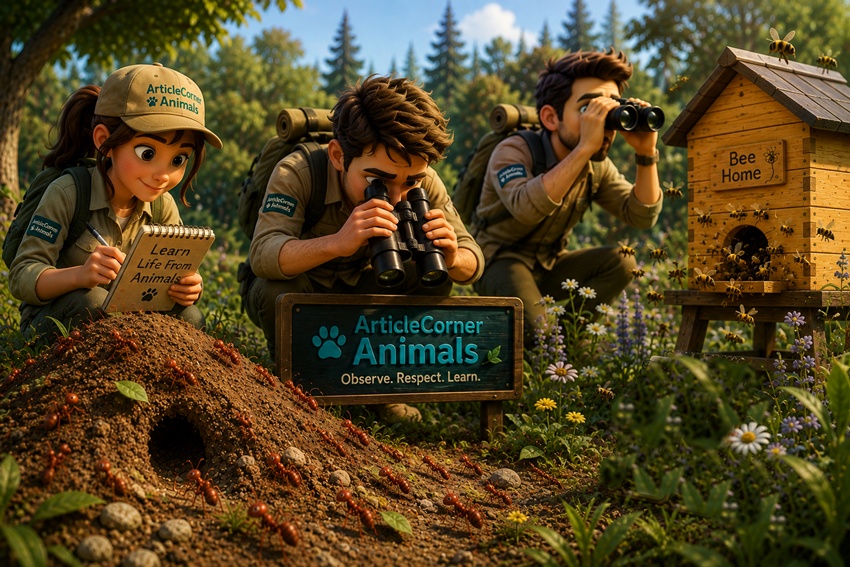
The ArticleCorner Animals team recently made this kind of observation. We watched ants around their colony and bees around their hive.
We did not interfere.
We did not disturb the colony, move stones, destroy the nest, or approach the hive in a way that might disturb the bees.
We simply watched.
And what we saw made us think not only about animals, but also about our own lives.
A Quiet Order Inside an Ant Colony:
At first, an ant colony may look like a place of endless confusion.
One ant is carrying food.
Another is moving in a different direction.
Some are entering the nest while others are coming out.
To us, it may look chaotic. But within this activity is an impressive sense of organization.
Ants communicate with one another. When they find food, they can leave signals that help other ants locate it. When danger appears, they respond. Different ants contribute to the needs of the colony.
A single ant is very small.
But when thousands work together, something much larger emerges.
A living system.
Life Lesson One: Small Things Can Still Matter:
Sometimes people look at their own lives and wonder whether what they do is important.
"Does what I do really make a difference?"
Ants give us an interesting reason to think about that question.
The small piece of food carried by one ant may look insignificant.
But for the colony, it matters.
Perhaps many important things in human life work the same way.
Big results are often built from small actions repeated over time.
Being small does not mean being unimportant.
Ants Show Us the Power of Working Together:
Another thing caught our attention during the observation.
The ants were constantly moving, but their movement did not appear to be only about individual effort.
What one ant found could benefit others.
What one ant carried could contribute to the colony.
This gives us another simple life lesson:
We do not always have to do everything alone.
In human life, our greatest strength does not necessarily come from everyone doing the same thing.
Sometimes it comes from different people doing different things while contributing to the same purpose.
Then We Watched the Bees:
After observing the ants, we turned our attention to the bees.
There was almost constant movement around the hive.
One bee arrived while another left.
Some were collecting food.
Others were involved in different tasks necessary for the colony.
Behind the entrance of the hive, we know that an even larger world exists.
From the outside, we may simply see a buzzing crowd.
But inside is a complex living community.
What Bees, Teach Us About Creating Together:
Bees remind us of something important.
Creating is not always about creating something only for ourselves.
The work of one bee contributes to the life of the colony.
Honey is not the achievement of a single bee.
It is the result of many contributions.
Human life can be similar.
A family, a team, or a community does not grow because of one person's effort alone.
One person's idea, another person's work, someone else's patience, and another person's help can eventually become something much greater.
Bees Also Remind Us Why Communication Matters:
Communication is essential to the life of a bee colony.
Bees have remarkable ways of communicating information, including information about food sources.
And this gives us another reason to think about our own lives.
It is difficult to move forward together if we do not listen to one another.
Humans talk constantly, but talking does not always mean listening.
Bees remind us that communication is not simply about sending information.
It is also about responding to the needs of the community.
Perhaps this is something we sometimes need to remember:
Listening can be just as important as speaking.
A Hive Makes Us Question Selfishness:
Watching bees also makes us think about ourselves.
People often ask:
"What will I gain?"
But the life of a bee colony is centered on the survival and functioning of the colony as a whole.
Of course, we should not simply copy animal behavior and apply it directly to human society.
Animals live according to their own biology, instincts, and social systems.
But nature can give us something valuable:
A reason to think.
A community becomes stronger when its members can see beyond themselves.
Living together sometimes means recognizing that our actions affect others.
Ants and Bees Are Not the Same:
There is an important point here.
Ants and bees are not the same animals.
Their biology, behavior, communication, and social structures are different.
So instead of saying, "Animals teach us exactly how humans should live," perhaps it is better to say that their behavior gives us something to reflect on.
Nature does not give us orders.
It shows us.
And we watch.
Then we think.
What Did the ArticleCorner Animals Team Learn?
We stood near the ant colony.
We watched the bees coming and going from the hive.
Then we asked ourselves a simple question:
"Why can such small creatures make us think about such big things?"
Perhaps the answer is simple.
Because life in nature is much larger than we often realize.
A small piece of food carried by an ant...
A small amount of food carried back to the hive by a bee...
Individually, these things may seem small.
But within the larger story of life, they have meaning.
And perhaps human life is not so different.
The Life Lesson:
From ants, we can think about the value of small steps.
From bees, we can think about the strength of cooperation.
From ants, we can remember patience and persistence.
From bees, we can remember the importance of communication.
But perhaps the greatest lesson is somewhere else.
When we observe nature, we stop placing ourselves at the center of everything.
We begin to look at the lives of other creatures.
And then we realize something:
We are not alone.
Millions of other living beings are building homes, communicating, finding food, protecting their communities, raising their young, and simply trying to survive.
When we begin to understand them, perhaps we also begin to understand ourselves a little better.
The ArticleCorner Animals team observed.
The ants continued living in their world.
The bees continued coming and going from their hive.
And we left with one simple thought:
Sometimes the greatest lessons about life are hidden in the world of the smallest creatures.
ArticleCorner Animals: Learn How to Live Your Life From Animals.
Writer: articlecorner.com