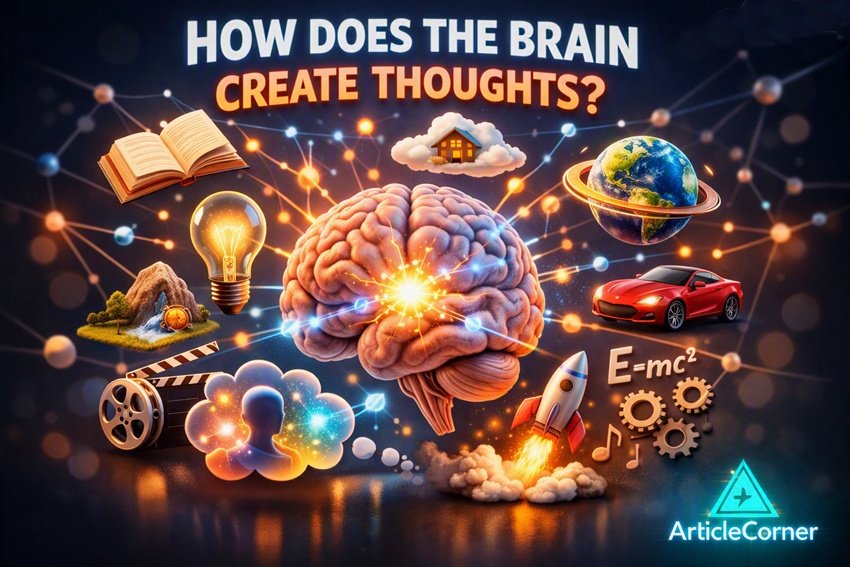
How Does the Brain Create Thoughts?
Dr. Mind Explains:
We have already met the brain, and then we took a closer look at neurons. We saw how these remarkable cells communicate through electrical and chemical signals, forming networks that are constantly changing and adapting. But now we are approaching a much more difficult question.
**How does all of this activity become a thought?**
Think about what happens when you wake up in the morning. Before you have even left your bed, thoughts may already be appearing in your mind. You may remember something you need to do. You may wonder what the weather is like. You may think about a person you spoke to yesterday. You may suddenly remember a dream.
None of these thoughts seem particularly unusual to you because thinking is something your brain does so naturally that you rarely notice the process itself.
But stop for a moment and consider how extraordinary that is.
A thought is not something you can hold in your hand. You cannot point to it in the physical world. You can measure electrical and chemical activity in the brain, but the thought itself is something you experience from the inside.
When you think about your childhood home, for example, you may experience an image, a feeling, a sound, or a collection of memories.
Your brain is active during this experience, but the activity is not simply a picture of the thought. It is part of the biological process through which the thought occurs.
So, where does a thought begin?
The honest answer is that we do not know exactly.
What neuroscience has shown us is that thinking involves the coordinated activity of many brain regions and networks rather than a single location where thoughts are produced. Different kinds of thinking can involve different networks.
Attention, memory, language, emotion, decision-making, perception, and planning all interact with one another.
A thought can therefore be better understood as a **dynamic pattern of brain activity** than as something produced by one particular point in the brain.
Let's make this more concrete.
Imagine that I ask you a simple question: **What did you have for breakfast this morning?**
Almost immediately, your brain begins searching through recent information. Your memory systems become involved. You may visualize a plate or a kitchen. You may hear your own inner voice saying the name of a food.
You may experience a feeling associated with the morning. You may even realize that you cannot remember what you ate.
Notice what just happened.
The question entered through your senses as language. Your brain interpreted the meaning of those words. It activated information related to memory.
Other neural systems helped you organize the answer. And eventually, you may have produced a spoken response.
There was no tiny voice inside your head looking through a filing cabinet labeled “breakfast.”
Instead, different neural processes interacted to produce a meaningful experience and response.
This is one of the central ideas in understanding the brain: **thoughts emerge from interactions between networks.**
The brain is constantly receiving information from the outside world and from the body itself. At the same time, it is drawing on memories, expectations, learned patterns, emotions, and previous experiences.
These streams of information interact continuously. The result is not simply a reaction to what is happening right now.
Your brain is also using what it already knows to interpret what is happening.
This means that two people can experience the same event and think about it very differently.
Imagine two people watching the same storm through a window. One person may think, “This is beautiful.” Another may think, “I hope the roads are safe.” A third may remember a frightening storm from childhood. The physical event is the same, but the mental experience is different because each brain brings its own history to the situation.
Your brain does not approach every moment as a blank page.
It arrives carrying your memories.
And those memories influence what you notice, what you expect, and how you interpret new information.
This is also why attention matters so much.
At any given moment, your senses are receiving an enormous amount of information. You cannot consciously process all of it equally. Your brain has to select what deserves greater attention. If you are sitting in a crowded café talking to a friend, there may be dozens of conversations happening around you.
Yet you can focus on the voice of the person sitting across from you. If someone suddenly says your name from another table, however, your attention may shift immediately.
Your brain is constantly deciding, in effect, **“What matters right now?”**
Much of this happens without conscious effort.
And this brings us to an important distinction: not everything the brain processes becomes a conscious thought.
Your brain performs an enormous amount of work outside your conscious awareness. It regulates many bodily functions, processes sensory information, detects patterns, evaluates signals, and influences behavior without requiring you to consciously direct every step. Conscious thought is therefore only one part of the brain's activity.
This may sound strange at first.
You are used to thinking of yourself as the person who thinks.
But much of what your brain does happens before you become aware of it.
Consider seeing a familiar face. You may recognize the person almost instantly, long before you consciously explain how you recognized them. Your brain has processed visual information, compared patterns with stored knowledge, and reached a result incredibly quickly.
You simply experience the result:
“I know that face.”
The complicated processing that made that recognition possible remains largely outside your awareness.
The same principle can be seen in language. When you read this sentence, you are not consciously calculating the meaning of every individual letter. Your brain has learned patterns that allow you to recognize words, interpret grammar, connect ideas, and build meaning rapidly.
Years of learning have changed your neural networks so that something that once required effort can eventually become almost effortless.
This is one reason experience matters so much.
Your brain is continuously learning from the world around you. Repeated experiences can strengthen particular neural pathways. New information can be connected with older knowledge. Skills can become more efficient with practice. Expectations can become deeply established.
In this sense, your thoughts are influenced not only by what is happening now but also by **what has happened to you before**.
Your brain carries a history.
That history becomes part of the way you think.
But there is another fascinating element: imagination.
When you imagine something that is not currently happening, your brain can activate some of the same systems involved in perception and memory. You can close your eyes and imagine the face of someone you love. You can picture a place you have never visited. You can imagine what your home might look like after a renovation.
Nothing is physically happening in front of you.
And yet your brain can construct an experience from internally generated information.
This ability is extraordinarily useful. It allows humans to plan, create, predict, invent, and consider possibilities before acting. A scientist can imagine an experiment. An architect can imagine a building before it exists. A writer can imagine an entire world and describe it to someone else.
Thought, therefore, is not limited to responding to reality.
It can also create possibilities.
And sometimes those possibilities become reality.
Now we should talk about language.
Language gives the human brain a powerful way to organize and communicate complex ideas. When you think in words, language can help structure your thoughts, label experiences, compare concepts, and communicate what is happening inside your mind.
But not every thought is made of words.
You can recognize a familiar melody without describing it verbally. You can feel that something is wrong without immediately knowing how to explain it. You can visualize a route through a familiar place without narrating every turn in your head.
Thought can involve language, images, memories, emotions, sensations, expectations, and abstract relationships.
It is not one single thing.
This is why defining a “thought” scientifically is more difficult than it first appears.
A thought can be a deliberate decision. It can be a fleeting idea. It can be a memory. It can be an expectation. It can be an image in the mind. It can be a question that suddenly appears without warning.
And sometimes, a thought seems to arrive before you know where it came from.
Have you ever suddenly remembered someone you had not thought about for years?
Or had an idea while taking a shower?
Or found the answer to a problem after you stopped actively trying to solve it?
These experiences remind us that conscious thinking is not always a simple, step-by-step process. The brain continues processing information even when you are not deliberately focusing on a problem. Associations can form between memories and ideas, and information that was previously outside your attention can later become part of conscious thought.
This does not mean that thoughts appear from nowhere.
There is usually a biological history behind them, even when that history is hidden from conscious awareness.
And now we arrive at one of the most interesting questions.
If thoughts depend on brain activity, does that mean that **you are simply the activity of your brain?**
Science can show us increasingly detailed relationships between brain activity and mental experiences. We can observe what happens when particular brain systems are damaged. We can study changes in activity during perception, memory, attention, and decision-making. We can even predict certain aspects of what a person is experiencing from patterns of brain activity.
But prediction is not the same thing as complete explanation.
We still do not fully understand how physical processes in the brain give rise to the subjective experience of having a thought.
We know a great deal about the machinery.
We are still trying to understand the experience.
Perhaps that is why the study of the mind remains such a fascinating meeting point between neuroscience, psychology, philosophy, and many other fields.
The brain gives us the biological foundation.
Psychology helps us understand behavior and mental processes.
Philosophy asks questions about meaning, consciousness, identity, and experience.
Each perspective reveals something important, but none has given us the final answer.
So, the next time a thought suddenly appears in your mind, take a moment to notice it.
You do not have to judge it.
Just observe.
A memory appears.
An image forms.
A question emerges.
A sentence begins inside your head.
And behind that seemingly simple experience is an enormous biological network communicating, adapting, remembering, predicting, and responding.
You are thinking.
But perhaps the deeper question is not simply **how the brain creates thoughts**.
It is this:
**How does the brain create the experience of knowing that you are thinking?**
That question takes us somewhere even deeper.
And that is where we are going next.
**Next time, let's explore memory — how the brain stores our past, and why some experiences stay with us while others disappear.**
— **Dr. Mind**
Writer: articlecorner.com - ArticleCorner