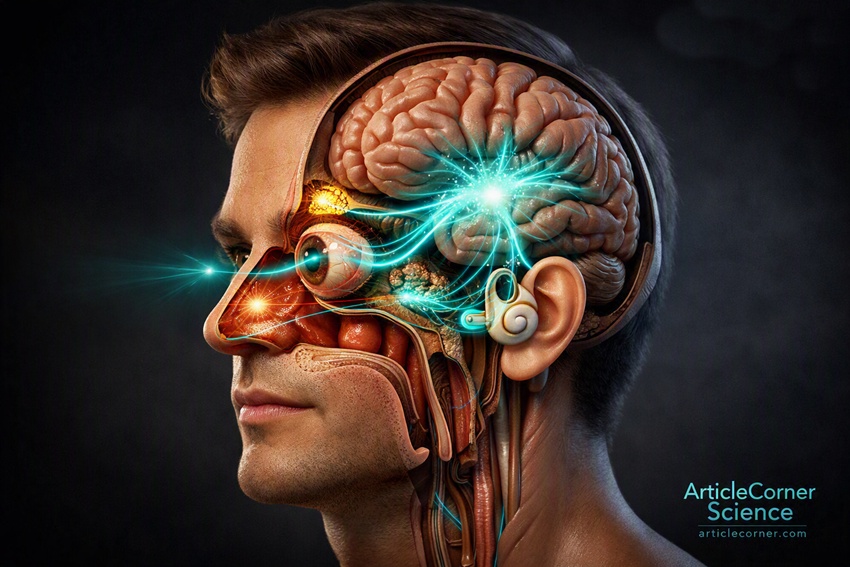
ArticleCorner Science:
How Do the Eyes, Ears, Nose and Brain Work Together?
We usually think of our eyes, ears and nose as separate senses. We see with our eyes, hear with our ears, and smell with our nose. It feels so natural that we rarely stop to wonder what is actually happening behind the scenes.
But there is something much more interesting going on.
Your eyes do not really “understand” what they see. Your ears do not understand music or speech. Your nose does not know that the smell coming toward you is coffee, rain or smoke. These organs collect information. The real interpretation happens inside the brain.
And the fascinating part is that the brain does not simply process each sense separately. It constantly brings information from different senses together, compares it with memories, checks whether the information makes sense, and creates the experience we call reality.
So, let's take a closer look at this extraordinary system and follow the journey from the outside world to the brain.
Your Eyes Do Not Actually See:
Let's start with something that sounds strange.
Your eyes do not actually understand what you are looking at.
Light enters your eye through the cornea and passes through the pupil. The lens then focuses that light onto the retina, a thin layer of specialized cells at the back of the eye.
The retina contains photoreceptor cells called rods and cones. They respond to light and begin converting it into electrical signals.
This is where the first transformation takes place.
The outside world gives your eyes light. Your eyes transform that light into information that the nervous system can use.
That information travels through the optic nerve toward the brain.
And then something remarkable happens.
Your brain receives patterns of electrical activity and begins asking questions without you consciously realizing it.
What is this shape?
How far away is it?
Is it moving?
Is it familiar?
Is it important?
Is it something I should avoid?
The brain combines all of this information and produces the visual experience you recognize as seeing.
So when you look at a tree, you are not simply receiving an image like a camera recording a photograph. Your brain is actively constructing your perception of that tree from incoming information.
Your Ears Are Doing Much More Than Hearing:
Now imagine that someone calls your name.
You immediately turn toward them.
It feels effortless, but your ears have just performed a complicated sequence of events.
Sound begins as vibrations traveling through the air. Those vibrations enter the outer ear and travel through the ear canal until they reach the eardrum.
The eardrum vibrates.
Tiny bones in the middle ear transfer and amplify those vibrations toward the inner ear. There, inside a structure called the cochlea, specialized sensory cells respond to the movement and convert it into neural signals.
Those signals then travel toward the brain.
But again, the ear itself does not know that someone has said your name.
The brain does.
Your brain receives the pattern of signals and compares it with information stored from previous experiences. It recognizes the sound as speech, identifies the words, and determines that the sound is your name.
This is why hearing is not simply about detecting sound.
It is about interpreting sound.
Your Nose Sends Information Too:
Now let's bring the sense of smell into the picture.
Imagine walking into a kitchen where coffee has just been made.
Before you even see the coffee, you may know that it is there.
Molecules from the coffee travel through the air and enter your nose. Specialized receptors in the olfactory system detect these molecules and generate neural signals.
Those signals travel into the brain, where they are processed as smell.
But smell has a particularly interesting relationship with memory and emotion.
A certain perfume can suddenly remind you of someone you have not seen for twenty years.
The smell of bread may remind you of your childhood home.
The scent of rain may bring back a completely forgotten moment.
Why?
Because the brain does not store sensory information in complete isolation. Smell has strong connections with brain regions involved in memory and emotion.
That is why a smell can sometimes take you back to a moment faster than a photograph can.
But Here Is Where Things Get Really Interesting:
So far, we have looked at the eye, ear and nose separately.
But your brain does not experience the world that way.
It receives information from all of them at the same time.
Imagine sitting in a café.
You see a cup of coffee on the table.
You smell the coffee.
You hear the sound of the machine behind the counter.
You feel the warmth of the cup in your hand.
Your brain combines all of these signals.
You don't consciously think:
“I am now receiving visual information.”
“I am now receiving olfactory information.”
“I am now receiving auditory information.”
Instead, all of these signals become part of one experience.
Coffee.
This ability to combine information from different senses is called multisensory integration.
It is one of the reasons our perception of the world feels so seamless.
Your Brain Is Constantly Comparing Information:
There is another fascinating part of the process.
Your brain does not simply receive information and accept everything exactly as it arrives.
It constantly compares new information with what it already knows.
Suppose you see a person talking, but the room is noisy.
Your ears may struggle to distinguish the words.
Yet if you can clearly see the person's lips moving, your brain can use that visual information to help interpret the speech.
Your eyes have helped your ears.
This is why watching someone's face can make it easier to understand them in a noisy environment.
The senses are not working in separate departments.
They are communicating.
Why Does the World Sometimes Feel Wrong?
This cooperation between the senses also explains some strange experiences.
Imagine watching a movie where an actor's lips move slightly before the sound reaches your ears.
You immediately notice that something feels wrong.
You may not know exactly what is wrong, but your brain detects a mismatch.
The visual information says one thing.
The auditory information says another.
Your brain expects these signals to arrive in a particular relationship. When they do not match, the experience feels unnatural.
This is one reason synchronization is so important in cinema, virtual reality, video calls and many other technologies.
Our brains are remarkably sensitive to whether information from different senses agrees.
Your Inner Ear Also Helps You Stay Upright:
There is another part of the ear that deserves attention.
Your inner ear is not only responsible for hearing.
It also contains the vestibular system, which helps your brain understand movement and balance.
Inside the inner ear are tiny structures that detect changes in the movement and position of your head.
When you turn your head, accelerate, stop or tilt your body, these structures send information to your brain.
But the brain does not rely on the inner ear alone.
It also receives information from your eyes and from receptors in your muscles and joints.
Your brain combines all of these signals to determine where your body is and how it is moving.
That is why balance is really a team effort.
Your eyes tell the brain what the world appears to be doing.
Your inner ear tells it how your head is moving.
Your muscles and joints provide information about the position of your body.
The brain puts everything together.
What Happens When the Information Disagrees?
This is where things can get surprisingly interesting.
Imagine sitting inside a moving car while looking at your phone.
Your eyes are focused on a relatively stationary screen.
But your inner ear is detecting movement.
Your body is also experiencing acceleration and changes in position.
Your brain receives conflicting information.
For some people, this mismatch can contribute to motion sickness.
The same basic principle helps explain why some people feel uncomfortable in virtual reality.
Their eyes may tell the brain that they are moving through a virtual environment, while the inner ear tells the brain that the body is actually standing still.
Once again, the brain is trying to make sense of information coming from different sources.
The Brain Is Not Just Receiving Information:
Perhaps the biggest misunderstanding about our senses is that we imagine information traveling in only one direction.
Outside world → eyes, ears and nose → brain.
But the brain is doing much more than receiving signals.
It is constantly making predictions.
It uses previous experiences, memories and expectations to help interpret what the senses are telling it.
This is why the same sound can mean completely different things in different situations.
A sudden noise in your house at midnight may make you nervous.
The same noise during the day may mean nothing.
The sound did not necessarily change.
Your interpretation of it changed.
Your brain knows the context.
Your Brain Builds Your Experience of Reality:
Think about what happens when you smell smoke.
Your nose detects chemical information.
Your brain recognizes the smell.
Your eyes may search for visible smoke.
Your ears may listen for an alarm.
Your body may become more alert.
Your brain then combines all of this information and asks the most important question:
Is there danger?
This entire process can happen incredibly quickly.
You do not need to consciously organize every piece of information.
Your nervous system does it automatically.
That is one of the reasons the human brain is so extraordinary.
It takes enormous amounts of information from the environment and turns them into something useful: perception, understanding and action.
So, Who Is Really Seeing, Hearing and Smelling?
In a sense, the answer is not simply the eyes, ears or nose.
These organs are the beginning of the journey.
The eye detects light.
The ear detects sound and movement.
The nose detects chemical molecules.
But the brain takes those signals and turns them into an understandable experience.
And it does not do this alone.
It uses memory.
It uses attention.
It uses previous experience.
It uses information from other senses.
It even uses expectations about what is likely to happen next.
That means the world we experience is not simply a direct copy of the physical world around us.
It is the result of an extraordinary conversation between our senses and our brain.
One Human System, Not Five Separate Senses:
We often learn about sight, hearing, smell, taste and touch as five separate senses.
Biologically, however, they are deeply connected.
When you eat an orange, your eyes see its color and shape. Your nose detects its aroma. Your tongue detects chemicals associated with taste. Your fingers feel its texture. Your brain combines all of this information and produces one experience: an orange.
Take away one source of information, and the experience can change.
Close your eyes.
The orange suddenly feels different.
Hold your nose.
The flavor seems different.
Listen to music while eating.
Your perception can change again.
The brain is constantly bringing the pieces together.
And that may be the most fascinating part of all.
We do not experience the world through our senses separately. We experience it through the brain's ability to connect them.
The eyes collect light.
The ears collect sound.
The nose collects chemical information.
The body collects information about touch and movement.
And somewhere inside the brain, all these signals meet.
From billions of tiny electrical and chemical messages, the brain creates something that feels incredibly simple:
“This is what I am seeing. This is what I am hearing. This is what I am smelling. This is where I am. This is what is happening around me.”
What feels like ordinary perception is actually one of the most sophisticated systems nature has ever produced.
ArticleCorner Science:
Your Senses Collect. Your Brain Connects.
Writer: articlecorner.com