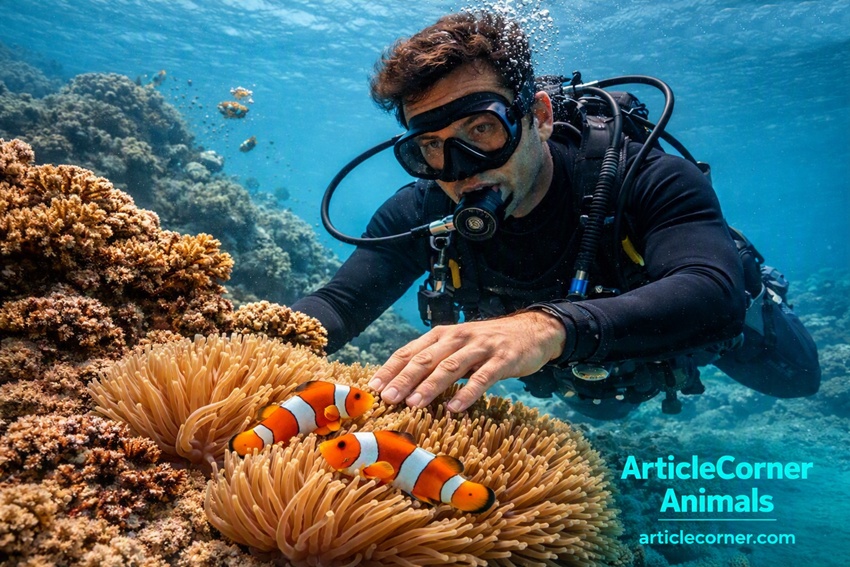
Clownfish and Their Life in Coral Reefs
I’m Murat, an ocean scientist who has spent many years observing life beneath the surface. Among all reef fish, clownfish have always caught my attention. Not simply because of their striking colors, but because their lives reveal something much deeper about the ocean: survival is often built on cooperation, trust, and relationships that are easy to overlook.
Clownfish live mainly in the warm, shallow waters of the Indian and Pacific Oceans. They are closely connected to coral reef ecosystems, but unlike many reef fish, they do not travel across large areas of the ocean.
A clownfish usually spends its life within a surprisingly small territory centered around a sea anemone. To the fish, this is far more than a hiding place. It is a home, a refuge, and the center of its social life. The anemone’s tentacles provide protection from predators, while the clownfish becomes part of the small community living around it.
Their social structure is equally fascinating. Clownfish live in small groups in which only one female and one breeding male reproduce. The largest fish is the female, followed by the breeding male, while the remaining individuals are smaller and do not reproduce.
If the female disappears, the social order can change. The breeding male can transform into a female, while the largest remaining non breeding fish takes his place. It is an extraordinary example of how an animal’s social environment can influence its biological life.
Reproduction is closely connected to the safety of the anemone. The female lays her eggs on a carefully selected surface near the anemone, and the male takes an active role in protecting them. He cleans the eggs, fans them with his fins to keep water moving across them, and guards them against danger until they hatch.
The relationship between clownfish and sea anemones is one of the most remarkable partnerships in the ocean. The clownfish receives protection by living among the anemone’s stinging tentacles, which discourage many predators. In return, the clownfish can defend the anemone from certain intruders, remove unwanted material, and contribute to water movement around its host.
This relationship is not simply a convenient arrangement. It is built through repeated interaction and familiarity. Young clownfish gradually become associated with their host anemone, creating a relationship that becomes central to their survival.
There is an important distinction to remember when we talk about coral reefs. Coral reefs are hard, complex structures created largely by colonies of tiny animals called corals. Sea anemones, although they belong to the same broad animal group as corals, are soft bodied and generally live as individual organisms. Clownfish are therefore not living inside coral itself when they shelter among an anemone’s tentacles.
From years of observing marine life, what strikes me most is how dependent this small world is on balance. A clownfish may appear to be just one colorful fish moving among the waves, but its survival can depend on the health of its anemone, its reef, its food sources, and the wider marine environment.
This is what makes the clownfish story important. It is not only the story of one beautiful fish. It is a story about connection. In nature, survival rarely happens in isolation. One species can depend on another, and the health of one small relationship can be connected to the health of an entire ecosystem.
As an ocean scientist, I believe our fascination with clownfish should lead us toward observation and protection rather than ownership. The ocean is their home. A glass aquarium can imitate some aspects of their environment, but it can never reproduce the complex web of relationships that exists on a living reef.
True appreciation of ocean life begins when we learn to admire animals where they belong, understand the relationships that keep them alive, and protect the natural world that gives those relationships a place to exist.
ArticleCorner Animals: Two Lives, One Reef, A Bond Built for Survival
Writer: articlecorner.com