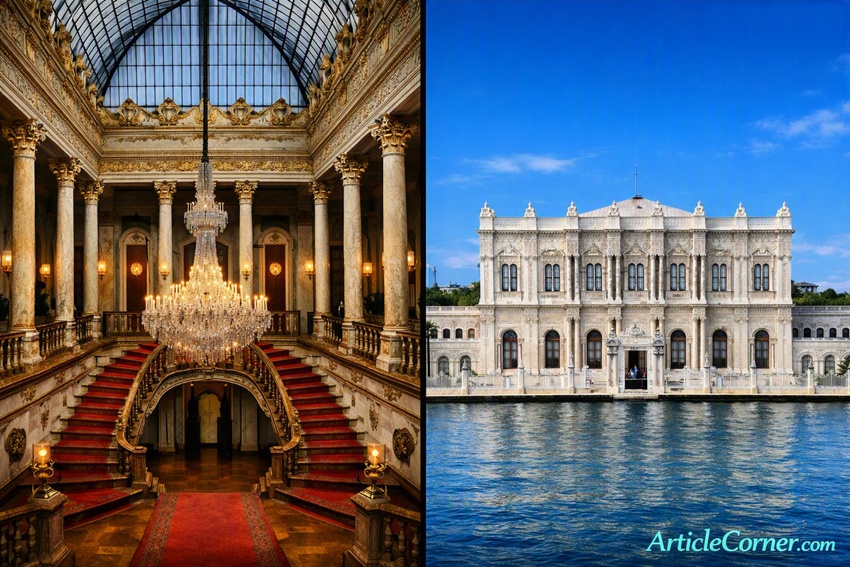
ArticleCorner Istanbul - Dolmabahçe Palace
Dolmabahçe Palace: A Palace by the Bosphorus
There are places in Istanbul where you do not simply visit a building. You step into a story.
Dolmabahçe Palace is one of those places.
As you walk along the Bosphorus and see the palace for the first time, it is almost impossible not to wonder about the people who once lived here.
Who looked through these windows?
Who walked through these halls?
Who stood here and thought about the future of an empire?
Dolmabahçe Palace is much more than a magnificent palace. It is a silent witness to the final years of the Ottoman Empire and to a period when the empire was trying to adapt to a rapidly changing world.
During the nineteenth century, the Ottoman court entered a new period. Compared with the traditional atmosphere of Topkapi Palace, Dolmabahçe reflected a stronger European influence.
Grand halls, enormous ceilings, crystal chandeliers, magnificent staircases and windows opening toward the Bosphorus created an atmosphere of extraordinary elegance.
Yet while walking through these rooms, you may find yourself thinking about something beyond the beauty.
Because palaces do not only tell stories of wealth and power.
Sometimes they tell the story of change.
Sometimes they tell the story of uncertainty.
And sometimes they silently carry the memory of an ending.
Dolmabahçe makes you feel this more deeply.
Sultans once lived here. Important decisions were discussed here. Foreign ambassadors were received here. The future of the empire was considered within these walls.
Perhaps someone once stood beside a window, looking at the Bosphorus and wondering what tomorrow would bring.
Then time moved forward.
The empire changed.
The world changed.
And Dolmabahçe continued to watch.
One of the most emotional chapters in the history of the palace is connected with Mustafa Kemal Atatürk, the founder of the Republic of Türkiye.
Atatürk spent the final period of his life at Dolmabahçe Palace.
On November 10, 1938, at 9:05 in the morning, Atatürk passed away here.
For anyone visiting Dolmabahçe today, this is not simply a line in a history book.
When you stand in the room where he spent his final moments, the atmosphere can feel different.
The grandeur of the palace suddenly becomes secondary.
Silence becomes more powerful.
A room.
A clock.
A bed.
And a moment that became part of the memory of an entire nation.
Perhaps this is one of the deepest lessons Dolmabahçe gives us.
Grandeur passes.
Power changes.
Time moves forward.
But some people and some moments remain alive in the memory of a nation.
Today, when you look at Dolmabahçe from the Bosphorus, do not see only a beautiful palace.
Think about the final years of the Ottoman Empire.
Think about an Istanbul that was changing.
Think about the great transformation from the Ottoman Empire to the Republic of Türkiye.
And think about the countless human stories that unfolded behind those magnificent walls.
Then stop for a moment.
Look at the Bosphorus.
The view is still there.
The water still flows.
Ships still pass.
Istanbul is still alive.
People change.
Generations change.
History moves forward.
But Dolmabahçe Palace remains beside the Bosphorus, quietly watching Istanbul and carrying the memories of another age.
For ArticleCorner Istanbul, Dolmabahçe is not simply a palace to visit.
It is a doorway into the memory of Istanbul.
ArticleCorner Istanbul: Where Istanbul Keeps Its Memories - Dolmabahçe Palace
Writer: articlecorner.com