A World Without Dopamine
Let us begin with a simple question.
What would you feel if you woke up tomorrow and discovered there was no electricity?
At first, you would probably smile.
"It will be back soon."
Hours pass.
Nothing happens.
Your phone battery slowly begins to fade.
Wi Fi disappears.
Eventually, mobile networks fall silent as backup power runs out.
The internet vanishes.
Televisions go dark.
Computers shut down.
Suddenly, it is not the world that stops.
It is the screens.
But did the world really stop?
Or did we?
The first day feels like an inconvenience.
The second day brings boredom.
By the third day, your hand reaches into your pocket almost automatically.
You take out your phone.
You tap the screen.
Nothing.
A few minutes later, you do it again.
Not because you need your phone.
Because your brain expects a reward.
For years, every notification was a tiny reward.
Every like felt like applause.
Every new video promised something exciting.
Every swipe whispered that the next post might be even better.
Without realizing it, we trained our brains to expect constant dopamine.
Now that stream has stopped.
This is where the true anatomy of addiction begins.
The electricity has not disappeared.
The dopamine has.
That is why the silence feels so uncomfortable.
It is not the darkness people struggle with.
It is the sudden absence of constant stimulation.
For the first time in years, the brain is no longer being rewarded every few seconds.
When the rewards disappear, the mind begins searching for them.
That restless feeling is not boredom.
It is withdrawal from a world that never stopped feeding the brain.
The strongest addiction of the modern age is not a substance.
It is constant stimulation.
Imagine an entire week without electricity.
The silence grows heavier every day.
The absence of notifications becomes strangely uncomfortable.
People begin to notice how often they instinctively reach for a phone that no longer offers anything.
By the end of the week, many would hear something they have ignored for years.
Their own thoughts.
Perhaps that is the most frightening part.
Not the darkness.
The silence.
Because in silence there is no endless feed.
No videos waiting to play.
No likes to collect.
No strangers to compare ourselves with.
Only ourselves.
And many of us have forgotten what it feels like to spend time with our own minds.
Perhaps that is why an extended blackout would not only challenge cities.
It would challenge identities.
Store shelves might eventually empty.
But something else would empty first.
Our endless stream of digital stimulation.
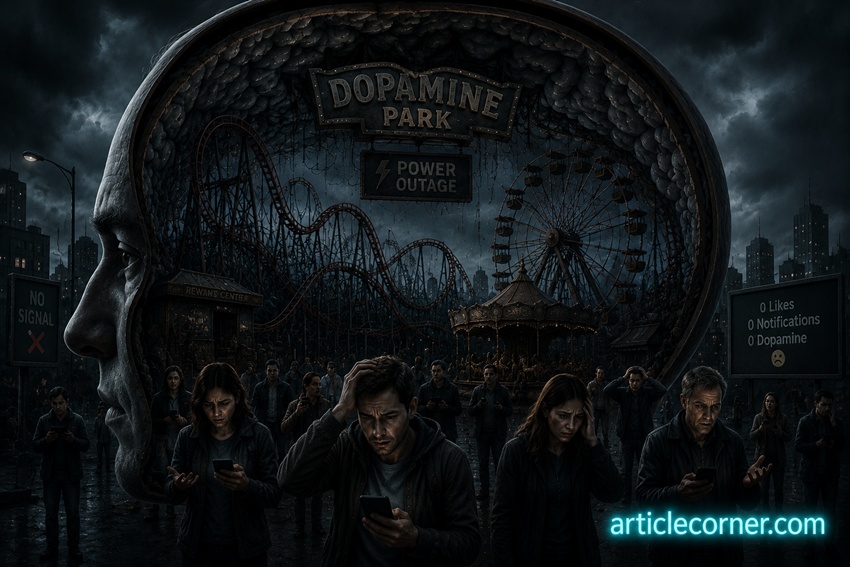
For years our brains have lived inside a colorful amusement park of sounds, images, vibrations, and instant rewards.
Now the gates are closed.
Without warning.
Children might slowly return to the streets to play.
Neighbors might sit outside and talk again.
Families might look into each other's eyes instead of looking down at screens.
Books might finally be opened.
The stars might once again become more interesting than a glowing display.
Yet for many people, none of this would feel like enough.
Because what they truly miss is not electricity.
It is dopamine.
Perhaps the greatest source of energy in modern life is not electricity at all.
It is attention.
And every scroll, every click, and every notification quietly consumes it.
Real freedom is not having a fully charged phone.
Real freedom is remaining peaceful after the phone goes dark.
The brightest light in our lives has never come from a screen.
It has always come from within.
ArticleCorner.com Perspective
Your brain naturally seeks dopamine, but your heart longs for something deeper than endless stimulation. When every moment is filled with notifications, the mind grows louder while the heart grows quieter.
Real balance begins when the brain is no longer chasing its next reward and the heart is finally heard again. Technology can entertain the mind, but only presence can nourish the heart.
Sometimes the greatest signal we can reconnect with is the one that has always existed within us.
Use Your Phone Only for Calls Today...
Writer: articlecorner.com