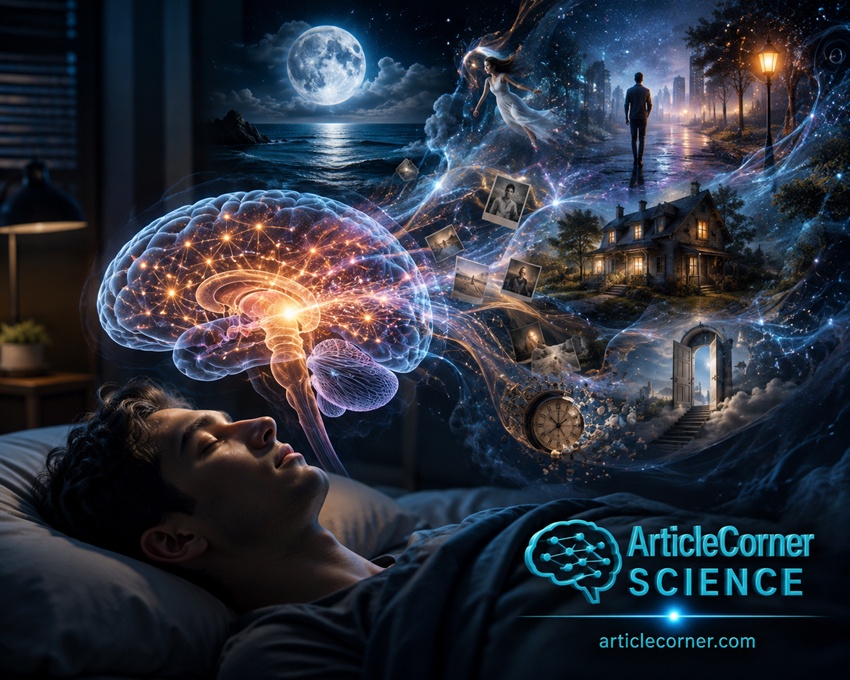
ArticleCorner Science:
The Science Behind Dreams
Have you ever woken up from a dream and, for a few seconds, wondered whether it had really happened? Maybe you were talking to someone you have not seen for years. Maybe you were walking through a place you have never visited, yet somehow it felt familiar. Perhaps you were falling, flying, running, or simply sitting somewhere peaceful, feeling an emotion so strong that it stayed with you even after you opened your eyes.
Then, slowly, reality returned. You were in your room.
The dream was gone, but the feeling was still there. It is a strange experience, isn't it? We spend hours asleep, apparently disconnected from the outside world, yet somewhere inside our minds, entire stories can unfold. So what is actually happening in our brain when we dream?
To understand dreams, we first have to understand something important about sleep: our brain does not simply switch off when we fall asleep. Sleep is an active biological process in which the brain moves through different stages, each with its own pattern of activity. One of the most fascinating stages is called **REM sleep**, short for Rapid Eye Movement sleep.
During REM sleep, the eyes move rapidly beneath the eyelids, brain activity becomes much more active, and many of the most vivid dreams occur. In some ways, the brain during REM sleep can look surprisingly active even though the body is resting. It is almost as if the body has stepped away from the world while the brain continues working behind the scenes.
And this is where dreams become especially interesting. During a vivid dream, areas of the brain involved in vision, emotion, memory, and sensation can become active. That helps explain why a dream can feel so real. When you dream about standing beside the sea, for example, your brain may create the impression of seeing the water, hearing the waves, feeling the wind, and experiencing the emotion connected with that scene.
There may be no actual ocean in the room, but your brain is capable of constructing an internal experience that feels remarkably convincing. The dream is not necessarily showing you reality; instead, your brain is creating its own version of reality from neural activity, memories, emotions, and imagination.
But there is something even more fascinating. Have you ever noticed how strange a dream can become without you questioning it? You may suddenly find yourself in your childhood home, then walking through a completely unfamiliar city, and a moment later talking to someone who has somehow become a completely different person. While awake, you would probably stop and say, “Wait, this makes no sense.” In a dream, however, the situation can feel perfectly normal.
One reason may be that regions involved in critical reasoning and self-monitoring do not operate in exactly the same way during REM sleep as they do when we are awake. At the same time, emotional and sensory processing can remain highly active. The result is a fascinating combination: the dream can be emotionally powerful and visually convincing, while the part of the brain that normally questions the logic of the situation may be less dominant.
This may also explain why dreams can bring such powerful emotions. A dream can make you feel fear, happiness, sadness, excitement, embarrassment, or even love without anything physically happening around you.
Your heart may beat faster. You may wake up anxious after a frightening dream or strangely peaceful after a beautiful one. The emotion was not necessarily “fake” simply because the event was imaginary. The experience happened inside your brain, and the brain is where emotions are actually processed.
A dream cannot physically take you to another world, but it can create an emotional experience that your waking mind remembers as something surprisingly meaningful.
Memory also seems to play an important role. During the day, we collect an enormous amount of information: faces, conversations, sounds, places, worries, images, and small moments that we barely notice. Our brain does not necessarily organize all of this information in a simple chronological file. During sleep, memories and experiences are processed, strengthened, reorganized, and connected in complex ways.
This does not mean that every dream is simply a replay of something that happened during the day. Instead, fragments of memories and emotions may become part of a new dream narrative. That is why someone from your past can suddenly appear in a completely unfamiliar place, or why an ordinary conversation from yesterday can somehow become part of an extraordinary story.
Perhaps this is one of the most beautiful things about dreaming. The brain does not need a movie screen, a camera, or an external world to create an experience. It can take pieces of what you have seen, heard, remembered, imagined, and felt, and combine them into something new. In that sense, dreaming gives us a glimpse of how creative the human brain really is.
It is not creativity in the same deliberate way that a writer creates a story or an artist paints a picture. Instead, it is an uncontrolled form of mental construction, happening while we are unaware of the process.
There is still much that scientists do not completely understand about dreams. We know that dreaming is closely associated with particular stages of sleep, especially REM sleep, and we know that brain activity changes significantly during these periods. We also know that dreaming is connected in complex ways with memory, emotion, and perception. But the exact reason why the brain produces dreams remains an active area of scientific research.
Are dreams simply a by-product of the sleeping brain? Do they help us process emotions? Do they contribute to memory and learning? Or do several of these processes happen at the same time? Science continues to investigate these questions, and the answers are more complicated than the simple idea that dreams are just random pictures in our heads.
And perhaps that is why dreams remain so fascinating. Every night, without consciously asking for it, we enter a world created by our own brain. We can meet people who are far away, return to places that no longer exist, experience impossible events, and feel emotions that seem completely real. Then morning arrives, we open our eyes, and the entire world disappears in seconds.
What remains may be only a few images, a feeling, or a strange sentence we cannot explain. Yet behind that brief experience is an extraordinarily complex biological process involving billions of neurons communicating inside the brain.
So the next time you wake up from a vivid dream, perhaps don't dismiss it simply as something strange that happened while you were asleep. Take a moment to wonder about it. Your brain has just spent hours maintaining your body, processing information, organizing memories, regulating biological functions, and perhaps creating an entire imaginary world while you were completely unaware of the process.
**A dream may disappear when you open your eyes, but the science behind that dream reveals something remarkable: even when the world around us becomes quiet, the human brain never truly stops being extraordinary.**
ArticleCorner Science:
Where Wonder Meets Science.
Writer: articlecorner.com