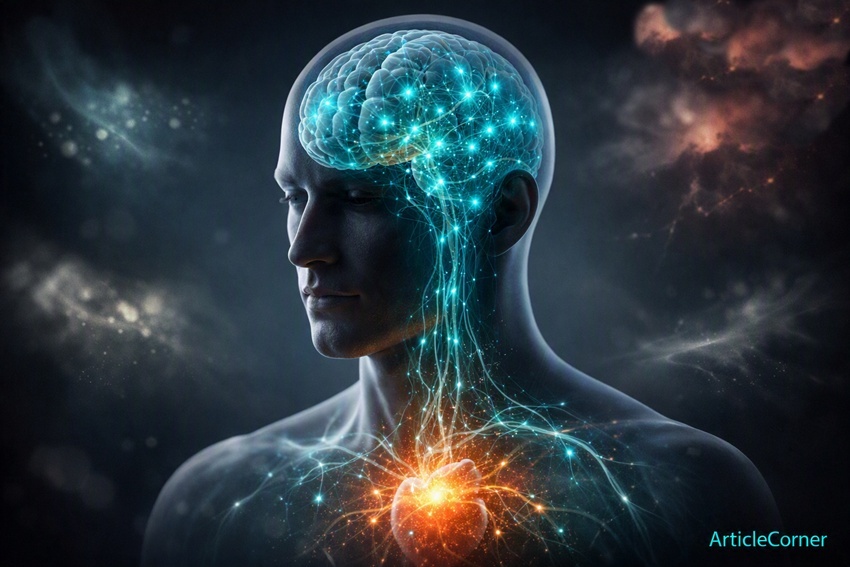
What Are Emotions?
Dr. Mind Explains:
Let me start with a simple question.
Have you ever felt your heart beating faster before something important happened? Have you ever become nervous before speaking to someone, felt an unexpected wave of happiness when hearing a familiar song, or suddenly become angry before you had time to think about why?
These experiences are so ordinary that we rarely stop to examine them. We simply say, “I’m nervous,” “I’m happy,” “I’m angry,” or “I’m afraid.” But behind these familiar words is a remarkably complex interaction between the brain, the body, our experiences, and the world around us.
So what exactly is an emotion?
There is no single definition that completely captures the concept, but emotions can be understood as coordinated responses that help us deal with situations that matter to us. They involve changes in the brain and body and can influence attention, memory, perception, decision-making, and behavior.
And this is important: **an emotion is not simply a feeling.**
The two are closely related, but they are not necessarily identical.
An emotion can involve changes happening throughout the brain and body. A feeling is the conscious experience of those changes and the meaning we give to them. For example, your body may begin responding to a threatening situation before you consciously describe what you are experiencing as fear.
Your heart rate may change, your muscles may become more prepared for action, and your attention may become focused on the possible danger. The conscious experience of these changes is part of what you recognize as feeling afraid.
This relationship between brain and body is one of the most fascinating aspects of emotion.
Imagine that you are walking home and suddenly notice a large dog running toward you. Before you have carefully analyzed the situation, your attention may become sharply focused. Your body may become tense. Your heart may beat faster. You may prepare to move away.
Your brain is not waiting for you to write a detailed report about the dog.
It is responding to a situation that could matter for your safety.
This rapid response is part of the reason emotions are so useful. They help organisms respond to important events without requiring every decision to pass through slow, deliberate reasoning.
But emotions are not always about immediate physical danger.
You can feel excitement before meeting someone you care about. You can feel sadness when remembering someone you have lost. You can feel pride after accomplishing something difficult. You can feel embarrassment when you realize that other people are watching you. You can feel relief when a problem you feared has finally been resolved.
The situations are different, but the underlying principle is similar.
Something matters to you.
Your brain evaluates what is happening, your body responds, your attention changes, and you experience an emotional state.
One brain region that often appears in discussions of emotion is the **amygdala**. The amygdala is a group of structures located deep within the brain and is involved in processing emotionally significant information, particularly information related to threat and fear. But it would be misleading to describe the amygdala as simply the “fear center” of the brain.
Emotion is much more complicated than that.
The amygdala works together with many other brain regions and systems. Areas involved in memory, attention, decision-making, body regulation, and conscious awareness all contribute to emotional experiences. Different emotions involve different patterns of interaction rather than one isolated part of the brain switching on and producing a specific feeling.
This is an important lesson when studying the brain.
The brain rarely works through simple one-to-one relationships.
There is usually a network.
Now think about something interesting: the same event can produce completely different emotions in different people.
Imagine receiving a message that says, “We need to talk.”
One person may immediately become anxious.
Another may become curious.
Someone else may become excited because they are expecting good news.
The words are identical.
The emotional response is not.
Why?
Because your brain does not interpret an event independently of your previous experiences. Your memories, expectations, knowledge, personality, current physical state, and interpretation of the situation can all influence how you respond.
Emotion is therefore not simply something that happens *to* you.
Your brain is constantly trying to understand what is happening and what it means for you.
This helps explain why context matters so much.
A loud noise in your home at three in the morning can make you frightened. The same sound during a fireworks display might make you excited. A racing heart can mean fear, excitement, physical exertion, or even anticipation.
The physical response alone does not always tell the whole story.
Your brain interprets the situation.
And that interpretation contributes to the feeling you experience.
This brings us to another important question.
**Can we control our emotions?**
Not completely.
You cannot simply decide never to feel fear, sadness, anger, or anxiety. Emotional responses are deeply connected to biological systems that operate faster and more automatically than conscious reasoning.
But that does not mean you are powerless.
You can often influence what happens after an emotion appears.
Suppose someone says something that makes you angry. The first emotional reaction may occur automatically. You may feel your body tense and your attention narrow toward the person or situation. But what you do next can depend on your ability to pause, reinterpret what happened, consider another explanation, and choose how to respond.
The emotion may not be under your immediate control.
Your response to the emotion can be more flexible.
This ability is part of what psychologists often study as **emotion regulation**.
Emotion regulation can involve many processes. People may change how they interpret a situation, shift their attention, use strategies to calm themselves, or choose a different behavior. These abilities develop over time and can be influenced by learning, experience, relationships, and the environment.
In other words, emotional maturity does not mean becoming emotionless.
It means becoming better at understanding and managing emotional responses.
And there is something else I want you to consider.
We often talk about emotions as if they interfere with rational thinking.
But that picture is too simple.
Emotions can sometimes distort judgment, especially when we are overwhelmed or responding to incomplete information. But emotions also provide information. They can help us recognize what matters, motivate us to act, draw our attention toward important events, and influence social relationships.
Imagine making every decision without any emotional significance attached to the possible outcomes.
Would you know what you actually care about?
Reason can compare possibilities.
But emotion often helps determine which possibilities matter.
This is one reason the relationship between emotion and decision-making is so important. Human decisions are rarely purely logical calculations. Our values, experiences, expectations, social relationships, and emotional responses all contribute.
Even choices that appear completely rational can be influenced by emotional factors that we do not consciously notice.
Now let's talk about love.
Why does seeing one particular person produce such a powerful reaction?
Why can separation from someone hurt so deeply?
Why can a simple voice, photograph, or familiar smell suddenly change your emotional state?
Love is not controlled by a single “love center” in the brain. It involves interacting systems associated with reward, motivation, attachment, memory, emotion, and social cognition. Chemicals such as dopamine, oxytocin, and other signaling molecules participate in these processes, but it would be an oversimplification to say that a single chemical “causes” love.
Human attachment is far more complicated than that.
It develops through biology, experience, learning, social interaction, memory, and personal meaning.
And this is where emotions become deeply connected to memory.
An emotionally significant experience can become particularly memorable. Think about a moment that changed your life. You may remember where you were, who was with you, what happened, and how you felt.
But emotion does not guarantee perfect memory.
A powerful emotional experience can make a memory feel vivid while some of its details may still change over time. The brain is not recording an emotional event with a perfectly preserved video camera. Instead, emotional significance can influence which aspects of an experience receive attention and how the memory is later reconstructed.
So emotion can help determine not only **how we feel about an experience**, but also **how strongly that experience remains connected to us**.
There is another side to this.
Sometimes emotions seem to appear without an obvious reason.
You wake up feeling unusually sad.
A familiar song makes you feel peaceful.
A particular place makes you uncomfortable even though you cannot immediately explain why.
This does not necessarily mean that the emotion has no cause. The brain is constantly processing information outside conscious awareness. Memories, bodily states, expectations, and subtle environmental cues can all influence emotional responses without becoming explicit thoughts.
Your conscious mind may simply receive the final experience:
**“Something feels different today.”**
The brain may have been working on the problem long before you noticed it.
And now we come to one of the biggest questions surrounding emotion.
Are emotions universal?
Some emotional expressions appear to be widely shared across human cultures, and certain emotional responses have deep biological roots. At the same time, culture and learning strongly influence how emotions are interpreted, expressed, and regulated.
A child learns not only how to experience emotions, but also how to understand them within a particular social world.
What is considered appropriate to express in one culture may be treated differently in another. The words we use to describe feelings can also influence how we understand our own experiences.
So emotions are neither purely biological nor purely cultural.
They emerge from an interaction between biology, experience, learning, context, and interpretation.
Perhaps that is why emotions can sometimes be difficult to explain.
You may know exactly what you feel without knowing exactly why.
You may understand intellectually that something should not bother you, yet still feel affected by it.
You may want to forgive someone but continue to feel hurt.
Your brain does not always change its emotional response simply because your conscious mind has reached a logical conclusion.
And that is not a contradiction.
Different processes are operating at different levels.
This is why understanding emotions can be useful.
Instead of asking only, **“Why am I feeling this?”**, you can begin asking more specific questions.
What happened?
What did I expect?
What did I interpret?
What is my body doing?
What memory did this situation activate?
What matters to me here?
And what do I want to do with this feeling?
These questions do not make emotions disappear.
They make them more understandable.
And perhaps that is one of the most important things we can learn about the emotional brain.
We do not have to choose between emotion and reason.
We are human because both are part of us.
Your emotions can influence your thoughts.
Your thoughts can influence your emotions.
Your memories can influence both.
And your experiences can gradually change the way your brain responds to the world.
So the next time you feel a sudden rush of anger, excitement, fear, or happiness, don't immediately ask yourself whether the emotion is right or wrong.
Pause.
Notice it.
Your heart may be beating differently.
Your attention may have shifted.
Your body may be preparing for action.
Your brain may be interpreting something as important.
And somewhere between those biological processes and your conscious experience, **a feeling is taking shape.**
We understand much more about emotions than we did in the past.
But there is still much to discover.
Because emotions are not simply reactions that happen inside the brain.
They are part of the way a human being experiences the world.
And that brings us to our next question.
**Why does the brain create dreams?**
When the body rests and the outside world becomes quieter, the brain does not simply switch off.
It enters another remarkable state.
**Next time, let's explore sleep and dreams — what happens inside the brain while we sleep, why dreams can feel so real, and why some of them disappear within minutes of waking.**
— **Dr. Mind**
Writer: articlecorner.com - ArticleCorner