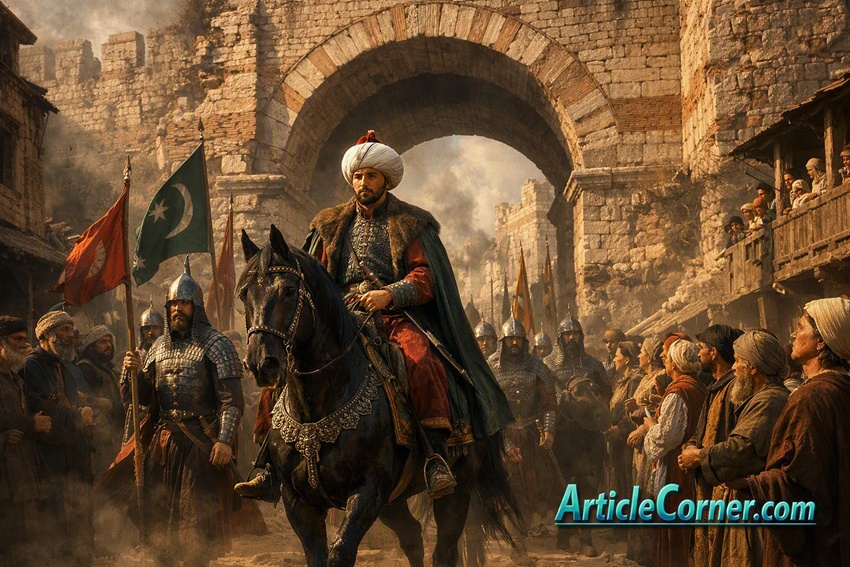
ArticleCorner Istanbul - How Was Istanbul Conquered? From Mehmed II to Fatih Sultan Mehmed
When we talk about the conquest of Istanbul, the date that immediately comes to mind is May 29, 1453.
Cannons, massive walls, Ottoman soldiers, Byzantine defenders and a young ruler entering one of the greatest cities in the world.
But the conquest of Istanbul was not simply a battle that lasted for one day.
It was the result of years of preparation, political calculation, military planning, engineering and determination. And behind all of this stood a young Ottoman ruler who believed that the city that had resisted countless armies could finally be conquered.
Before the conquest, he was not known as Fatih.
He was **Mehmed II**.
The title Fatih, meaning the Conqueror, became associated with him after the conquest.
That distinction makes his story even more fascinating.
Because when Mehmed II stood before the walls of Istanbul, he was still a young ruler facing a city that had survived for centuries.
The Young Mehmed and His Dream
Mehmed II was born in 1432 and received an extensive education from an early age.
His education was not limited to military matters. He studied history, languages, mathematics, philosophy and the art of government. He was being prepared not simply to command armies, but to rule a great empire.
Istanbul had a special place in the history of the region.
For centuries, it had been the capital of the Roman and Byzantine Empires. It stood at the meeting point of Europe and Asia, controlling the Bosphorus and important trade routes.
The Ottoman rulers before Mehmed had already attempted to conquer the city.
They had failed.
The walls of Istanbul were among the strongest defensive structures of their time. The city was protected by land walls, the sea and the strategic position of the Golden Horn.
For Mehmed II, however, these obstacles were not reasons to abandon the idea.
They were problems that needed solutions.
Perhaps this was one of the qualities that separated Mehmed from many other rulers.
When he saw a wall, he did not simply see a wall.
He tried to imagine how that wall could be overcome.
Preparing for the Conquest
In 1451, after the death of his father Murad II, Mehmed II returned to the Ottoman throne.
He was now determined to make another attempt at Istanbul.
But this time he would not rely only on the strength of his army.
He understood that the conquest required careful preparation.
The Bosphorus had to be controlled.
Possible military assistance to the city had to be restricted.
The army needed supplies.
Weapons had to be prepared.
And most importantly, a way had to be found to break through the massive walls of Istanbul.
One of the most important steps was the construction of **Rumeli Fortress** on the European side of the Bosphorus.
Across the water stood the older Anadolu Fortress.
The two fortresses faced each other across the narrow strait.
Between them flowed the Bosphorus.
And beyond them stood Istanbul.
Today, when we look at these two fortresses, it is easy to imagine the strategic importance of the scene.
Anadolu Fortress on one side.
Rumeli Fortress on the other.
The Bosphorus between them.
And Istanbul waiting beyond.
The message was clear.
Mehmed II was tightening his control over the passage leading to the city.
The Great Cannons
The greatest challenge remained the walls.
Istanbul's land walls had protected the city for centuries. Traditional weapons had repeatedly failed to destroy them.
Mehmed understood that something different was necessary.
Large cannons were produced for the coming siege. The Hungarian cannon founder Urban played an important role in this effort.
These weapons were enormous for their time.
But producing the cannons was only part of the problem.
They had to be transported.
Imagine moving enormous pieces of artillery across difficult roads in the fifteenth century, without modern vehicles, engines or machinery.
Men and animals worked together.
Roads had to be prepared.
The movement of the army had to be coordinated.
Every part of the operation required planning.
Mehmed II was preparing not simply for a battle, but for one of the greatest military operations of his age.
The Siege Begins
On April 6, 1453, the Ottoman army arrived before Istanbul.
The city was surrounded.
Inside Istanbul, Byzantine Emperor Constantine XI prepared for the defense.
The people of the city knew what was coming.
Soldiers took their positions on the walls.
The Golden Horn was protected by a massive chain designed to prevent enemy ships from entering.
The Ottoman cannons began firing.
The walls shook under the impact.
Yet Istanbul continued to resist.
Days passed.
The fighting intensified.
The defenders repaired damaged sections of the walls while Ottoman forces continued their attacks.
For the people inside the city, the future was becoming increasingly uncertain.
For the Ottoman army, there was no turning back.
When Ships Traveled Over Land
One of the most remarkable moments of the siege came when Mehmed II faced the problem of the Golden Horn.
The chain across its entrance prevented the Ottoman fleet from entering.
Instead of accepting the obstacle, Mehmed found another solution.
The ships would be moved over land.
It sounds almost unbelievable even today.
But the Ottoman forces prepared a route using wooden platforms and carefully arranged materials. Ships were pulled across the land and eventually launched into the Golden Horn.
Imagine witnessing that scene in 1453.
Ships moving where ships were never supposed to move.
Men pulling ropes.
Soldiers and workers struggling together.
The enormous effort continuing through the night.
And then the ships appearing inside the Golden Horn.
It was more than a military maneuver.
It demonstrated something about Mehmed's approach to warfare.
When the obvious path was blocked, he looked for another path.
The Final Days
As the siege continued, the pressure on Istanbul increased.
The Byzantine defenders remained determined, but their situation was becoming more difficult.
The Ottoman army was large.
The cannons continued to damage the walls.
The Golden Horn was no longer safe.
The final attack was approaching.
Mehmed II was only twenty one years old.
Yet the responsibility resting on his shoulders was enormous.
If he failed, he would not simply lose a battle.
He would fail to capture the city that Ottoman rulers had dreamed of conquering for generations.
But Mehmed continued.
Preparations were made for the final assault.
The night before the attack must have felt completely different inside the city.
People prayed.
Soldiers prepared their weapons.
Families wondered what the morning would bring.
Outside the walls, the Ottoman army waited for the final order.
Nobody could know exactly what the next day would look like.
But everyone knew that history was approaching a turning point.
May 29, 1453
At dawn, the final Ottoman assault began.
The fighting became intense.
Ottoman soldiers attacked the walls while Byzantine defenders fought desperately to hold their positions.
Cannons continued to fire.
The city resisted.
But eventually Ottoman forces entered Istanbul.
The city had been conquered.
May 29, 1453 became one of the most important dates in world history.
Mehmed II had achieved what generations of rulers had failed to accomplish.
He had conquered Constantinople.
And from that moment, the young ruler who had entered the city as Mehmed II would be remembered by another name.
**Fatih Sultan Mehmed.**
After the Conquest
Perhaps the most important part of the story begins after the fighting ended.
Conquering a city was one thing.
Governing it was something entirely different.
Fatih Sultan Mehmed understood this.
Istanbul could not remain simply a captured city.
It had to become a living capital.
The city needed people.
It needed markets.
It needed craftsmen.
It needed religious institutions.
It needed homes, public buildings and economic life.
People from different parts of Anatolia and Rumelia were settled in Istanbul, helping the city recover and grow.
The city gradually began to change.
Markets became active again.
New buildings appeared.
Mosques, schools, baths, markets and charitable foundations shaped the developing Ottoman capital.
But there was another important aspect of Fatih's policy.
The people who had lived in Istanbul before the conquest did not simply disappear.
Different religious communities continued to exist.
Fatih allowed the Greek Orthodox community to maintain its religious institution and reorganized the Orthodox Patriarchate. Gennadios Scholarios was appointed patriarch.
The Christian population was therefore able to continue its religious life under Ottoman rule.
Other communities also maintained their religious and social institutions.
Of course, the fifteenth century cannot be judged as if it were the modern world. Concepts such as citizenship, equality and human rights were understood very differently.
Yet Fatih's approach was important because he understood that governing a great imperial city required more than military power.
It required order.
It required coexistence.
And it required allowing different communities to maintain parts of their religious and social lives.
From Conquered City to Imperial Capital
Fatih did not want Istanbul to remain a symbol of a defeated empire.
He wanted it to become the center of a new one.
The city was rebuilt and developed.
The population increased.
Trade expanded.
New institutions were established.
The Ottoman state began transforming Istanbul into an imperial capital.
The city became home to Muslims, Greeks, Armenians, Jews and many other communities.
Different languages could be heard in its streets.
Different traditions existed side by side.
Different places of worship formed part of the city's landscape.
This diversity would become one of the defining characteristics of Istanbul throughout the centuries that followed.
The conquest therefore created a new chapter rather than simply closing an old one.
Looking at Istanbul Today
There is something deeply emotional about standing beside the Bosphorus today and thinking about 1453.
The water still flows between Asia and Europe.
Anadolu Fortress still stands.
Rumeli Fortress still looks toward the opposite shore.
Ships continue to pass through the same strait.
But the world around them has changed completely.
The armies are gone.
The cannons are silent.
The soldiers who fought on the walls have been gone for centuries.
Yet the city remains.
That may be the most remarkable thing about Istanbul.
Empires rise.
Empires disappear.
Rulers come and go.
Battles become memories.
But the city continues to live.
When we remember Fatih Sultan Mehmed, it is easy to imagine him only as the conqueror who entered Istanbul on May 29, 1453.
But before he became Fatih, he was Mehmed II.
A young ruler.
A student of history.
A military strategist.
A man who believed that an apparently impossible goal could be achieved through preparation, patience and determination.
He did not simply attack the walls.
He built fortresses.
He prepared artillery.
He controlled the Bosphorus.
He moved ships over land.
He planned the siege carefully.
And when the city finally fell, his greatest responsibility began.
He had to govern what he had conquered.
He had to rebuild the city.
He had to bring people back.
He had to establish institutions.
He had to create a capital worthy of an empire.
That is why the story of Istanbul's conquest should not end with the moment the Ottoman soldiers entered the city.
The real story continues after the gates opened.
Because conquering Istanbul changed the name of Mehmed II.
But governing Istanbul helped define the legacy of Fatih Sultan Mehmed.
A City That Remembered Everything
Perhaps this is why Istanbul feels different from many other cities.
Walk through its streets and you can feel that the past has never completely disappeared.
Roman Istanbul is there.
Byzantine Istanbul is there.
Ottoman Istanbul is there.
Modern Istanbul is there.
They exist together.
The stones of Rumeli Fortress remember the preparations.
The Bosphorus remembers the ships.
The old walls remember the siege.
The city remembers May 29, 1453.
And somewhere within all of this history stands a young man who once looked at Constantinople and believed that the impossible could become possible.
Before the conquest, he was Mehmed II.
After the conquest, history called him Fatih.
But perhaps the greatest part of his story is not that he conquered a city that had resisted for centuries.
It is that after conquering it, he understood that a city must not only be won.
It must be rebuilt.
It must be governed.
It must be given life.
And Istanbul continued to live.
That is why, more than five centuries later, when we stand beside the Bosphorus and look toward the two great fortresses, we are not simply looking at old stones.
We are looking at the remains of a dream that changed history.
ArticleCorner Istanbul - A Visionary Sultan Who Opened the Door to a New Age : Fatih Sultan Mehmed.
Writer: articlecorner.com