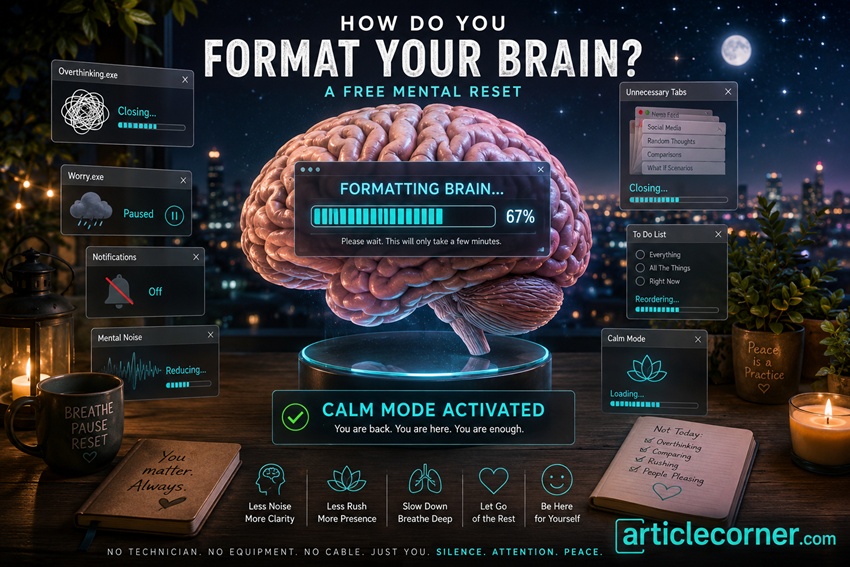
Format Your Brain - No Cost
Yes, you heard that right. Today, we are formatting the brain. And the best part? It is completely free.
No technician. No special equipment. No expensive software. And definitely no cable connected to your head.
For a few minutes, we are going to treat your brain like a computer. We will close some tabs, reduce the incoming traffic, lower the noise, and give the system a little breathing room.
Then we will ask the interesting question:
What does the brain actually understand when we do this?
Step one: Take the brain offline.
Turn off the phone. Close the laptop. Stop checking notifications. Put the news, messages, emails, and endless scrolling on hold.
For a few minutes, your brain does not need another notification telling it what to look at next.
Think of it as disconnecting the brain from the internet.
Your brain receives information through your senses all day long. Sounds, images, conversations, screens, movement, memories and emotions are constantly being processed. Your attention jumps from one thing to another, often without you even noticing.
So first, we reduce the traffic.
And when we do that, the brain gets a very simple message:
“There is nothing I need to react to right now.”
Step two: Close the unnecessary processes.
Is your mind still running yesterday's conversation?
Close it.
Are you worrying about something that has not happened yet?
Put it on hold.
Is your brain asking the same question for the fiftieth time?
Tell it, “We will deal with that later.”
We are not deleting these thoughts. We are simply stopping them from using all of our attention.
And when we stop constantly feeding a thought with attention, the brain can begin to understand that it does not need to keep treating that thought as an urgent task.
Step three: Deal with the stubborn process.
Sometimes one thought refuses to close. You click the little button in your mind, but it keeps running.
That is where many of us make the same mistake.
We fight the thought.
Don't.
Let it stay in the background.
Notice it. Take a slow breath. Then bring your attention back to something simple.
Look at a tree.
Watch the sky.
Focus on one object in the room.
Listen to a quiet sound.
And something important is happening here. You are teaching your attention where to go.
When you repeatedly bring your attention back to the present, your brain receives a different kind of message:
“This moment is where we are.”
You are not trying to erase the thought. You are simply changing its priority.
Step four: Clear the mental cache.
Take a walk. Stretch your body. Sit somewhere quiet. Take a few slow breaths. Get away from the screen.
You do not always need more information.
Sometimes your brain needs less.
When you step away from constant stimulation, you give your attention a chance to settle. Your body can also begin to move away from that constant state of alertness.
In other words, you are not fixing the brain.
You are giving it room to regulate itself.
Step five: Install calm mode.
This is probably the most important update.
Give your brain a few minutes without demands.
No messages.
No deadlines.
No scrolling.
No trying to solve every problem in the world.
Just sit there.
Look outside.
Watch the clouds.
Look at the stars.
Let the city continue without you for a few minutes.
And now comes the interesting part.
When you stop constantly feeding your attention with new information, your brain begins receiving a very different signal.
“You do not have to react to everything.”
That can make the mind feel quieter. The urge to check, respond, analyze, remember, predict and worry can begin to lose some of its intensity.
And this is why our little brain format is more than a funny computer metaphor.
We are changing the environment in which the brain is operating.
No, we are not actually formatting the brain.
We are not deleting memories.
We are not cutting neural connections.
We are not turning the brain off.
We are simply reducing unnecessary stimulation and giving the brain a chance to rest, regulate and refocus.
So what did the brain understand after all this?
It understood that not everything needs an immediate response.
The phone does not need our attention every second. The email can wait until we are ready. Not every problem needs to be solved tonight, and not every thought deserves to become a full investigation.
For a few minutes, the brain learned something surprisingly simple:
“I can slow down. I can breathe. I can simply be here.”
And perhaps most importantly, you do not have to respond to everything immediately.
Maybe that is the closest thing we have to a free brain format.
No technician required.
No software license.
Just a little silence, a little attention, a little fresh air and, if possible, a few minutes under the stars.
System status: calmer.
Unnecessary tabs: reduced.
Mental noise: lower.
Attention: redirected.
Peace mode: activated.
Welcome back.
Writer: articlecorner.com