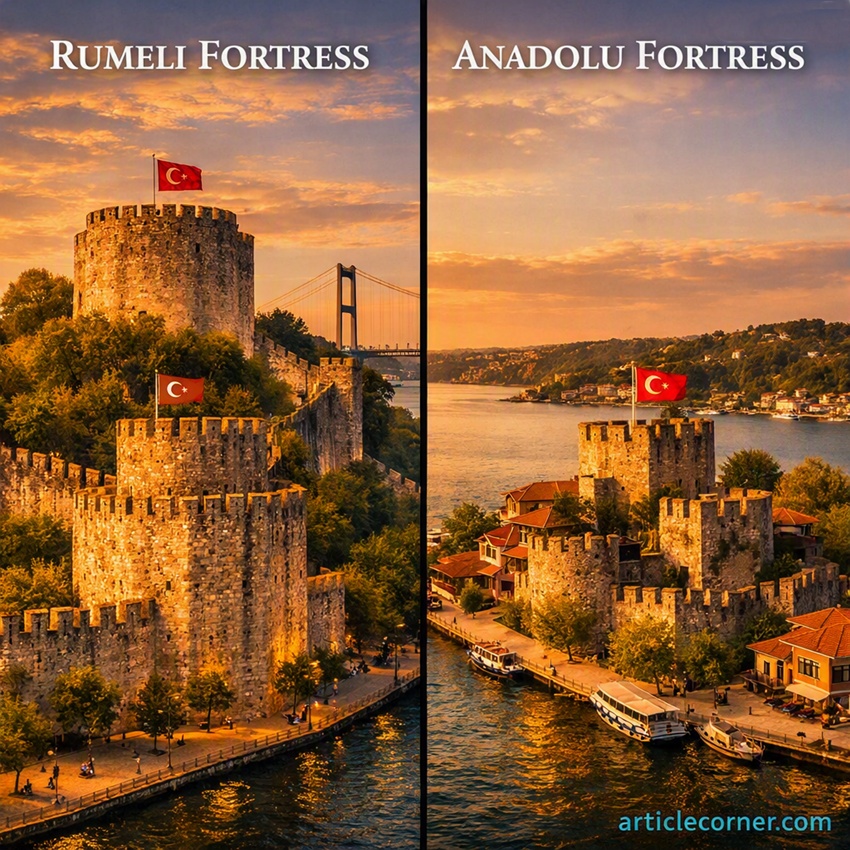
ArticleCorner Istanbul - Anadolu Fortress, Rumeli Fortress and the Bosphorus Triangle
Quick Note: We prefer using the local names Anadolu Fortress and Rumeli Fortress throughout our story to keep the spirit of Istanbul alive. However, if you are looking them up in historical textbooks or academic papers, you might also find them listed as the Anatolian and Rumelian Fortresses.
Where should we begin if we want to tell the story of Istanbul?
Perhaps the answer is the Bosphorus. But instead of looking at it simply as a beautiful waterway, let us look a little closer. On one side stands Anadolu Fortress. On the opposite shore stands Rumeli Fortress. Between them flows the Bosphorus, connecting Asia and Europe while carrying centuries of history through the heart of Istanbul.
Today, the scene is completely different from what it once was. Ferries cross the water, private boats move slowly between the shores, fishermen wait patiently with their lines, and modern Istanbul continues its busy life around these ancient structures. Yet when you look at Anadolu Fortress and Rumeli Fortress, it is easy to imagine that the city has not completely forgotten its past.
These two fortresses are more than old stone walls. They are two important pieces of the same story. One stands on the Asian side and the other on the European side. Between them is the Bosphorus itself. Together, they form a remarkable historical triangle in which geography, water and history meet.
So let us forget the rest of Istanbul for a moment and focus on these two fortresses and the water between them.
Anadolu Fortress: The Quiet Guardian of the Asian Shore
When you first look at Anadolu Fortress, perhaps the most interesting thing is not its size but its location. It stands on the Asian side of the Bosphorus at a strategically important point where the waterway becomes relatively narrow. Today, the area around it is part of everyday Istanbul, with houses, roads, restaurants and people going about their daily lives. But the old walls remind us that this was once a place where the position of a fortress could influence the movement of ships and the balance of power around Istanbul.
Anadolu Fortress was built in the 1390s by Ottoman Sultan Bayezid I. At that time, the Ottoman interest in Constantinople and the surrounding region was becoming increasingly important. The Bosphorus was not simply a beautiful passage between two seas. It was a strategic waterway connecting the Black Sea with the Sea of Marmara. Whoever could control important sections of the Bosphorus could influence movement through one of the most important natural passages in the region.
This is why the location of Anadolu Fortress was so significant. If you stand near the fortress today and look toward the opposite shore, the geography becomes much easier to understand. The Bosphorus narrows here, bringing the two continents surprisingly close to one another. For people living in the medieval period, this was not simply an impressive landscape. It was a location of enormous strategic value.
Over the centuries, the fortress changed, developed and became surrounded by the expanding city. What was once an isolated military structure eventually found itself inside a living urban environment. Today, its historic walls stand beside the modern city, creating an unusual meeting point between different centuries.
Perhaps that is what makes Anadolu Fortress so interesting.
It does not need to dominate the skyline to tell its story.
It simply stands beside the water.
Quietly.
And if its walls could speak, they would have centuries of stories to tell.
Rumeli Fortress: The Great Fortress Across the Water
Now turn your eyes toward the European shore.
There stands Rumeli Fortress.
The atmosphere changes immediately. Its enormous walls and three major towers create one of the most recognizable historic silhouettes along the Bosphorus. Built by Sultan Mehmed II in 1452, just before the conquest of Constantinople, Rumeli Fortress was created for a very specific strategic purpose: controlling this crucial section of the Bosphorus and restricting assistance that could reach Constantinople from the Black Sea.
The speed with which the fortress was constructed is one of the remarkable details of its history. Its massive walls, towers and strategic position demonstrate how important the site was. When you see the fortress from the water, its purpose becomes even easier to understand. The structure was not placed here by accident. It was designed to dominate an important passage through the Bosphorus.
The three great towers give Rumeli Fortress its distinctive character. Connected by thick walls and defensive structures, they rise directly beside the water and create a dramatic contrast with the modern city surrounding them.
Today, traffic moves along the roads nearby. Bridges cross the Bosphorus. Boats and ferries pass in front of the fortress. Restaurants and residential areas have grown around it. Istanbul has changed enormously.
But the fortress remains.
Its stone walls still stand where they stood centuries ago, watching the Bosphorus and the city around it.
There is something fascinating about seeing such an old structure surrounded by modern life. You can look at a fortress wall and, only a few meters away, see cars, mobile phones, modern buildings and boats. It is almost as if different centuries are sharing the same view.
Two Fortresses, One Bosphorus
The real story begins when we stop looking at Anadolu Fortress and Rumeli Fortress separately.
Look at them together.
One is on the Asian shore.
The other is on the European shore.
Between them is the Bosphorus.
This simple geographical relationship gives the two fortresses a much deeper meaning. They were built in different periods, but both became part of the long struggle to understand and control this extraordinary waterway.
Imagine yourself standing on a ferry.
The boat moves slowly along the Bosphorus. On one side, Anadolu Fortress appears among the buildings and trees of the Asian shore. Then you turn your head toward Europe and see Rumeli Fortress rising above the water.
The same water flows between them.
But the two fortresses tell different chapters of history.
Anadolu Fortress represents an earlier stage of Ottoman expansion. Rumeli Fortress, the emblem of power before conquest.
When you see them from the water, history suddenly feels much less distant.
It is right there.
On the shore.
In the stone walls.
In the towers.
And in the water flowing between them.
The Bosphorus: The Third Character
But there is something important we should not forget.
The Bosphorus is not simply the space between the two fortresses.
It is the third character in this story.
Without the Bosphorus, these two fortresses would not have had the same meaning. The water separated them, but at the same time it connected them. It was the reason their locations were so important.
For centuries, ships travelled through these waters. Trade routes passed along the Bosphorus. Armies moved through the region. Empires rose and disappeared. Cities changed. Technology changed. Ships changed.
But the Bosphorus remained.
It continued flowing between Asia and Europe.
Today, when you travel along the Bosphorus on a city ferry, you might simply take a photograph of the view. You might notice the bridges, the waterfront houses, the boats and the towers.
But if you look a little more carefully, you can see something that has remained almost unchanged through all those centuries.
The water.
And on either side of that water, two fortresses.
Seeing the Fortresses from Today's Istanbul
Visiting Anadolu Fortress and Rumeli Fortress is not simply about seeing two historic buildings. It is also a way of understanding Istanbul's geography.
Sometimes, to understand the history of a city, you need to look at the landscape before you look at the buildings.
Look at where the Bosphorus becomes narrow. Look at how close the two continents come to each other. Look at the position of the fortresses in relation to the water.
Suddenly, their history begins to make much more sense.
Stand near Anadolu Fortress and look across the Bosphorus.
Then imagine standing at Rumeli Fortress and looking back toward the Asian shore.
The two fortresses begin to feel connected.
You no longer see two separate historical structures.
You see one story.
Anadolu Fortress + Bosphorus + Rumeli Fortress
A triangle formed by stone, water and history.
And perhaps that is what makes this part of Istanbul so special.
The city around these fortresses has changed dramatically. Modern Istanbul is fast, crowded and constantly moving. Yet these two old fortresses remain in their places, quietly watching the Bosphorus.
Anadolu Fortress continues to face the European shore.
Rumeli Fortress continues to rise above the Asian horizon.
And between them, the Bosphorus continues its timeless journey.
The city changes.
The people change.
The ships change.
But the water keeps flowing.
And the two fortresses remain there, reminding Istanbul that its past is not somewhere far away.
It is standing beside the Bosphorus.
ArticleCorner Istanbul - Rumeli and Anadolu Fortress: Guardians of the Bosphorus, Echoes of Empire.
Writer: articlecorner.com