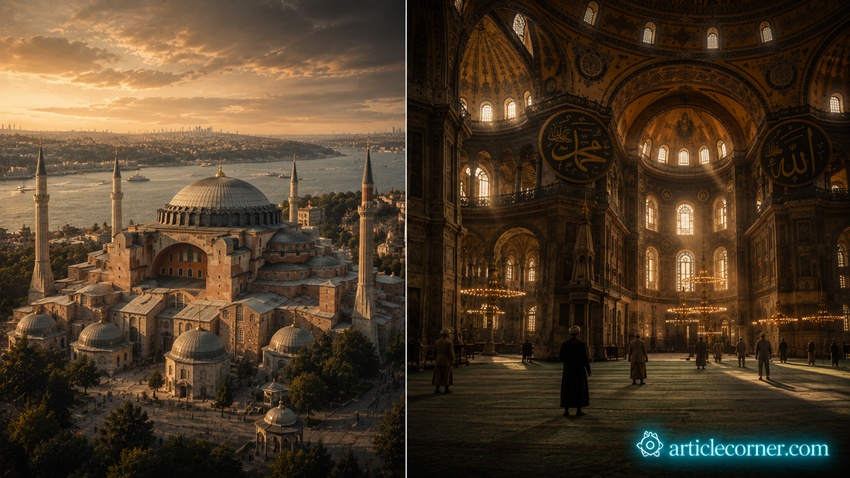
ArticleCorner Istanbul - Hagia Sophia
The Memory of Istanbul:
There are places in the world that you visit, and there are places that seem to remember you.
Hagia Sophia belongs to the second kind.
Stand before it for a moment and look carefully.
Its walls have seen emperors come and go. Its enormous dome has watched generations of people enter through its doors. Prayers have risen beneath it in different languages and traditions. Celebrations have filled its surroundings, while sorrow has also passed quietly through its doors.
For centuries, Istanbul changed around Hagia Sophia.
The city changed its names, its rulers, its languages and its colors. Ships continued to cross the Bosphorus. Streets became crowded. Palaces rose and disappeared. New buildings appeared beside old ones.
Yet Hagia Sophia remained there, quietly watching.
Perhaps this is why Hagia Sophia is more than a historical monument.
It is one of the places where Istanbul remembers itself.
And that is where our journey begins.
In the Heart of a City:
To understand Hagia Sophia, we first have to understand the place where it stands.
Istanbul has always been a city between worlds.
It stands between Europe and Asia, between the Black Sea and the Mediterranean, between different cultures, religions and civilizations. Its history was never simple. Different peoples left their marks here, sometimes peacefully and sometimes through conflict.
At the center of the old city stands Hagia Sophia.
From here, the history of Constantinople and Istanbul seems to unfold in every direction.
The Blue Mosque stands nearby. The Topkapi Palace looks toward the Bosphorus. The old streets descend toward the Golden Horn. Ships pass beyond the historic peninsula.
It is difficult to stand here without feeling that the present is sitting directly on top of the past.
And Hagia Sophia is perhaps the strongest expression of that feeling.
532 A New Beginning:
The story of the present Hagia Sophia began in the sixth century.
The Byzantine Emperor Justinian I wanted to build something that would demonstrate the greatness of his empire.
Earlier churches had already stood on the site, but they had been destroyed during periods of political and social turmoil.
Justinian decided that the new church would be different.
He wanted something extraordinary.
Construction began in 532.
The project was enormous. Architects Anthemius of Tralles and Isidore of Miletus were entrusted with the design. Thousands of workers took part in the construction.
The result was astonishing for its time.
In 537, the new church was inaugurated.
Imagine entering it in those days.
There were no modern machines, no cranes powered by engines, no digital calculations.
And yet, above the people stood an enormous dome that seemed almost impossible.
For the people of Constantinople, this was not simply a building.
It was a statement.
An empire had built something intended to last.
Perhaps the most unforgettable part of Hagia Sophia is not something you can fully understand from a history book.
It is the feeling of standing beneath its dome.
The space seems larger than expected.
The light enters from above and changes the atmosphere inside. Stone, marble, columns and mosaics come together in a way that makes the building feel both enormous and strangely intimate.
The people who built it understood something important.
A building can make a person feel small.
But it can also make a person feel connected to something greater than themselves.
For centuries, people experienced that feeling here.
They looked upward.
They prayed.
They waited.
They celebrated.
They mourned.
And they left.
The building remained.
When Empires Change:
History is often told through rulers.
One emperor follows another.
One army defeats another.
One empire rises while another disappears.
But buildings experience these changes differently.
They do not choose sides.
They simply remain.
Hagia Sophia witnessed the long history of the Byzantine Empire. It stood at the center of Constantinople while the empire grew, struggled and gradually lost much of its former territory.
Generations were born beneath its shadow.
Generations disappeared.
The city itself became more vulnerable.
And eventually, the greatest turning point in its history arrived.
The year was 1453:
The Ottoman army entered Constantinople on May 29, 1453.
The Byzantine Empire came to an end.
The city that had been Constantinople became the capital of a new Ottoman era.
And Hagia Sophia entered another chapter of its long life.
For centuries, it had been one of the great churches of the Byzantine world.
Now it became a mosque.
This was not simply a change in the use of a building.
It was a moment when one civilization gave way to another.
Yet Hagia Sophia itself did not disappear.
Its story continued.
A New Life Under the Ottomans:
The Ottoman period added another layer to Hagia Sophia.
Minarets rose around it.
New structures were added.
The surrounding complex developed.
The interior changed as Islamic architectural and artistic elements became part of the building.
Calligraphic panels appeared.
A mihrab was installed.
A minbar became part of the interior.
The building that had once represented the Byzantine Empire now stood at the heart of Ottoman Istanbul.
And perhaps this is one of the most fascinating things about Hagia Sophia.
It did not simply belong to one historical moment.
It accumulated history.
One century placed its mark beside another.
One civilization left something that the next generation could see.
Sinan and the Art of Preservation:
When people speak about Ottoman architecture in Istanbul, one name inevitably appears:
Mimar Sinan.
Sinan was not the original architect of Hagia Sophia. The building was already almost a thousand years old when he became one of the most important architects of the Ottoman Empire.
But he understood its architectural power.
He also understood its weaknesses.
The enormous structure needed constant care.
Sinan strengthened the building and designed important supporting structures around it. His interventions helped preserve Hagia Sophia and influenced the way Ottoman architects approached monumental architecture.
In a sense, Sinan became part of the building's long conversation with history.
He did not create its beginning.
He helped protect its future.
The People Who Passed Through:
History books often remember emperors.
But Hagia Sophia remembers something more.
It remembers ordinary people.
A child entering the building for the first time.
A soldier standing nearby.
A mother carrying her child.
A traveler arriving in Constantinople.
A worshipper looking toward the dome.
An architect studying its walls.
A stranger who simply stopped outside and looked upward.
These people rarely appear in official history.
We do not know their names.
But they were part of Hagia Sophia's life.
Perhaps that is why old buildings can feel strangely human.
Their stones remain, while the people who touched them disappear.
A Witness to Istanbul:
Hagia Sophia has survived earthquakes, political changes, wars, restorations and centuries of transformation.
The city around it has changed dramatically.
But the building continues to occupy the same historic heart of Istanbul.
Look at it today and you are looking at more than architecture.
You are looking at layers.
Byzantine Constantinople.
Ottoman Istanbul.
Modern Turkey.
Different periods, different people and different meanings are all present in the same place.
That is what makes Hagia Sophia extraordinary.
Its history is not finished.
More Than a Monument:
It is tempting to reduce Hagia Sophia to dates.
532.
533.
534.
Different centuries.
Different rulers.
Different uses.
But numbers cannot fully explain a place like this.
A date can tell us when something happened.
It cannot tell us how people felt when they entered the building.
It cannot tell us what the dome looked like through the eyes of someone seeing it for the first time.
It cannot tell us what it meant to generations who lived their entire lives beneath its shadow.
That is why history needs stories.
And that is why ArticleCorner Istanbul looks at places differently.
We do not want to see only the stone.
We want to understand the memory inside the stone.
Hagia Sophia Today:
Today, millions of people from around the world come to Istanbul and stand before Hagia Sophia.
They arrive with different languages, different backgrounds and different ideas about history.
Some come as travelers.
Some come because of faith.
Some come because of architecture.
Some simply want to see a place they have heard about all their lives.
And when they stand before the building, they become part of its newest chapter.
For a moment the centuries become strangely close.
The past is no longer just something written in a book.
It is standing in front of you.
If These Walls Could Speak:
Imagine, just for a moment, that Hagia Sophia could speak.
What would it tell us?
Perhaps it would not begin with emperors.
Perhaps it would tell us about people.
About the workers who lifted stones.
About the artists who created mosaics.
About the people who prayed beneath the dome.
About those who watched the city change.
About those who arrived in Istanbul and never left.
Perhaps it would simply say:
I have seen you all pass through.
And then it would remain silent again.
Because buildings do not need to speak loudly.
Sometimes their existence is enough.
The Beginning of Our Istanbul Journey:
Hagia Sophia is only the beginning.
Istanbul has many more stories waiting to be heard.
The Galata Tower has watched the city from above.
Topkapi Palace remembers sultans, courtiers and generations of Ottoman life.
The Blue Mosque rises across from Hagia Sophia.
The Grand Bazaar has listened to merchants and travelers for centuries.
The Bosphorus continues to carry ships between two continents.
Everywhere we look, Istanbul gives us another story.
And perhaps this is the best way to discover the city.
Not by rushing through it.
But by stopping.
Looking.
Listening.
And asking one simple question:
What happened here before I arrived?
ArticleCorner Istanbul is our attempt to answer that question.
We will visit the landmarks of this extraordinary city, not simply as tourists, but as listeners.
Because Istanbul is not only a city to be seen.
It is a city to be remembered.
ArticleCorner Istanbul: Hagia Sophia: Where Civilizations Meet.
Writer: articlecorner.com