Why Are Horses Sometimes Euthanized After Breaking a Leg?
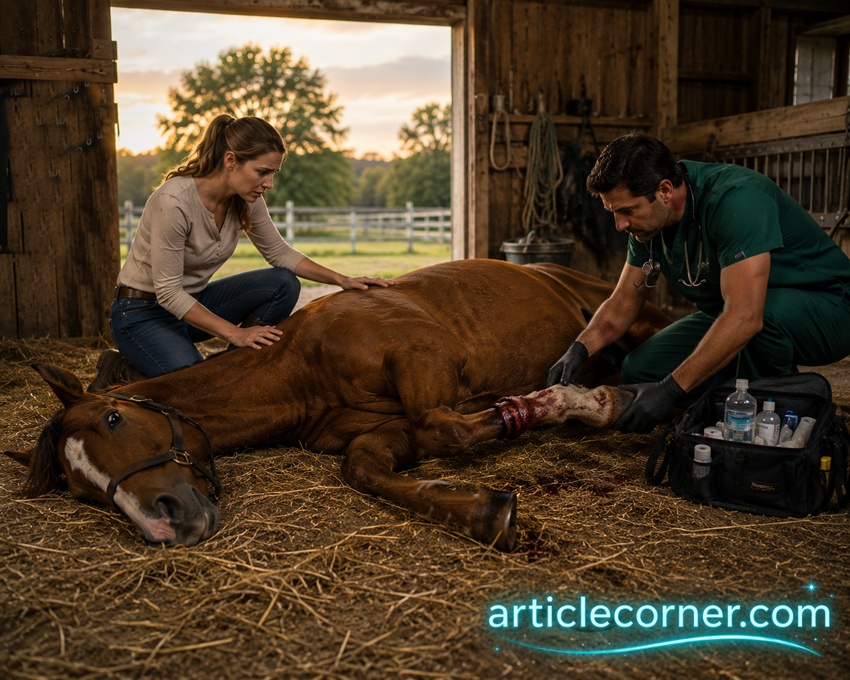
Imagine a horse breaking its leg.
Only a few hours earlier, it was running, playing, eating, and perhaps greeting its owner at the stable. Then an accident happens. Suddenly, everything changes.
And then comes a sentence that is difficult to hear:
“There is nothing we can do. The horse needs to be euthanized.”
You cannot help but stop and wonder:
Is there really no other solution?
When a human breaks a leg, we usually think about surgery. Plates, screws, rehabilitation, and sometimes prosthetic limbs can help a person return to a meaningful life.
So why is the situation so different for horses?
A Horse's Life Depends on Four Legs
Horses have a very different anatomy from humans.
A horse can weigh several hundred kilograms, and its legs are essential not only for movement but also for simply standing.
When one leg is seriously injured, the horse naturally tries to place more weight on the other three. Unfortunately, this can create enormous stress on the healthy legs.
That is where another serious problem can begin.
Excessive weight-bearing on the remaining legs can lead to complications such as **laminitis**, a painful and potentially devastating condition affecting the hoof.
And not every fracture is the same.
A bone may be shattered into several pieces. A joint may be severely damaged. Blood vessels or nerves may be affected. In some cases, restoring the leg's ability to carry the horse's weight may simply not be possible.
That is why veterinarians can sometimes face an incredibly difficult decision.
Do we keep fighting to save the horse, or are we only prolonging its suffering?
But This Makes Me Ask Another Question
Why can't a prosthetic leg be a solution more often?
I think this is a question worth asking.
Human prosthetic technology has developed enormously. We have advanced mechanical systems, lightweight materials, carbon-fiber components, and increasingly sophisticated prosthetic limbs.
And prosthetics for animals already exist.
So the idea itself is not science fiction.
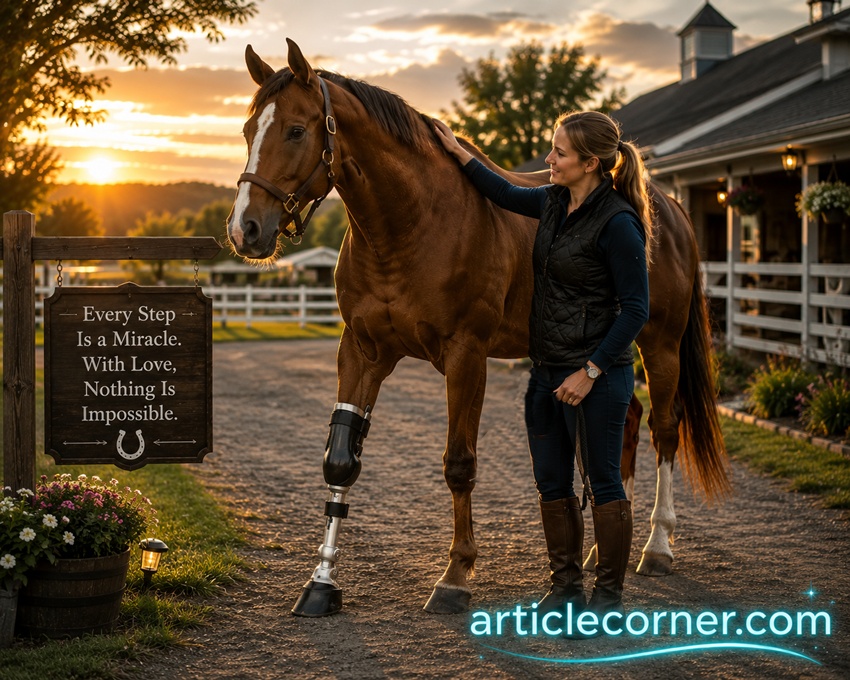
Some horses have received prosthetic or specialized orthopedic devices, particularly when a portion of a limb has been lost and the remaining anatomy can support a prosthesis.
But this is where things become extremely complicated.
A horse's prosthesis cannot simply replace a foot.
It has to support hundreds of kilograms.
It has to withstand the forces created every time the horse takes a step.
It must maintain balance.
It must avoid damaging the skin and surrounding tissue.
It must not place excessive stress on the other legs.
And, most importantly, the horse has to be able to use it comfortably in everyday life.
So the problem is not simply:
“Why don't we put a prosthetic leg on the horse?”
The real question is:
“Can we design a prosthesis that allows this particular horse to live comfortably and safely?”
Perhaps the Future Will Be Different
What seems impossible to a veterinarian today may become a standard treatment tomorrow.
Imagine a future in which a prosthetic limb for a horse is designed specifically for its body.
Sensors could continuously measure weight distribution.
Artificial intelligence could analyze the horse's walking pattern.
Smart materials could absorb impact.
A mechanical joint could adjust itself according to the horse's movement.
The system could even warn veterinarians when too much pressure is being placed on another leg.
It may sound like science fiction.
But many technologies we take for granted today once sounded impossible.
Human prosthetic technology itself has gone through an extraordinary journey.
So why shouldn't veterinary medicine continue on the same path?
Can Every Horse Be Saved?
No.
And it would be wrong to pretend otherwise.
Some fractures are simply too severe. If the horse is suffering constantly and there is no realistic possibility of restoring an acceptable quality of life, euthanasia may be the kindest option.
The important point is that we should not automatically think:
“The horse broke its leg, so it must be put down.”
Every case is different.
The location and severity of the fracture, damage to blood vessels and nerves, infection risk, the horse's overall health, available treatment options, and above all, its quality of life must all be considered.
Maybe This Is the Real Question
If technology can potentially save a life, how much effort should we put into developing that technology?
Think about what happens when a human breaks a leg.
The doctor does not simply say:
“You cannot walk anymore. Your life is over.”
We look for solutions.
We operate.
We rehabilitate.
We use orthopedic devices.
And when necessary, we use prosthetics.
Because we believe that life can continue in a different way.
Perhaps we should ask the same question for horses.
“Is there another way?”
Maybe the answer will still be no in some cases.
But when there is a possibility, perhaps we should invest more in research, better prosthetic technology, veterinary medicine, engineering, and artificial intelligence.
Because sometimes saving a life does not begin with a miracle.
It begins with someone saying, “There must be another way.”
And perhaps one day, when a horse breaks its leg, the first words we hear will not be:
“There is nothing we can do.”
They will be:
“We have another option. Let's try a prosthesis.”
If that day comes, we will have developed more than technology.
We will have expanded our idea of what it means to give a life another chance.
ArticleCorner: Every Life Deserves Another Chance.
Writer: articlecorner.com