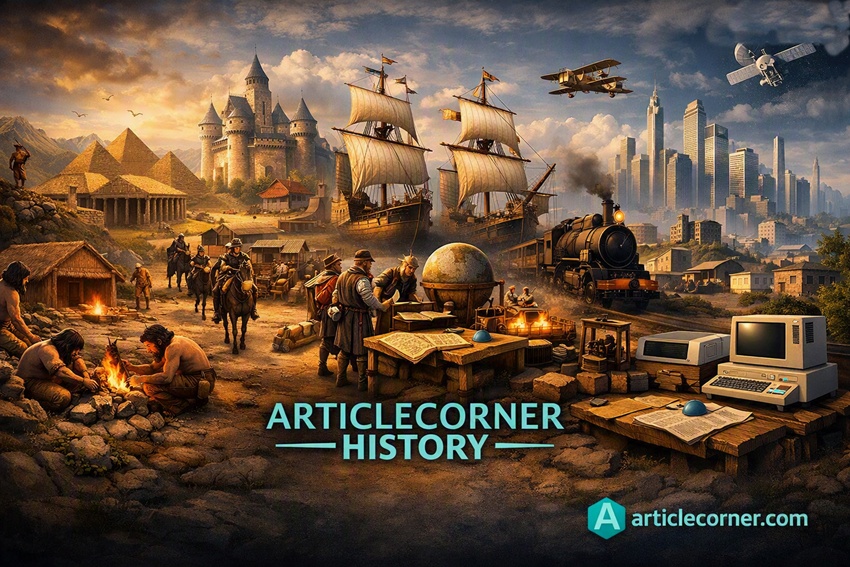
ArticleCorner History: The Great Turning Points of Human History
History is often divided into periods: Ancient, Medieval, Early Modern, and Modern. These divisions help us understand the enormous story of humanity, but history itself never followed such clean boundaries. While one society was entering a new age, another might still be living according to traditions that had existed for centuries.
The dates we use are therefore not walls separating one age from another. They are landmarks — moments that help us recognize important changes in the way people lived, organized societies, exchanged ideas, built economies, and understood their world.
The story begins long before kings, empires, written laws, or great cities. For most of human existence, people lived in small communities, moved across landscapes, hunted animals, gathered plants, and adapted to changing environments.
Then something extraordinary began to change.
In several parts of the world, humans gradually adopted agriculture and permanent settlement. Villages appeared. Food could be stored. Populations grew. Specialized occupations developed. Villages became towns, and towns became cities.
Writing emerged to help increasingly complex societies keep records. States and armies developed. Laws were written down. Trade connected distant communities. Metalworking transformed tools and weapons. Money gradually changed the way people exchanged goods and measured value.
Then came empires, religions, migrations, discoveries, revolutions, machines, electricity, computers, the Internet, and artificial intelligence.
Every age inherited something from the one before it. And every major transformation created opportunities as well as problems that earlier generations could scarcely have imagined.
This is the long journey from the first permanent settlements to the digital and artificial intelligence age.
🟠 Ancient History — c. 1 Million BCE – 476 CE
Ancient history begins long before written records.
Humans first learned to control fire to survive and expand their territories, followed much later by the adoption of agriculture and permanent settlements that enabled the establishment of complex societies, and eventually, writing emerged alongside states, trade, and metalworking to manage these growing civilizations.
These changes were neither sudden nor universal. Different communities adopted new ways of living at different times, while many continued hunting and gathering for thousands of years. Yet these developments gradually transformed the relationship between humans, food, land, technology, and society.
Populations grew, occupations became more specialized, and social organization became more complex. Eventually, cities appeared, writing systems developed, states were organized, and some of the world's earliest civilizations emerged along major rivers and fertile regions.
c. 1 Million BCE or Earlier — The Mastery of Fire:
Fire provided warmth, light, protection, and cooked food, making life easier and expanding the environments humans could inhabit.
The mastery of fire was one of humanity's earliest major technological achievements and a foundation for later civilization.
c. 10,000 BCE — The Agricultural Revolution:
The development of agriculture was one of the greatest turning points in human history.
In regions such as the Fertile Crescent, communities began cultivating plants and domesticating animals. Similar developments occurred independently in other parts of the world.
Agriculture allowed people to remain in one place for longer periods. Permanent settlements grew, food surpluses became possible, and populations increased.
But settled life also introduced new challenges. Land became more valuable. Property became more important. Social differences became more visible, and competition over resources could become more intense.
Humanity had not simply discovered a new way to obtain food. It had begun creating a fundamentally different kind of society.
c. 3500 BCE — The Development of Writing:
In southern Mesopotamia, the Sumerians developed one of the world's earliest known writing systems: cuneiform.
Writing transformed civilization because information no longer depended entirely on memory and oral transmission.
Kings could record laws. Merchants could document transactions. Administrators could keep tax records. Religious traditions could be preserved. Historical events could be recorded.
Yet writing was not invented primarily for storytelling. Some of its earliest uses were remarkably practical: recording administration, managing trade and taxation, documenting ownership, and organizing increasingly complex societies.
Writing gave human societies something they had never possessed before: the ability to preserve information beyond the lifetime of the person who remembered it.
c. 7th Century BCE — The First Coins:
Trade existed long before money. People exchanged goods directly, used commodities as stores of value, and developed different ways of measuring what things were worth.
Around the 7th century BCE, the Lydians of western Anatolia became associated with some of the earliest standardized metal coins.
Coins provided something extremely useful: a portable and recognizable unit of value. They made many transactions easier and eventually became important for taxation, government payments, military organization, and long-distance commerce.
Money did not create trade. People had traded for thousands of years before coins appeared.
Money changed the system of exchange.
It made value easier to measure, wealth easier to store, and transactions easier to organize. Over time, this would help transform local exchange into increasingly sophisticated economies.
c. 2560 BCE — The Great Pyramid of Giza:
The Great Pyramid of Giza was constructed during the reign of Pharaoh Khufu, probably around the middle of the 26th century BCE.
For thousands of years, it remained the tallest human-made structure in the world.
Its construction demonstrated the organizational abilities of ancient Egypt. Moving enormous quantities of stone, feeding and organizing a large workforce, and coordinating construction required sophisticated planning, administration, engineering, and resource management.
The pyramid therefore represents more than a monumental tomb. It is evidence of a civilization capable of combining agriculture, administration, mathematics, engineering, labor organization, and political authority on an extraordinary scale.
c. 1750 BCE — The Code of Hammurabi:
King Hammurabi of Babylon created one of the most famous surviving collections of written laws in the ancient world.
The Code of Hammurabi dealt with property, trade, family relationships, wages, injuries, debts, and crimes.
It was not the first set of laws ever created, but it is one of the best-preserved and most famous examples of ancient written law.
Its importance lies partly in the idea that rules could be publicly recorded rather than existing only through custom or royal judgment.
At the same time, the laws reflected the unequal social structure of Babylonian society. Punishments could differ according to a person's social status.
The code therefore reveals both an important development in organized government and the inequalities built into ancient societies.
c. 1274 BCE — The Battle of Kadesh:
The Battle of Kadesh was fought between the Egyptian forces of Pharaoh Ramesses II and the Hittite Empire under King Muwatalli II.
The battle is one of the best-documented military confrontations of the ancient world. Neither side achieved a decisive victory, and the conflict eventually gave way to diplomacy.
The Egyptians and Hittites later concluded a peace agreement that is often described as the earliest known surviving international peace treaty.
Kadesh demonstrates that ancient states did not rely only on warfare. Powerful kingdoms also negotiated, exchanged messages, established agreements, and recognized situations in which diplomacy could achieve more than continued conflict.
753 BCE — The Traditional Foundation of Rome:
According to Roman tradition, Rome was founded in 753 BCE by Romulus.
The historical development of Rome was more complicated than the legend suggests. The settlement grew gradually from communities in central Italy and was influenced by neighboring peoples, particularly the Etruscans.
Over the following centuries, Rome transformed from a small city-state into a republic and eventually into one of the most powerful empires of the ancient world.
Roman political institutions, legal traditions, military organization, engineering, architecture, and language would influence Europe and the Mediterranean for centuries.
334 BCE — Alexander the Great Begins His Eastern Campaign:
In 334 BCE, Alexander III of Macedon crossed into Asia and began the campaign that would eventually carry his armies as far as northwestern India.
His conquests destroyed the Persian Empire and created a vast political world connecting Greece, Egypt, Persia, and parts of Central and South Asia.
Alexander's empire did not survive intact after his death, but his campaigns helped create the Hellenistic world.
Greek language, art, philosophy, science, and political traditions interacted with older cultures across the eastern Mediterranean and Asia.
The result was not simply the spread of Greek culture. It was a complex cultural exchange in which different civilizations influenced one another.
1st Century CE — The Rise of Christianity:
Jesus of Nazareth was executed by crucifixion under Roman authority, probably during the early decades of the 1st century CE. The exact year remains uncertain.
His followers came to believe that he had risen from the dead, and a new religious movement gradually developed around his teachings and the belief in his resurrection.
Christianity initially emerged within the Jewish world of Roman Judea. It later spread throughout the Roman Empire and beyond.
For several centuries, Christians lived as a minority community, sometimes facing persecution. Eventually, Christianity gained imperial support under Constantine in the 4th century and became deeply connected with the political and cultural structure of the Roman world.
Religion was becoming not only a matter of personal belief, but also an increasingly important force in politics, culture, law, and society.
c. 4th–5th Centuries CE — The Migration Period:
Beginning particularly in the 4th and 5th centuries, large-scale movements of peoples transformed Europe.
The arrival of the Huns and the movements of Germanic and other groups placed enormous pressure on the Roman frontier.
The traditional expression "Barbarian Invasions" can be misleading because these movements included migration, warfare, settlement, alliances, and political integration.
Many groups eventually established kingdoms inside former Roman territories.
The Roman world was changing from within as well as being challenged from outside.
476 CE — The Fall of the Western Roman Empire:
In 476 CE, the Germanic military leader Odoacer deposed the young Western Roman emperor Romulus Augustulus.
This event is traditionally used as the end of Ancient History and the beginning of the Middle Ages in European historical periodization.
But the Roman world did not suddenly disappear.
The Eastern Roman Empire, later known as the Byzantine Empire, continued for almost another thousand years. Roman law, Christianity, language, administration, and culture also continued to influence the societies that emerged after the Western Empire.
The year 476 is therefore better understood as a symbolic landmark than as the exact moment when antiquity ended.
🟢 Medieval History — 476–1453
The medieval world was far more diverse than the image of castles and knights often suggests.
While western Europe developed feudal relationships and powerful Christian institutions, the Byzantine Empire continued Roman traditions in the east. Islamic civilization expanded across the Middle East, North Africa, and parts of Europe and Asia. Major centers of scholarship, commerce, mathematics, medicine, philosophy, and literature flourished across the Islamic world.
China experienced powerful dynasties and major technological developments. Trade routes connected Europe, Africa, and Asia. The Silk Road remained an important network of exchange, carrying not only goods but also religions, ideas, technologies, languages, and diseases.
The medieval world was not a collection of isolated civilizations. People, goods, knowledge, and beliefs moved across enormous distances.
The Middle Ages were therefore not a period when the world simply stood still. They were centuries of movement, transformation, conflict, innovation, and cultural exchange.
622 — The Hijra:
In 622 CE, Muhammad and his followers migrated from Mecca to Medina.
This migration, known as the Hijra, became the starting point of the Islamic calendar.
In Medina, the emerging Muslim community developed into an organized political and religious society.
Within decades, Islam spread across large parts of Arabia and subsequently into the Middle East, North Africa, and beyond.
The rise of Islamic civilization became one of the defining developments of the medieval world, contributing to major advances and exchanges in science, mathematics, medicine, philosophy, literature, and commerce.
732 — The Battle of Tours:
In 732, Frankish forces under Charles Martel fought an Umayyad army near Tours in present-day France.
The Frankish victory became an important event in European historical memory.
However, the battle should not be presented simply as the moment when Muslim expansion into Europe was permanently stopped. Muslim political and cultural influence remained significant in Iberia for centuries, while the Mediterranean continued to be a region of interaction between Christian and Muslim societies.
The significance of Tours lies not only in the battle itself, but also in the political changes taking place across western Europe.
800 — Charlemagne Crowned Emperor:
On Christmas Day in 800, Charlemagne was crowned emperor by Pope Leo III in Rome.
The event symbolized the revival of an imperial tradition in western Europe and strengthened the political relationship between the Frankish monarchy and the Latin Church.
Charlemagne's realm became one of the most powerful political entities in western Europe.
The later Holy Roman Empire would claim a connection to this imperial tradition, although the Holy Roman Empire itself is generally dated from a later period, traditionally beginning in 962 with the imperial coronation of Otto I.
1054 — The Great Schism:
In 1054, tensions between the western Latin Church and the eastern Greek-speaking Church culminated in a formal rupture traditionally known as the Great Schism.
The Christian world became increasingly divided between the Roman Catholic Church in the West and the Eastern Orthodox Church in the East.
The separation had political, cultural, linguistic, and theological dimensions.
It was not the result of a single disagreement, but the culmination of centuries of growing differences.
1071 — The Battle of Manzikert:
The Seljuk Turks defeated the Byzantine army under Emperor Romanos IV Diogenes at the Battle of Manzikert.
The battle became a major turning point in the history of Anatolia.
The Byzantine Empire did not immediately lose all of Anatolia, but the defeat weakened imperial control and contributed to the gradual settlement and expansion of Turkic powers across the region.
Over the following centuries, Anatolia underwent profound political, demographic, linguistic, and religious changes.
1096–1099 — The First Crusade:
The First Crusade began in 1096 following a call for military support to the Byzantine Empire and a broader religious campaign to recover Jerusalem.
Crusader armies captured Jerusalem in 1099.
The Crusades created centuries of conflict between Christian and Muslim powers, but they also produced trade, diplomatic contacts, cultural exchanges, and political changes across the Mediterranean.
The medieval Mediterranean was not simply divided into two isolated worlds. It was a region where people constantly encountered one another through war, commerce, travel, pilgrimage, and diplomacy.
1215 — Magna Carta:
In 1215, King John of England accepted the Magna Carta after conflict with rebellious barons.
The document was created in a very different political world from modern democracy, and it did not establish universal political rights.
Nevertheless, it became historically important because it expressed the principle that the king was not completely above the law.
Over centuries, later generations interpreted and expanded this principle.
Magna Carta therefore became an important symbol in the development of constitutional government and the idea that political authority could be limited by law.
1258 — The Mongol Destruction of Baghdad:
In 1258, Mongol forces led by Hulagu captured Baghdad, the capital of the Abbasid Caliphate.
The city suffered catastrophic destruction, and the Abbasid political order was effectively ended.
Baghdad had previously been one of the great intellectual and commercial centers of the medieval world.
Its destruction became a powerful symbol of the violence of the Mongol conquests, although the Mongol Empire also contributed to increased connections across Eurasia in the decades that followed.
The Mongol period demonstrates the complexity of historical change: the same political expansion could bring enormous destruction in one place while increasing communication and exchange across a much larger region.
1347–1351 — The Black Death:
The Black Death was one of the greatest demographic disasters in human history.
The plague spread through Europe, the Middle East, and parts of North Africa, killing enormous numbers of people.
In Europe, perhaps around one-third or more of the population died, although estimates vary considerably by region.
The consequences were profound.
Labor became scarce. Wages and social relationships changed. Land values shifted. Religious beliefs were challenged. Communities were traumatized.
The plague did not single-handedly destroy feudalism, but it accelerated social and economic changes that were already underway.
A disease had changed not only population numbers, but also the balance between workers, landowners, institutions, and economic power.
1453 — The Fall of Constantinople:
In 1453, Ottoman Sultan Mehmed II captured Constantinople after a siege.
The Byzantine Empire came to an end.
Constantinople became the capital of the Ottoman Empire and remained one of the world's most important cities.
The conquest is traditionally used as the closing point of the Middle Ages and the beginning of the Early Modern period.
Once again, however, the date is a historical landmark rather than an invisible wall. Many medieval institutions, traditions, and patterns of trade continued long after 1453.
🔵 Early Modern History — 1453–1789
The centuries after 1453 witnessed extraordinary transformations.
European ships began crossing oceans on an unprecedented scale. Printing accelerated the circulation of ideas. Renaissance art and scholarship changed intellectual life. Religious reform fractured western Christianity. Scientific investigation challenged traditional explanations of nature.
At the same time, European overseas expansion created vast colonial empires and devastating systems of conquest, exploitation, and forced labor.
The Early Modern period was therefore both an age of discovery and an age of domination.
The world was becoming more interconnected — but that connection was often violent and unequal.
c. 1450s — Gutenberg and the Printing Revolution:
Johannes Gutenberg's development of movable-type printing in Europe transformed the production of written material.
Printing made books faster and cheaper to reproduce.
Ideas could travel farther and survive in larger numbers.
Religious arguments, scientific observations, political criticism, and literary works could reach audiences that earlier generations could scarcely have imagined.
The printing press did not single-handedly cause the Renaissance or Reformation, but it dramatically increased the speed at which ideas could circulate.
Information was beginning to acquire a new kind of power.
15th–17th Centuries — The Age of Exploration:
European sailors began crossing the Atlantic and other oceans in search of new trade routes, wealth, and territories. Voyages led by explorers such as Christopher Columbus, Vasco da Gama, and Ferdinand Magellan connected previously distant parts of the world more closely than ever before.
These voyages transformed global trade and created new connections between continents. But they also brought conquest, colonization, slavery, and devastating diseases to Indigenous populations.
The Age of Exploration did not simply make the world larger.
It made the world more connected — and changed the balance of global power forever.
1517 — The Reformation Begins:
In 1517, Martin Luther's criticism of certain practices of the Catholic Church became one of the catalysts for the Protestant Reformation.
Religious disputes soon developed into broader political and social conflicts.
Protestant churches emerged across parts of Europe, while the Catholic Church responded through the Catholic Reformation.
Europe's religious unity was permanently broken, and religious identity became deeply connected with political power and state authority.
1526 — The Mughal Empire Begins:
In 1526, Babur defeated Ibrahim Lodi at the First Battle of Panipat and established the foundations of the Mughal Empire in India.
The Mughal state would become one of the great imperial powers of South Asian history.
Under rulers such as Akbar, Jahangir, Shah Jahan, and Aurangzeb, the empire developed a sophisticated political, administrative, artistic, and architectural culture.
The Mughal world also demonstrated how cultures, languages, religions, and political traditions could interact and merge within a large empire.
1642–1651 — The English Civil Wars:
The English Civil Wars were fought amid deep disputes over monarchy, Parliament, religion, taxation, and political authority.
King Charles I was defeated and executed in 1649.
England briefly became a republic under the Commonwealth and later the Protectorate.
Although the political system did not immediately become modern democracy, the conflict strengthened the historical argument that monarchs could be challenged and that political power required limits.
1648 — The Peace of Westphalia:
The Peace of Westphalia ended major phases of the Thirty Years' War in Europe.
The treaties are often associated with the development of the modern state system and the principle of territorial sovereignty.
Historians debate how directly Westphalia created the modern nation-state system, but the settlements were important in the development of European diplomacy.
States were increasingly treated as political entities whose territories and governments mattered independently of universal religious authority.
1687 — Newton and the Scientific Revolution:
In 1687, Isaac Newton published Philosophiæ Naturalis Principia Mathematica.
His work provided a mathematical framework for understanding motion and universal gravitation.
Newton did not create modern science alone. His achievements built upon the work of earlier scientists such as Copernicus, Galileo, Kepler, and many others.
But Newton's synthesis represented a remarkable moment in the Scientific Revolution.
Nature increasingly appeared to humanity as something that could be measured, tested, calculated, and described through universal principles.
A new confidence was emerging: perhaps the natural world could be understood not only through tradition and authority, but through observation, mathematics, and experiment.
1776 — The American Declaration of Independence:
On July 4, 1776, the thirteen American colonies declared their independence from Great Britain.
The American Revolution eventually produced the United States.
The Declaration expressed ideas about natural rights, government, and political legitimacy that would have enormous influence.
Yet the new republic was also deeply contradictory. Slavery continued, women lacked political equality, and Indigenous peoples faced displacement and violence.
The revolutionary language of liberty would later be used by generations demanding that those principles be applied more broadly.
1789 — The French Revolution:
In 1789, the French Revolution began.
The old political and social order was challenged by ideas of citizenship, equality, popular sovereignty, and republican government.
The revolution eventually destroyed the French monarchy, produced radical political movements, and led to years of war and upheaval.
Its influence extended far beyond France.
The French Revolution is traditionally used as the boundary between the Early Modern period and the Modern Age.
A different political and social world was beginning to emerge.
🟣 Modern History — 1789–Present
The modern era has been defined by extraordinary acceleration.
Machines transformed production. Railways and steamships compressed distances. Electricity changed cities. Mass education and newspapers expanded access to information. Nationalism reshaped political identity.
Then came automobiles, airplanes, radio, television, nuclear weapons, computers, the Internet, smartphones, and artificial intelligence.
But technological progress also created new forms of destruction.
Industrial societies developed weapons capable of killing millions. Two world wars transformed the global balance of power. Colonial empires collapsed. New nations emerged.
The modern age is therefore a story of both extraordinary human achievement and unprecedented human destructive capacity.
c. 1760–1840 — The First Industrial Revolution:
Although the Industrial Revolution began before the French Revolution, its effects extended deep into the modern era.
Britain became the center of early industrialization, with mechanized textile production, steam power, coal, iron, and factory organization transforming the economy.
Production increasingly moved from small workshops and homes into factories.
Cities expanded rapidly as people moved in search of industrial employment.
The agricultural society that had dominated Europe for centuries was gradually being transformed into an industrial society.
Human beings were beginning to produce goods at a scale and speed that previous generations could barely imagine.
Industrialization also changed the meaning of work itself. Time became increasingly measured by the factory clock, while workers, employers, machines, and markets became part of a new economic system.
1914–1918 — The First World War:
The First World War began in 1914 and developed into a global conflict.
Millions of soldiers and civilians died.
The war destroyed or weakened major empires, including the Ottoman, Russian, Austro-Hungarian, and German empires.
New states emerged. Borders were redrawn. Political ideologies gained strength.
Modern industrial technology had turned warfare into something far more destructive.
Machine guns, artillery, submarines, aircraft, chemical weapons, railways, and mass mobilization transformed the battlefield.
The old European order would never fully return.
1917 — The Russian Revolution:
In 1917, revolution transformed Russia.
The Bolsheviks eventually seized power under Vladimir Lenin and established a communist government.
The Russian Revolution became one of the defining political events of the 20th century.
In 1922, the Union of Soviet Socialist Republics was formally established.
The Soviet Union would later become one of the world's two superpowers and a central rival of the United States.
The revolution demonstrated how economic inequality, war, political instability, and ideology could combine to transform an entire state.
1923 — The Republic of Türkiye:
Following the collapse of the Ottoman Empire and the Turkish War of Independence, the Republic of Türkiye was proclaimed on October 29, 1923.
Mustafa Kemal Atatürk became the republic's founding leader.
The new state pursued major political, legal, educational, cultural, and social reforms intended to build a modern, sovereign republic.
The transformation of Türkiye became one of the major political changes in the aftermath of the First World War.
1939–1945 — The Second World War:
The Second World War became the most destructive conflict in human history.
The war involved dozens of countries and affected virtually every major region of the world.
The Holocaust resulted in the systematic murder of approximately six million Jews by Nazi Germany and its collaborators, alongside the persecution and mass murder of many other groups.
In August 1945, the United States used atomic bombs against Hiroshima and Nagasaki.
The war ended soon afterward.
But humanity had entered a frightening new era.
For the first time, humans possessed weapons capable of destroying entire cities with a single bomb.
The nuclear age had begun.
1947–1991 — The Cold War:
After the Second World War, the United States and Soviet Union emerged as rival superpowers.
Their competition was ideological, political, military, technological, and economic.
The Cold War rarely became a direct full-scale war between the two superpowers, partly because both possessed nuclear weapons.
Instead, rivalry played out through alliances, espionage, propaganda, arms races, economic competition, space exploration, and conflicts in other countries.
The world became increasingly divided into competing political blocs.
Yet the Cold War also produced extraordinary technological achievements, particularly in science, computing, aerospace, communications, and nuclear technology.
1969 — Humans Reach the Moon:
On July 20, 1969, NASA's Apollo 11 mission achieved one of humanity's most extraordinary technological accomplishments.
Neil Armstrong became the first human to walk on the Moon, followed shortly afterward by Buzz Aldrin.
The Moon landing was not simply a scientific achievement.
It demonstrated what large-scale cooperation among scientists, engineers, governments, and thousands of workers could accomplish.
Humanity had crossed a boundary that had existed for almost its entire history.
The same technological age that had produced nuclear weapons had also carried human beings to another world.
1989 — The Berlin Wall Falls:
On November 9, 1989, the Berlin Wall opened.
The wall had become one of the most powerful symbols of the division between communist Eastern Europe and the Western bloc.
Its fall accelerated the collapse of communist governments across Eastern Europe.
Two years later, in 1991, the Soviet Union itself dissolved.
The Cold War order had come to an end, and a new international era was beginning.
1991 — The World Wide Web Enters Public Use:
The Internet had existed before the World Wide Web, but the Web created a much easier way for people to access and connect information online.
Tim Berners-Lee developed the World Wide Web at CERN, and the system entered wider public use in the early 1990s.
The distinction matters: the Internet is the underlying global network, while the Web is a system of interlinked information and services that operates on that network.
The Web gradually transformed communication, publishing, commerce, education, entertainment, and access to information.
For the first time, ordinary people could potentially publish information to a worldwide audience without owning a printing press, newspaper, television station, or broadcasting network.
The world was entering the Information Age.
21st Century — The Digital and Artificial Intelligence Revolution:
The 21st century has brought another transformation.
Smartphones placed powerful computers into billions of people's hands. Social networks changed communication. Cloud computing made enormous amounts of information accessible from almost anywhere. Automation began changing factories, offices, transportation, and services.
Then artificial intelligence began moving from specialized applications into everyday life.
Machine learning systems became capable of recognizing images, understanding speech, generating text, creating images, analyzing enormous datasets, and assisting with increasingly complex tasks.
Generative AI and large language models introduced a new kind of technological relationship.
For much of human history, tools primarily extended human physical abilities.
Machines made it possible to lift more, travel faster, build larger structures, and produce more goods.
Artificial intelligence is different in one important respect: it increasingly interacts with tasks associated with language, reasoning, creativity, analysis, and knowledge.
The consequences are still unfolding. AI may transform education, science, medicine, business, entertainment, communication, and the nature of work itself. No one can yet know exactly where this transformation will lead.
The Story Is Still Being Written:
From the first farmers to the first cities, from ancient scribes to printing presses, from sailing ships to steam engines, from factories to computers, humanity has repeatedly changed the way it lives.
Each transformation created opportunities — but also new dangers.
Agriculture fed larger populations but created inequality and competition over land.
Writing preserved knowledge but also made taxation, bureaucracy, and centralized authority more powerful.
Money did not invent trade, but it transformed the scale and organization of economic life.
Empires connected distant societies but were often built through conquest.
Scientific progress improved human understanding but eventually produced weapons capable of threatening civilization itself.
Industrialization created enormous wealth but also transformed labor, cities, inequality, and the environment.
The Internet connected billions of people but also created new forms of misinformation, surveillance, dependency, and social conflict.
Artificial intelligence may become one of the most important technological transformations yet.
But perhaps the most interesting part of history is not simply that technology changes. Human beings change with it.
The tools we create influence how we work, communicate, trade, travel, learn, govern, and even imagine the future.
The ancient world could not imagine the modern world.
The medieval world could not imagine the Internet.
And people living today may be unable to imagine what the next transformation will look like.
That is why history is more than a collection of dates.
History is the story of how humanity became what it is — and the unfinished story of what it may become.
ArticleCorner History: Looking Back to Understand the World Ahead.
Writer: articlecorner.com