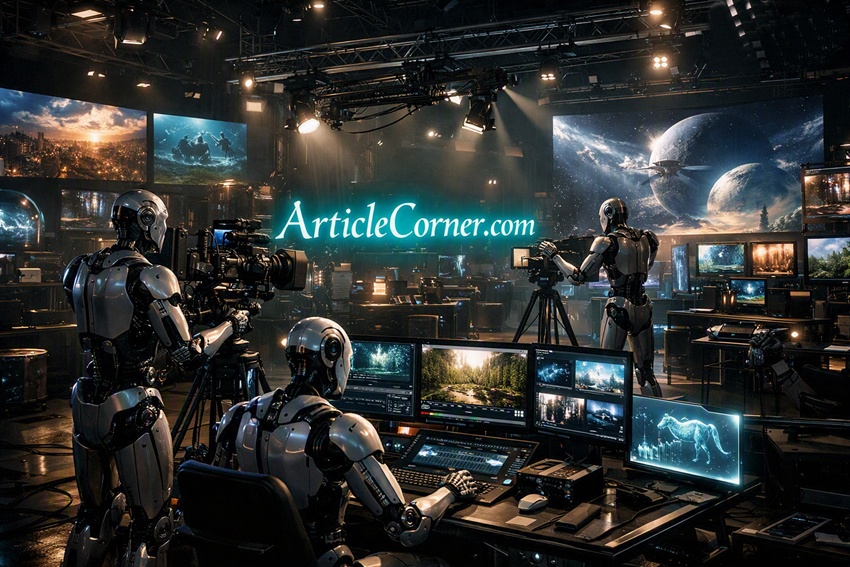
How Does Artificial Intelligence Create These Videos?
**Amazing!**
You type a few sentences into an artificial intelligence system, and suddenly you are watching a river flowing through a forest, birds flying across the sky, people walking through a city, waves crashing against the shore, or a camera slowly moving through a landscape that has never actually existed.
The strange part is not simply that AI can create a picture.
It can create **movement**.
It can make the water flow, the trees move in the wind, clouds travel across the sky, people walk, animals run, and cameras move through a scene as if someone had actually filmed it.
I became curious about this.
**How does artificial intelligence know how all of this should look?**
I researched the subject and wanted to share what I discovered with you.
AI Does Not Film the World
The first thing that surprised me is that an AI video model does not create a video in the same way a human filmmaker does.
There is no camera.
There is no forest that the AI visits.
There is no actor standing in front of a lens.
There is no real river flowing somewhere while the system records it.
Instead, modern generative video models learn from enormous amounts of visual and audiovisual data. They learn relationships between objects, environments, movement, lighting, perspective and time. Some current systems can accept natural-language descriptions and images as inputs and produce high-resolution video, while newer systems can also generate synchronized audio.
This means that when you write something like:
“A quiet river flows through a dense forest at sunset while birds fly above the trees and two people walk along the riverbank.”
the model does not simply search for a video containing those exact words.
It interprets the relationships inside your description and attempts to construct a new visual scene that matches them.
The river has to look like water.
The forest has to look like a forest.
The people need to remain people as they move.
The birds need to move through the sky.
The sunset needs to affect the lighting of the entire scene.
And all of these things need to exist together.
That is where the real difficulty begins.
A Picture Is One Thing-A Video Is Another
Creating a single image is already an impressive task.
Creating a convincing video is much harder.
A still image only has to look correct at one moment.
A video has to remain believable **over time**.
Imagine a person walking through a forest.
In one frame, the person is standing beside a tree.
A moment later, the person takes a step.
The next moment, the person is farther down the path.
The trees remain in the same environment. The clothing remains consistent. The lighting continues to make sense. The camera may move slightly. Shadows change. Leaves move in the wind.
The AI has to generate all of these changes while maintaining enough consistency for our eyes to perceive one continuous event rather than a collection of unrelated pictures.
This is one reason modern video generation is so fascinating.
The AI is not only creating what the world looks like. It is trying to predict how that world changes from one moment to the next.
Research into video models increasingly treats video as something with both spatial and temporal structure. Some world-model research, for example, represents video in compressed latent spaces and predicts subsequent states over time rather than simply generating unrelated frames.
But How Does It Actually Create the Image?
Here comes the part that sounds almost like science fiction.
Many modern generative systems use approaches based on diffusion.
A simplified way to imagine this is to start with something resembling visual noise and then gradually transform it into something meaningful.
At first there is no beautiful forest.
There is no perfect river.
There is no carefully composed scene.
The model repeatedly refines the representation until it moves toward the visual result requested by the prompt.
You can think of it as:
Noise → shapes → objects → details → lighting → coherent scene
The actual mathematics and architectures are much more complicated than this, but the basic idea gives us a useful mental picture: generation happens through repeated refinement rather than simply pulling a finished movie out of a digital drawer. Diffusion-based approaches are widely used in generative media, and research systems have also applied diffusion processes to synchronized audio generation for video.
So Does AI Understand Nature?
This is where the subject becomes even more interesting.
When AI generates a forest, it has never actually stood inside a forest.
It does not smell the trees.
It does not feel the wind.
It does not hear the leaves moving.
Yet it can produce an image of a forest that looks convincing to us.
Why?
Because it has learned visual patterns from examples.
It has encountered countless representations of trees, rivers, mountains, clouds, animals, people, roads, buildings, sunlight, shadows and countless combinations of these things.
Over time, the model learns statistical relationships between them.
It learns that trees have trunks and branches. It learns that distant objects appear smaller. It learns that sunlight creates shadows. It learns that water reflects and distorts light. It learns that clouds have particular forms and that animals have characteristic body structures and movements.
It does not necessarily possess human-like knowledge of these things.
But it can learn enough about their **visual relationships** to reproduce convincing versions of them.
That distinction is extremely important.
The World Is Full of Movement
Nature is particularly difficult because almost everything is moving.
A river flows.
Leaves move.
Clouds travel.
Birds change direction.
Waves rise and collapse.
People walk.
Animals run.
Smoke drifts.
Light changes.
Even when a scene appears quiet, it is actually full of tiny movements.
A good video model therefore has to deal with much more than appearance.
It has to deal with **time**.
That is why the development of generative video is much more than simply making better photographs. Researchers are increasingly working toward models that can represent how environments, objects and actions evolve through time.
And Then There Is Sound
Something else has changed very quickly.
Video does not have to remain silent.
Modern generative systems are beginning to connect visual events with sound. Google DeepMind, for example, has demonstrated technology that can use video information and text prompts to generate soundtracks, sound effects and other audio that correspond to what is happening on screen.
Imagine watching an AI-generated mountain scene.
The wind moves through the trees.
You hear the wind.
A bird flies across the screen.
You hear the bird.
A stream passes over rocks.
You hear the water.
Suddenly, the artificial scene becomes much more convincing.
The image tells your eyes what is happening.
The sound tells your brain that it is happening.
Does AI Really Understand Reality?
This may be the most important question of all.
When we see an AI-generated video of a person walking through a forest, it can look as if the AI understands the forest.
But we should be careful with that conclusion.
AI does not experience the forest in the way a human being does.
It does not feel the temperature.
It does not smell the rain.
It does not become tired while walking.
It does not hear the birds and think about what their song means.
What it does is something different.
It learns patterns from enormous quantities of information and uses those patterns to generate new possibilities.
That may sound less mysterious, but in practice it is still extraordinary.
Because the result can be something that **never happened in the real world** and yet looks as if it did.
The Strange Future of Video
This may change the way we think about filmmaking.
In the past, if you wanted to show a river in a remote forest, you needed to find the forest, travel there, bring a camera, organize equipment and actually film the river.
Now the first step can be a sentence.
A writer can describe a world that does not exist.
A musician can create a visual world around a song.
A teacher can visualize a scientific process.
A filmmaker can experiment with scenes before ever picking up a camera.
And perhaps this is only the beginning.
The most fascinating development may not be that AI can create beautiful images.
It is that AI is increasingly learning to represent **movement, space, sound, objects and events over time**.
The boundary between imagination and visual reality is becoming thinner.
One Final Question
There is something almost poetic about all of this.
We used to need reality in order to create a picture.
Then we learned how to create pictures without having reality in front of us.
Now we are learning how to create moving worlds that never existed at all.
A river can flow through a place that has never existed.
A person can walk through a city that was never built.
A bird can fly through a landscape that no camera has ever seen.
A story can become a moving world simply because someone described it.
And that leaves us with a much bigger question:
If artificial intelligence becomes capable of creating increasingly convincing versions of reality, how will we decide what is real?
Perhaps the future of video will not simply be about watching.
Perhaps it will be about learning to **question what we see.**
That may be the real revolution.
ArticleCorner: Artificial intelligence no longer walks or runs. It flies... But where are we heading?
Writer: articlecorner.com