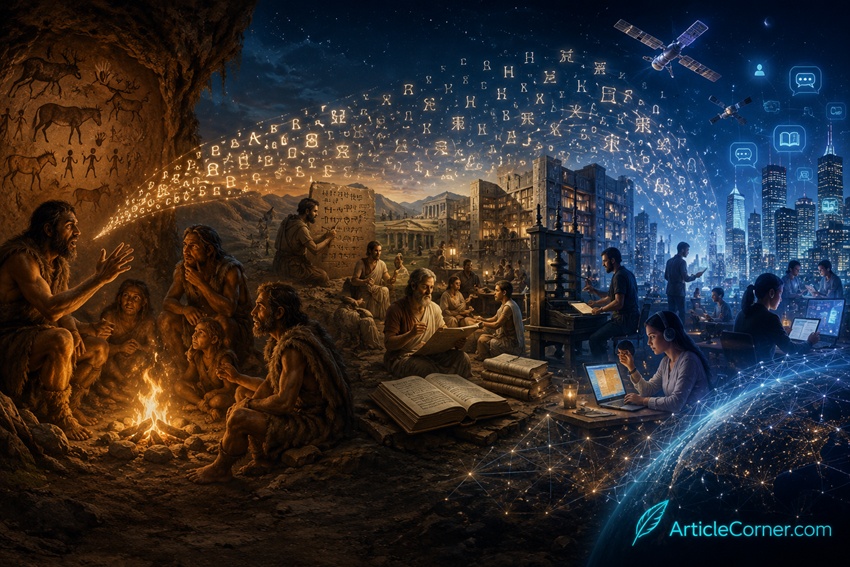
Is Language Really an Invention?
One evening I found myself asking a simple question.
If someone asked me what the greatest invention in human history is, what would I answer?
The wheel?
Fire?
Writing?
Electricity?
The Internet?
I thought about it for a long time.
Then an unexpected answer came to my mind.
Language.
But almost immediately another question followed.
Is language really an invention?
As far as I knew, nobody had invented it.
There was no inventor.
No exact date.
No patent.
So why don't we think of language as one of humanity's greatest inventions?
That question stayed with me.
One day I mentioned it to a friend.
He smiled.
"People didn't invent language," he said.
"Then where did it come from?" I asked.
"Maybe it simply appeared over time."
His answer sounded too simple.
Nothing that changes the course of history simply appears.
There had to be more to the story.
So I began to imagine the distant past.
Two hundred thousand years ago, people lived in a world without cities.
Without schools.
Without books.
Without alphabets.
But they still had fears.
They still had families.
They still loved.
They still lost people they cared about.
One day someone spotted a lion in the distance.
What would they have done?
Perhaps they shouted.
Perhaps they pointed.
Perhaps they made the same sound again and again whenever danger appeared.
Over time that sound may have become a shared warning.
Another sound could have meant water.
Another could have meant fire.
Another could have meant night.
Nobody sat down to write the first dictionary.
Nobody gathered everyone together and declared that a certain sound would forever represent a certain idea.
Yet after thousands of repetitions, sounds slowly became meanings.
I looked back at my friend.
"So language grew little by little?"
"Exactly."
"Then isn't that still an invention?"
He paused for a moment.
"Yes and no."
That answer fascinated me.
Someone built the first wheel.
Someone designed the first steam engine.
Someone developed the light bulb.
We know the names behind countless inventions.
But language belongs to no single person.
It was never created in one moment.
It was shaped by millions of people across thousands of generations.
A child spoke a new sound.
A parent repeated it.
A community accepted it.
Children taught it to their own children.
Without realizing it, every generation added another small piece.
Perhaps language is not the work of one inventor.
Perhaps it is the greatest collaboration in human history.
Then another thought crossed my mind.
Language was never just about speaking.
It allowed knowledge to survive.
Before language, experience disappeared with the individual.
Af
ter language, experience could be shared.
A hunter could teach his son how to track animals.
A mother could warn her daughter about poisonous plants.
An elder could explain how to navigate by the stars.
Knowledge no longer died with the person who discovered it.
It could travel from one mind to another.
Generation after generation.
Perhaps civilization truly began at that moment.
My friend asked another question.
"So you think language is even more important than writing?"
I nodded.
Without language, writing could never have existed.
Every law was first spoken.
Every story was first told.
Every song was first sung.
Every poem first lived in someone's voice before it lived on paper.
Writing did not create language.
Writing preserved it.
Today we rarely think about any of this.
We say hello.
We say thank you.
We say I'm sorry.
We say I love you.
These words feel ordinary.
Yet every sentence we speak is built upon hundreds of thousands of years of human cooperation.
We are using one of humanity's oldest shared creations without even noticing.
As our conversation came to an end, my friend asked me one final question.
"So have you decided?"
"Is language really an invention?"
I thought quietly for a moment.
Then I smiled.
"Not in the way we usually define an invention."
"But if an invention can be something humanity creates together over countless generations..."
"Then perhaps the answer is yes."
Because some inventions belong to one brilliant mind.
Language belongs to all of us.
Writer: articlecorner.com