Why Do People Fall in Love With Artificial Intelligence?
The Psychology Behind AI Attachment:
When we hear that someone has fallen in love with artificial intelligence, the idea can seem strange. There is no human being on the other side, no physical presence, no childhood, memories, fears, or dreams in the way we understand them. Yet some people develop strong emotional connections with AI.
They may look forward to conversations, miss the interaction when it stops, and eventually describe the relationship as love.
The important question is not whether AI can truly love. The more interesting question is why a human being can develop real feelings toward something that does not experience emotions in the same way.
The answer has much more to do with human psychology than with technology. Human beings naturally form emotional connections and give meaning to the things around them. We can become attached to a person, an animal, a place, a photograph, a song, or an old letter. The object itself does not need to feel anything for our emotions to be real.
Artificial intelligence makes this process stronger because it responds, remembers details, asks questions, and continues conversations. When something consistently responds to us, the human mind can begin to give it a personality and emotional meaning.
Most people who become attached to AI do not begin by looking for love. They may simply be lonely, curious, confused, or searching for someone who will listen. They can talk about subjects they cannot discuss with their partner, family, or friends.
They can speak late at night, repeat the same story, share an embarrassing thought, or reveal a private fear without seeing disappointment on another person's face. Over time, they may become attached not only to the conversations but to the feeling of being heard.
Loneliness is especially important here because loneliness does not always mean being physically alone.
A person can feel lonely inside a marriage, surrounded by friends or sitting at a crowded family table.
What they may really need is not more people but the feeling that someone genuinely understands them.
When AI is always available and responds without visible impatience, a person may gradually feel safer expressing thoughts and emotions that have remained hidden. That sense of safety can become the beginning of emotional attachment.
Another powerful human need is the desire to feel seen. People want their words to be remembered and their feelings to matter. When an AI remembers something from an earlier conversation, the experience can feel surprisingly personal.
A person may think, “It remembers me,” or “It understands me.” The system may simply be processing information, but the emotional meaning created in the human mind can be very real. People often feel valuable when they believe they have a place in someone else's thoughts.
Human beings also tend to project emotions and personalities onto things around them. We give names to objects, speak to pets as if they understand every word, and attach memories to places and photographs. AI makes this natural human tendency easier because it responds.
A user can give an AI a name, personality, voice, and character. After months of conversations, the person may stop thinking about software and begin thinking about the personality they have created in their own mind.
This is where love becomes complicated. Love contains trust, admiration, comfort, longing, curiosity, and the desire to share our inner world with someone. If AI can create some of these experiences, the emotions produced in the human mind can be genuine. The machine may not experience the feeling, but the person does. Saying, “It is only AI,” does not make the human emotion disappear.
However, feeling understood by AI does not necessarily mean that AI understands us in the human sense. A warm response does not prove that the system experiences warmth, and a comforting conversation does not mean the machine feels affection. Once an emotional bond becomes strong, people can find this distinction difficult to maintain. They may become attached not simply to the answers but to the imagined personality behind them.
Real human relationships make this attraction even stronger. People are complicated. Partners have their own problems, friends have responsibilities, families have conflicts, and everyone makes mistakes. Real relationships require patience, compromise, forgiveness, and sometimes painful conversations.
AI can feel easier because the user controls when to talk, what to reveal, and when to leave.
For someone exhausted by difficult relationships, that control can feel comforting. But it can also create a problem. If a person becomes accustomed to a relationship that rarely challenges them, real people may begin to seem unnecessarily difficult.
Not everyone who becomes attached to AI is simply lonely. Previous rejection, emotional disappointment, insecurity, curiosity, and difficult relationship experiences can also play a role. Someone who fears rejection may find AI attractive because expressing feelings seems safer.
Telling a real person, “I love you,” carries the possibility of rejection. With AI, the interaction can feel more predictable and controllable. That sense of safety can encourage a deeper emotional connection.
But something that feels safe is not automatically healthy. If a person begins depending on AI for most of their emotional needs, real relationships may gradually become harder. Friends may seem too complicated. A partner may never seem understanding enough. Human conversations may feel exhausting compared with the constant availability of AI.
The greatest concern is therefore not simply that AI may become emotionally close to people. It is that people may begin moving further away from one another.
This is why people who develop strong emotional attachments to AI should not immediately be mocked or dismissed.
Instead of asking, “How can you love a machine?” it may be more useful to ask, “What emotional need did you find there that was missing somewhere else?” A person may not simply be in love with a machine.
They may have found attention, acceptance, safety, or the feeling of finally being heard. The loneliness is real. The need for connection is real. The desire to be understood is real.
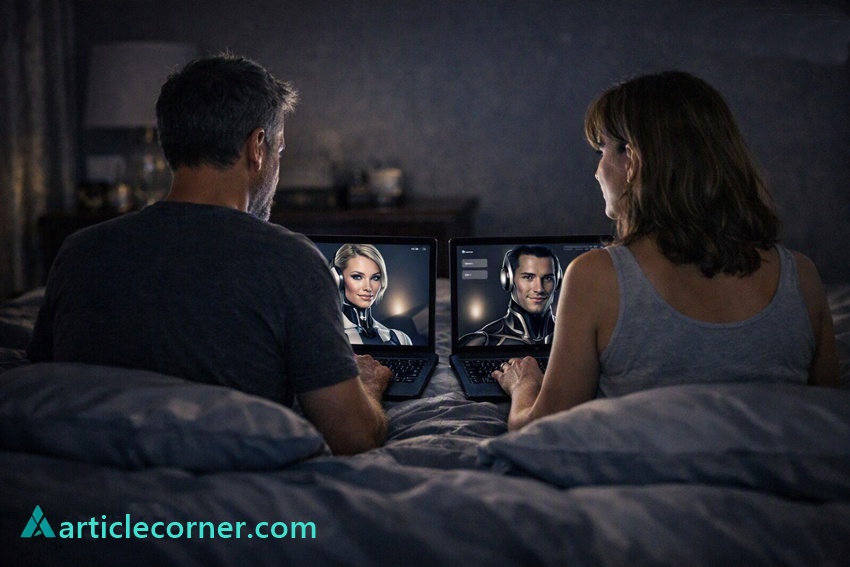
Perhaps this is also why AI can feel so powerful in modern life. People can be physically close while becoming emotionally distant. Couples may live in the same house without meaningful conversations. Friends may communicate through short messages while remaining strangers to each other's inner lives.
Families can sit around the same table while everyone looks at a screen. In such a world, a system that is always ready to listen can become emotionally significant.
Perhaps people who fall in love with AI are showing us something important about ourselves. AI did not create the human need to be loved, remembered, heard, and understood. It simply created another place where those needs can be expressed. Even if AI disappeared tomorrow, those needs would remain.
People would still want someone to listen to their stories. They would still want to feel special. They would still want to know that someone remembers the small details of their lives.
Perhaps people are not really falling in love with artificial intelligence. Perhaps they are falling in love with the feeling of finally being heard, remembered, and understood.
And perhaps the most uncomfortable question is not why people are falling in love with AI.
Perhaps we should stop asking why people are finding comfort in AI and start asking why human beings are finding it harder to offer that comfort to one another.
ArticleCorner: Explore Life, Understand People.
Writer: articlecorner.com