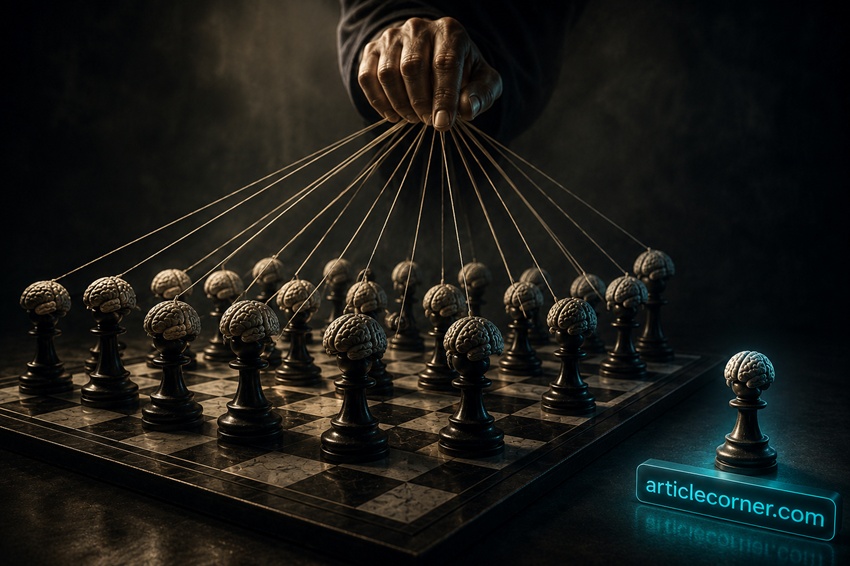
Manipulation The Silent Architecture of Modern Minds
Every now and then, I find myself asking a simple but unsettling question.
How many of my thoughts truly belong to me?
It sounds like an easy question. Yet the longer you think about it, the more difficult the answer becomes.
There was a time when mornings felt different. We would read the newspaper, enjoy a cup of coffee, and let our minds wander naturally. Thoughts weren't handed to us. We discovered them ourselves, one idea at a time.
Today, the pace has changed.
Information no longer waits politely at the door. It arrives instantly, already packaged with opinions, emotions, and conclusions. We scroll, react, and continue to the next headline before asking a simple question:
"Why do I believe this?
Think about your own day.
You watch a television show. A commercial appears. Later that afternoon, the very same product shows up on your phone. That evening, someone casually mentions it in conversation. The next morning, you notice it again.
Coincidence?
Maybe.
Or maybe repetition is quietly doing what repetition has always done.
The unfamiliar becomes familiar.
The familiar becomes comfortable.
Comfort slowly becomes preference.
And before long, preference becomes a decision that feels entirely your own.
That is how modern manipulation often works.
It rarely raises its voice.
It whispers.
It doesn't push people. It gently nudges them, again and again, until the suggested path begins to feel like their own idea.
News, too, has changed.
Its purpose was once to inform. Increasingly, it also competes to persuade.
Different channels often present entirely different realities, each complete with its own heroes, villains, and carefully selected facts. Somewhere in the middle, truth waits patiently. It speaks the least, yet it is usually the hardest voice to hear.
Many of us no longer search for truth.
We search for agreement.
And the internet is remarkably good at giving us exactly that.
Then comes social media.
A brilliant stage where millions perform, compare, celebrate, argue, and chase attention.
Photos become carefully edited memories.
Opinions become performances.
Likes become approval.
Followers become status.
Without realizing it, validation begins to replace self-worth.
A single emotional post can reach millions within hours, not because it is accurate, but because emotion travels much faster than careful thinking.
With every endless scroll, something subtle happens.
The line between authentic and artificial grows thinner.
We stop reflecting.
Instead, we begin reflecting what everyone else is reflecting.
Little by little, the crowd starts replacing our conscience.
The performance starts replacing the person.
Even the entertainment we love shapes us more than we realize.
Television series.
Short videos.
Trending challenges.
Viral moments.
None of them seem dangerous on their own.
Yet together, day after day, they quietly reshape our attention, shorten our patience, and redefine what feels normal.
Sometimes we think we are consuming stories.
Then one day, we realize the stories have been quietly shaping us all along.
And that is why I occasionally do something that feels strangely old-fashioned.
I switch on an old radio.
No algorithm knows what song will come next.
No notification competes for my attention.
No headline demands an immediate reaction.
There is only a voice.
A melody.
And something increasingly rare...
Silence.
It is in those quiet moments that I remember something important.
Freedom does not begin with louder opinions.
It begins with quieter minds.
It begins the moment you step away from the noise long enough to hear your own thoughts.
It begins when you pause before sharing.
When you question before believing.
When you choose deliberately instead of reacting automatically.
Your mind may be the most valuable thing you will ever own.
Protect it.
Not because someone can steal it overnight...
But because it can slowly be rewritten without you ever noticing.
In a world where almost everything is competing for your attention, your beliefs, and your decisions, independent thinking has become something rare.
It is more than intelligence. It is quiet resistance. It is clarity. And perhaps today, it is one of the last forms of real freedom.
Writer: articlecorner.com