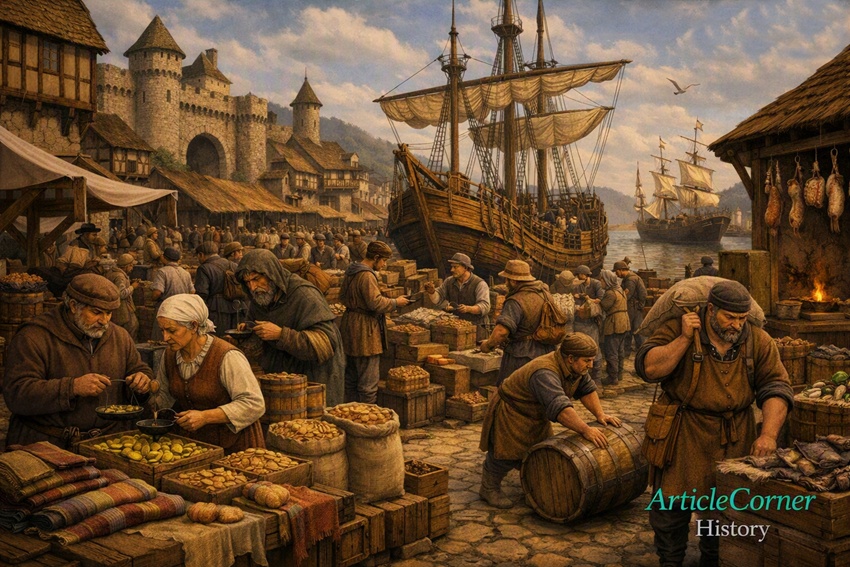
From the Medieval World to the Modern Age
When we look at history from a distance, it can sometimes seem as if the whole world moves together. One period ends, another begins, a new idea appears, and humanity simply moves forward. But history was never quite that simple. While one society was building castles, another was building great cities.
While one region was dealing with political conflicts, another was making advances in mathematics, medicine, astronomy, literature, or trade.
The world was always changing, but it was not changing at the same speed or in the same direction.
This is perhaps one of the most interesting things about the Medieval World. We often imagine the Middle Ages through European castles, knights, kings, churches, and villages. Yet Europe was only one part of a much larger world. At the same time, powerful civilizations were developing across Asia, the Middle East, Africa, and the Americas.
Merchants were crossing deserts and seas, scholars were studying the stars, cities were growing, and ideas were traveling from one culture to another. The world was already far more connected than we sometimes imagine.
So, let us take a little journey. Not the kind where we memorize dates and names, but the kind where we sit down and have a conversation with history. What did an ordinary person see when they opened their eyes in the morning? How did people work and trade? What did they believe? Where did knowledge travel? And how did this enormous medieval world eventually begin to change?
A World Without a Single Timeline:
Imagine waking up somewhere in the year 1000.
You might be living in a small European village, working the land and depending heavily on the harvest. Or perhaps you are somewhere in the Islamic world, living in a busy city where merchants, scholars, craftsmen, and travelers meet every day. Maybe you are in China, surrounded by sophisticated cities, manufacturing, trade, and technological developments.
All of these people are living in the same year.
That simple thought changes the way we look at history.
There was no single “medieval experience.” The word Medieval is mainly a European historical classification, and it does not perfectly describe what was happening everywhere else. Different civilizations had their own political systems, cultures, religions, economies, technologies, and ideas.
And yet, despite these differences, people everywhere shared something remarkably familiar: they needed food, shelter, security, family, work, and money to buy the things they needed.
Money was already an important part of economic life in the Medieval World. Coins were used in markets, towns, ports, and along major trade routes. Merchants bought and sold agricultural products, animals, textiles, metals, spices, tools, and countless other goods.
One of the greatest networks connecting these worlds was the Silk Road. It was not a single road, but a vast network of trade routes stretching across Asia and linking China with Central Asia, Persia, the Middle East, Anatolia, and eventually the Mediterranean. Silk was one of its famous products, but merchants also carried spices, precious metals, textiles, ceramics, horses, and many other goods. Along with merchandise, money, knowledge, inventions, languages, and ideas traveled from one civilization to another.
At the same time, ships connected ports across the Mediterranean and the Indian Ocean, while caravans crossed enormous distances by land. Markets brought people together, and trade allowed distant communities to become economically connected.
The world was not isolated. It was already connected by movement, trade, and money.
The Medieval World Was More Active Than We Imagine:
Perhaps the biggest mistake we can make is to imagine the Middle Ages as a completely dark and motionless period.
Life could certainly be difficult. Disease was dangerous, medical knowledge was limited, wars could destroy communities, and social inequality was often severe. But people were not simply waiting for the modern world to arrive.
They were building, experimenting, studying, trading, writing, creating art, and asking questions.
In different parts of the world, scholars preserved and developed knowledge in mathematics, astronomy, medicine, philosophy, engineering, and literature. Books and ideas traveled across languages and cultures. A mathematical idea developed in one civilization could influence another, sometimes thousands of kilometers away.
This is one of the great stories of human civilization: knowledge travels.
And Then Europe Began to Change:
By the later Middle Ages, Europe itself was changing. Cities were becoming more important, trade was expanding, merchants were gaining influence, universities were developing, and literacy was gradually increasing.
Then something remarkable began to happen, particularly in the Italian city-states.
People started looking back.
They became fascinated again by the art, philosophy, literature, architecture, and ideas of ancient Greece and Rome. But this was not simply about copying the ancient world. It was also about asking new questions.
What is a human being capable of?
What can we discover through observation?
Can art represent the human body more realistically?
Can we challenge an old idea and investigate it ourselves?
This growing cultural movement became known as the Renaissance.
Renaissance:
The Renaissance began in Italy during the 14th century and developed strongly during the 15th and 16th centuries before spreading more widely across Europe.
At first glance, the name itself is interesting. Renaissance means “rebirth.”
But rebirth of what?
In large part, it referred to a renewed interest in classical Greek and Roman culture. Artists studied anatomy, perspective, light, proportion, and nature. Writers explored human emotions and individual experience. Scholars returned to ancient texts and began thinking differently about knowledge and humanity.
The Renaissance was not a switch that suddenly turned Europe from “old” to “modern.” It was a gradual transformation, built through generations of questions, discoveries, books, artistic experiments, and encounters with ideas from different cultures.
One generation asked a question. Another took it further. A new technique appeared. A book was translated. A merchant traveled. A scholar encountered an unfamiliar idea.
Slowly, Europe began to change.
Then Came the Reformation:
While these intellectual and cultural changes were taking place, another major transformation was developing in Europe: the Reformation.
The Protestant Reformation, which was a religious revolution, started in Germany in 1517.
The Reformation became particularly significant in the 16th century. In 1517, Martin Luther's criticism of certain practices of the Catholic Church became a powerful symbol of a much larger religious movement.
But history was not simply about one person standing up and changing everything overnight. There had already been debates about religion, authority, church practices, education, and the interpretation of scripture.
Then printing changed the situation.
Ideas could now travel much faster. A text that once might have reached a small number of readers could be reproduced and distributed to much larger audiences.
And this is where technology quietly enters the story.
The printing press did not create the Reformation by itself. But it dramatically increased the speed at which ideas could circulate.
Think about that for a moment.
A new idea is powerful.
But a new idea that can travel is much more powerful.
From Manuscripts to Mass Communication:
For centuries, books had to be copied by hand. They were expensive, slow to produce, and relatively rare.
Printing changed the equation.
Words could be reproduced much more quickly. Religious texts, political arguments, scientific works, maps, stories, and news could reach increasingly larger audiences.
In a sense, humanity was discovering something that feels surprisingly modern:
**Information changes society when it becomes easier to share.**
Today, we send a message around the world in seconds. We publish an article and someone on another continent can read it almost immediately. A video can reach millions of people before we have even finished our morning coffee.
The technology is radically different, but the basic human process is familiar.
An idea appears.
Someone shares it.
Someone else reacts.
Another person changes it.
And eventually, society begins to change.
From the Medieval Market to the Modern Economy:
There is another connection between the medieval world and our own time: trade.
Medieval merchants already operated within complex economic networks. Coins circulated through markets and ports, merchants traveled across borders, credit arrangements developed, and governments collected taxes. The Silk Road and maritime trade routes connected distant economies long before the modern global economy existed.
What changed over the centuries was the scale and organization of these systems.
Money became more standardized. Banking became more sophisticated. Credit expanded. International trade grew. Exploration opened new maritime routes. Industrialization transformed production, and eventually computers and the internet transformed commerce once again.
Today, we can buy something from another country without ever meeting the seller.
The medieval merchant needed a road, a caravan, or a ship and perhaps months of travel.
We need a screen.
The distance has changed.
The human need to trade has not.
From Renaissance Questions to Modern Science:
The Renaissance also reminds us that modern science did not simply appear one morning.
The development of modern scientific thinking was a long process. Observation became increasingly important. Old authorities were questioned. Mathematics became more deeply connected with the study of nature. Printing helped scientific ideas circulate, instruments improved, and scholars communicated across borders.
Over time, these developments contributed to what we now recognize as modern science.
Today, we expect evidence. We expect experiments. We expect explanations that can be tested.
But many of these expectations were once revolutionary.
That is why history is so fascinating.
Things that seem obvious to us today were once new ways of thinking.
And What About the Rest of the World?
While the Renaissance and Reformation were transforming Europe, the rest of the world did not simply stand still.
The Ottoman Empire was expanding. China experienced major political and economic transformations. India remained home to powerful states and vibrant commercial networks. African kingdoms and empires participated in regional and long-distance trade. Across the Americas, complex civilizations developed their own cities, political systems, technologies, agriculture, and cultures.
This is why we should be careful when saying, “The world entered the Renaissance.”
Europe entered a particular cultural transformation.
Other societies were experiencing their own transformations at the same time.
History becomes much more interesting when we stop imagining the world as a single classroom where everyone receives the same lesson at the same time.
There were many classrooms.
And sometimes, those classrooms connected through merchants, travelers, books, inventions, goods, and ideas.
From the Old World to the World We Know:
Eventually, the changes that developed during the late medieval and early modern periods helped create a radically different world.
The Renaissance transformed European art, literature, education, and intellectual life. The Reformation changed religious and political structures. Printing accelerated communication. Exploration connected continents on an unprecedented scale, with consequences that were both transformative and devastating.
Scientific developments changed our understanding of nature. Ocean trade expanded. Industrialization later transformed how goods were produced and transported.
And slowly, the world moved toward modernity.
But perhaps we should not imagine a straight line from a medieval village to a modern city.
History is not a straight road.
It is more like a vast network of roads crossing one another.
Some roads disappear.
Some continue for centuries.
Some ideas return after being forgotten.
Some inventions appear in one civilization and are transformed by another.
And sometimes, a change that seems small at first eventually changes everything.
We Are Still Living in That Story:
When we look around today, it is tempting to believe that our world is completely different from the world of medieval people.
In technology, it certainly is.
We have electricity, airplanes, smartphones, satellites, artificial intelligence, modern medicine, digital currencies, and instant global communication.
But underneath all of this technology, many human questions remain surprisingly familiar.
How should we live?
Who should have power?
What makes a society fair?
How should wealth be distributed?
What should we believe?
How can we discover what is true?
How should we trade with one another?
How can new technology improve our lives without creating new problems?
These are not entirely modern questions.
People centuries ago asked versions of them too.
A Final Thought:
Perhaps the most important lesson of the Medieval World, the Renaissance, and the Reformation is not a particular date or famous name.
It is the realization that change rarely happens all at once.
The medieval world did not suddenly disappear. The Renaissance did not suddenly create the modern world. The Reformation did not instantly transform society. Each emerged from conditions that had been developing for generations.
And perhaps our own time is no different.
We are living through enormous changes in artificial intelligence, communication, science, economics, and culture.
One day, people may look back at our century in the same way we look back at the Renaissance.
They may ask:
“When did the old world begin to disappear?”
And perhaps the answer will be the same one history has given us again and again:
**We usually do not notice the moment when the future begins. We only recognize it after it has already become the past.**
ArticleCorner History: The Middle Ages — A Different World, The Same Human Questions.
Writer: articlecorner.com