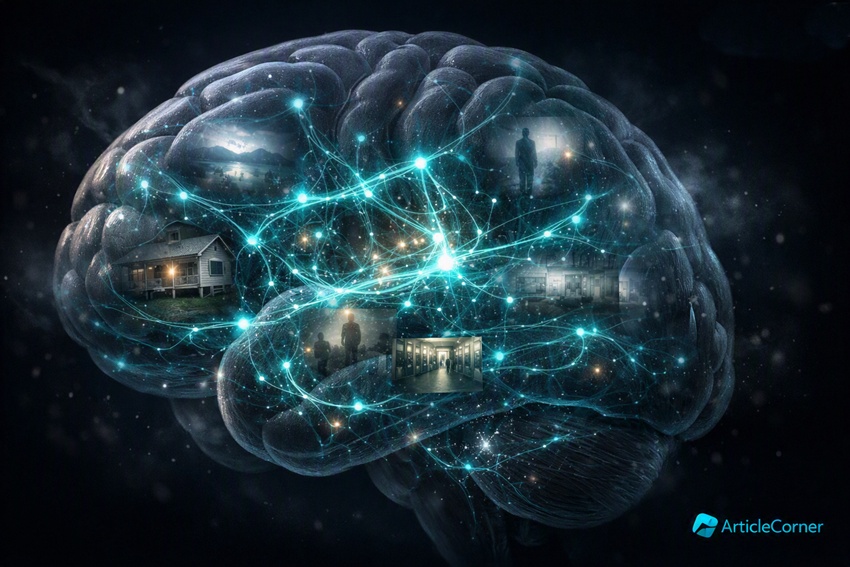
What Is Memory?
Dr. Mind Explains:
Let me ask you something.
What is the first thing you remember from your life?
Perhaps you can see a room from your childhood. Maybe you remember the face of a family member, the sound of a voice, a schoolyard, a particular smell or a moment that seemed unimportant at the time but somehow remained with you.
You may not remember the entire event.
You may only have a small fragment of it. Yet that fragment can still feel surprisingly real.
Memory is one of those abilities we use every day without giving much thought to it. You remember your name, how to speak, where you live, what you did yesterday, and how to use objects you have handled thousands of times.
You also remember things that happened years ago. Some memories arrive deliberately when you search for them, while others appear unexpectedly because a sound, smell, place, or conversation reminds you of something from the past.
But memory is not a perfect recording of your life.
And this is where our story becomes interesting.
Your brain does not store every moment exactly as it happened and then play it back whenever you want. Memory is an active biological process.
It involves taking information from an experience, processing it, changing it in various ways, and later attempting to retrieve it.
In other words, remembering is not simply opening a file.
It is more like rebuilding one.
When you experience something, your brain first has to process what is happening. You see, hear, touch, smell, or otherwise experience information through your senses.
Attention plays an important role here. If you are deeply distracted, you may experience an event without forming a strong memory of it.
Information that receives more attention is generally more likely to become part of a lasting memory.
This initial process is often described as **encoding**.
Encoding does not mean that the brain creates a perfect copy of an experience. Instead, different aspects of the experience are processed by different neural systems.
What you saw, what you heard, what you felt, what you were thinking, and how important the event seemed to you can all influence what is later remembered.
Consider meeting someone for the first time.
You may remember their face but forget what they were wearing. You may remember something funny they said but forget exactly where the conversation happened.
You may remember how you felt during the meeting more clearly than the words that were spoken.
The experience was one event.
Your memory of it is a collection of information that has been processed and connected in different ways.
One of the brain structures that plays a central role in forming many new memories is the **hippocampus**, located deep within the brain. The hippocampus is particularly important for forming and organizing memories of events and experiences. It does not simply act as a permanent storage box, however.
Memory involves interactions among many regions of the brain, and the hippocampus works as part of a much larger system.
This distinction matters.
There is no single place in the brain where all of your memories are stored.
A memory of a childhood birthday, for example, may involve information about faces, sounds, emotions, locations, language, and other details. Different aspects of that memory can depend on different neural networks.
The memory you experience consciously is therefore connected to a distributed pattern of brain activity rather than a single physical location.
Now let's consider what happens after a memory is formed.
Some information remains available for only a short period of time. Other information can become much more persistent. You may briefly remember a phone number long enough to enter it into your phone and then lose it moments later. At other times, an experience can remain accessible for decades.
Psychologists often distinguish between different forms of memory, including **short-term or working memory** and **long-term memory**.
Working memory allows you to temporarily hold and manipulate information. If I give you a number and ask you to keep it in mind while you perform a calculation, you are using working memory.
It is limited, which is one reason it becomes difficult to keep many pieces of unrelated information active at the same time.
Long-term memory is different. It allows information to remain available over much longer periods. But even long-term memory is not one single system. We can remember facts and information, personal experiences, skills, habits, and many other forms of knowledge.
You probably do not consciously remember the first time you learned how to walk.
Yet your brain remembers how to coordinate the movements involved.
You may not remember every step you took when learning to ride a bicycle.
But once the skill becomes established, you can often perform it without consciously describing every movement.
This reminds us that memory is not limited to things we can describe in words.
Some memories are **explicit**, meaning that we can consciously recall them. Others are expressed through skills and learned behaviors and can operate without conscious recollection of when they were learned.
Now comes one of the strangest things about memory.
**Why do we forget?**
At first, forgetting might seem like a failure. We often think that a strong memory means remembering everything and a weak memory means forgetting too much.
But forgetting is not necessarily a defect.
Your brain is constantly receiving information. If every detail of every moment were preserved with equal strength, your mind would be overwhelmed by an enormous amount of irrelevant information. Forgetting helps the brain prioritize.
Information that is rarely used may become harder to retrieve, while information that is repeatedly used or considered important can remain more accessible.
This does not mean that the brain simply deletes unwanted information like a computer deleting a file.
Memory is more complicated.
Sometimes information is still present in some form but becomes difficult to retrieve. You may know that you know someone's name but be unable to produce it. Then, hours later, the name suddenly appears in your mind.
That familiar experience tells us something important.
**Memory and retrieval are not the same thing.**
Having information available in the brain does not always mean that you can access it immediately.
And memories can change.
Every time you remember something, the memory may become vulnerable to modification. The act of remembering is not necessarily a completely passive replay. New information, later experiences, expectations, emotions, and suggestions can influence how an old memory is reconstructed.
This is one reason human memory can sometimes be surprisingly inaccurate.
You may remember an event with great confidence and still be mistaken about some of its details.
Confidence and accuracy are not always the same thing.
This becomes particularly important when memories involve strong emotions.
Have you ever remembered exactly where you were when you heard important news?
Perhaps you remember the room, the people around you, what you were doing, and even how you felt at that moment.
Emotional experiences can produce particularly vivid memories. The emotional significance of an event can influence attention and the way information is encoded and later retrieved. But vivid does not necessarily mean perfectly accurate.
A memory can feel extremely real while still containing errors.
And there is another fascinating feature of memory: **smell can bring back the past with surprising strength.**
A particular perfume, a meal, the smell of rain, or the scent of an old room can suddenly transport you to a moment from years ago. This happens partly because systems involved in processing smell have strong connections with brain regions involved in emotion and memory.
You may not have thought about that childhood moment for decades.
Then one familiar smell appears.
And suddenly, it is there.
This tells us that memory is not simply a list of facts.
Memories can be connected to sensations, emotions, places, people, and bodily experiences. The brain creates associations, and those associations can become powerful routes back into the past.
But perhaps the most important thing to understand is that memory helps shape who you believe you are.
Think about it.
Your knowledge of your own past is largely constructed from memories. You remember people you have loved, mistakes you have made, places you have visited, things you have learned, and experiences that changed you. These memories become part of the story you tell yourself about your life.
But if memories can change, what does that mean for your identity?
Are you the person who experienced those events?
Or are you also the person who remembers them?
And if your memory of an event changes over time, does the event remain part of the same story?
These are not questions that neuroscience can answer completely on its own. They take us toward psychology and philosophy, where questions about identity, personal experience, and the nature of the self become much deeper.
For now, there is something simple I want you to remember.
Your memory is not a perfect archive.
It is a living process.
It allows you to carry information from the past into the present, helping you learn from experience, recognize people, develop skills, make decisions, and construct a sense of continuity in your life.
And perhaps that is why forgetting is not the opposite of remembering.
Both are part of how the brain manages information.
We remember because some experiences become meaningful, useful, repeated, emotionally important, or strongly connected to what we already know.
And we forget because the brain must constantly decide what information remains accessible and what becomes harder to reach.
So the next time an old memory suddenly appears in your mind, pause for a moment.
Don't just ask:
**“Why do I remember this?”**
Ask something even more interesting:
**“Why did my brain decide that this was worth remembering?”**
We are getting closer to one of the most mysterious parts of being human.
Because memory does not simply preserve our past.
**It helps construct the person who experiences the present.**
And that gives us another question to explore.
**Next time, let's look at emotions — why some experiences affect us deeply, why feelings can influence our decisions, and how the brain turns events into emotional experiences.**
— **Dr. Mind**
Writer: articlecorner.com - ArticleCorner