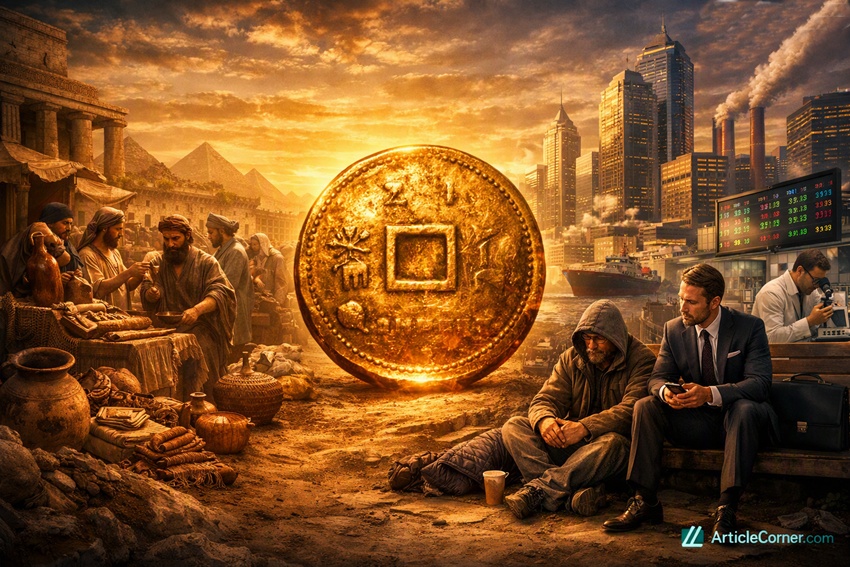
How the Invention of Money Changed the World
Have you ever stopped to wonder what life would be like if money had never been invented?
Not a world without wealth, because wealth existed long before coins and banknotes. People owned land, animals, tools, and food. But imagine a world where every loaf of bread, every piece of clothing, and every service depended on finding someone who wanted exactly what you had to offer.
If you grew apples but needed shoes, you had to hope that a shoemaker happened to want apples. If not, you walked home empty-handed. Every exchange relied on coincidence. Every transaction required patience. Every dream depended on someone else's immediate need.
That was the reality for much of human history.
Money did not appear because people wanted to become rich. It appeared because civilization had become too complicated to rely on chance.
The invention itself seems almost ordinary today. We carry it in our wallets, watch numbers appear on our phone screens, and rarely think about why it exists. Yet few inventions have changed the course of humanity as profoundly as money.
Before money, trade was personal.
People exchanged goods face to face. Trust mattered more than numbers. A farmer knew the blacksmith. The fisherman knew the baker. Communities were small enough that reputation often carried more value than possessions.
But as villages became towns and towns became cities, this simple system began to break.
A merchant could travel hundreds of miles with goods to sell, only to discover that nobody wanted what he carried. Even when two people wished to trade, they often disagreed on value.
How many chickens were worth one cow?
How much grain equaled a handmade cart?
There were no universal answers.
Humanity needed something everyone could agree upon.
Different cultures experimented with different solutions. Shells, salt, beads, precious stones, and even livestock became forms of payment. They all shared one important characteristic: people believed they had value.
Eventually, metals such as gold and silver became the preferred choice. They were durable, portable, difficult to counterfeit, and scarce enough to inspire trust.
For the first time, value could fit inside a person's pocket.
That simple idea transformed everything.
Trade no longer depended on perfect coincidence.
A farmer no longer needed to find someone who wanted wheat. He could sell it for money and use that money whenever and wherever he wished.
Suddenly, opportunities multiplied.
Markets expanded.
Cities flourished.
Roads connected distant civilizations.
Ships crossed oceans carrying goods that would never have reached foreign shores before.
Money became the invisible bridge linking strangers who would never meet.
It helped build markets, fund expeditions, finance inventions, and support artists whose work still inspires us centuries later.
But every powerful invention carries two faces.
Money made generosity easier.
It also made greed easier.
It helped families build better lives.
It also fueled wars, corruption, and inequality.
Entire empires rose because they controlled wealth. Others collapsed when they lost it.
History was no longer shaped only by swords or kings. Increasingly, it was shaped by whoever controlled the flow of money.
Centuries passed, yet the invention kept evolving.
Metal coins became paper.
Paper became plastic cards.
Today, money often exists only as invisible numbers stored inside computers. We tap a phone against a payment terminal, and ownership changes hands without a single coin making a sound.
The invention that once weighed heavily in leather pouches now travels silently through light and electricity.
Yet despite all these changes, its purpose remains remarkably similar.
Money cannot feed your hunger on its own.
It cannot keep you warm by itself.
It cannot guarantee happiness.
What it truly represents is trust—
a shared agreement that allows millions of strangers to cooperate every single day.
Without that belief, supermarkets would empty, international trade would slow, and modern economies would struggle to function.
Perhaps the greatest achievement of money was never making people richer.
Its greatest achievement was allowing human cooperation to grow beyond the limits of family, tribe, and village.
Every skyscraper, every airport, every university, every hospital, and every global business carries the fingerprints of this simple invention.
Money did not create human ambition.
It simply gave ambition a language that everyone could understand.
The next time you pay for a cup of coffee, buy a book online, or tap your phone to complete a purchase, remember that you are participating in one of humanity's oldest agreements.
Not because the paper, the coin, or the digital number has value on its own.
But because billions of people have chosen to believe that it does.
And sometimes, the most powerful inventions are not the ones we hold in our hands...
They are the ideas we all agree to believe.
ArticleCorner.com Perspective
The invention of money was never humanity's greatest mistake. On the contrary, it was one of our greatest achievements. It made trade easier, connected distant civilizations, accelerated innovation, and improved the quality of life for billions of people. Without money, the modern world we know today would likely never have existed.
Yet money itself has never been the real problem.
The real challenge has always been the human mind. Greed, endless consumption, the desire for more, and the unequal distribution of wealth have turned a remarkable invention into a source of conflict for many societies.
Money did not create inequality. It simply made it more visible.
It did not invent greed. It merely gave greed a powerful tool.
Perhaps the question is not whether money changed the world, but whether humanity learned how to use one of its greatest inventions wisely.
At ArticleCorner, we believe that inventions are neither good nor bad by themselves. Their true impact depends on the values of the people who use them.
Writer: articlecorner.com