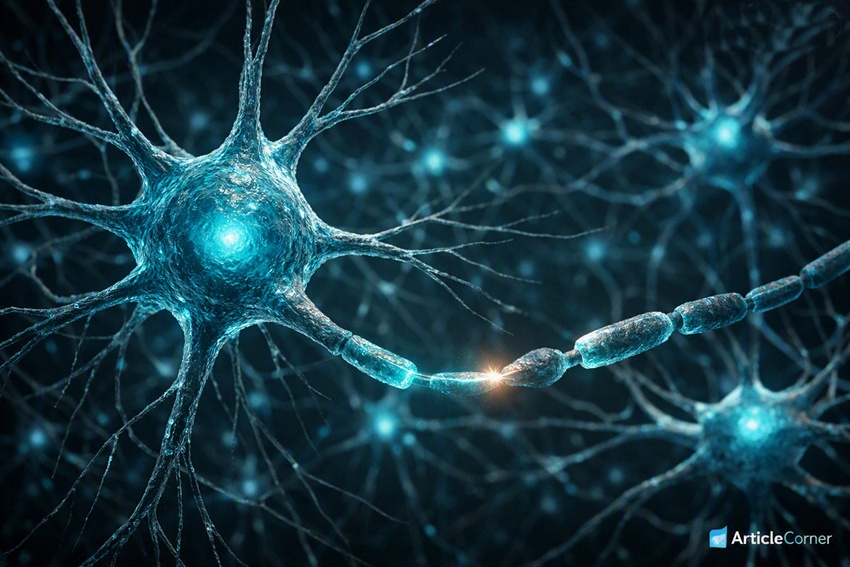
What Are Neurons?
Dr. Mind Explains:
In our first conversation, we looked at the human brain from a distance. We saw it as an extraordinary organ capable of memory, thought, emotion, perception, and consciousness.
But now I want to take you much closer. Because if we really want to understand the brain, we need to meet some of the tiny cells that make all of this possible.
They are called **neurons**.
Neurons are specialized cells of the nervous system that communicate information. They are found in the brain, spinal cord, and throughout the peripheral nervous system. The human brain contains tens of billions of neurons, and they are connected through an enormous network of cellular communication.
Each neuron has a particular role, but neurons do not work alone. Their abilities emerge from the way they connect and communicate with one another.
Imagine a huge city at night. Millions of people are moving through streets, sending messages, receiving information, making decisions, and responding to events. Now imagine that this city is alive with communication at every moment. That gives you a very rough idea of what is happening inside your nervous system.
Except that the brain is vastly more complex, and the messages are moving through biological networks rather than streets.
So, what does a neuron actually look like?
A typical neuron has several important parts. The **cell body**, also called the soma, contains the nucleus and maintains the basic functions of the cell. Extending from the cell body are branching structures called **dendrites**. These usually receive signals from other cells.
A long structure called the **axon** carries electrical signals away from the cell body toward other neurons or target cells. Some axons are extremely short, while others can extend a considerable distance through the body.
At the end of the axon are structures that communicate with another cell. This is where things become especially interesting.
Neurons generally do not touch one another directly. Instead, they communicate across tiny junctions called **synapses**. When an electrical signal reaches the end of an axon, it can trigger the release of chemical messengers called **neurotransmitters**. These molecules cross the small gap between cells and bind to receptors on the receiving cell.
Think of it as a conversation between two cells.
One neuron sends a message. Another neuron receives it. But unlike an ordinary conversation, the message is not necessarily a simple “yes” or “no.” Depending on the type of neurotransmitter, the receptors involved, and the state of the receiving neuron, the signal may increase or decrease the likelihood that the next neuron will generate its own electrical signal.
This distinction is important because the brain does not operate like a simple chain of commands. Neurons receive information from many sources at once. Some incoming signals may encourage a neuron to become active, while others may inhibit its activity. The neuron effectively integrates these competing influences.
If the electrical changes reach a certain threshold, the neuron can generate an **action potential**, a rapid electrical signal that travels along its axon.
An action potential is one of the fundamental ways neurons transmit information over distance.
You might imagine electricity simply flowing through a wire, but a neuron works differently. The electrical signal is produced by controlled changes in the movement of ions across the cell membrane. Sodium, potassium, and other charged particles are involved in maintaining and changing the electrical state of the neuron.
When the appropriate conditions are reached, a rapid sequence of ion movements produces the action potential, which travels along the axon.
The process is extraordinarily fast.
And it happens again and again, across enormous numbers of neurons.
But here is something worth remembering: **a neuron firing does not automatically mean that a specific thought has occurred.** A single electrical signal is only one small event within a much larger network. Meaning emerges from patterns of activity involving many neurons and many connections.
This is one of the reasons the brain cannot be understood simply by finding a single “memory cell” or a single “thought cell.” Mental processes generally depend on networks of interacting neurons. Different brain regions and neural circuits contribute to different functions, and the same neuron can participate in different processes depending on the network in which it operates.
Now let's talk about connections.
The human brain contains an extraordinary number of synaptic connections. These connections are not necessarily permanent or equally strong. They can change with experience, development, learning, and activity. Some connections become stronger; others may weaken. New connections can form, while existing ones can be modified or eliminated.
This ability to change is fundamental to the brain's adaptability.
Suppose you begin learning a completely unfamiliar skill. At first, the task may require intense concentration. Your movements may feel awkward, and you may have to consciously think about every step. With practice, the task can become easier and more automatic.
Behind that change is not simply the accumulation of information. The nervous system itself is adapting as neural circuits are repeatedly activated and modified.
This is one aspect of **neuroplasticity**.
Neuroplasticity does not mean that the brain can become anything we want simply through positive thinking. The reality is much more interesting and much more complicated. The brain has biological limits, but within those limits, its networks can change in response to experience. Learning, development, injury, environment, and repeated behavior can all influence neural organization.
There is another important point that is sometimes overlooked: neurons are not the only cells in the brain.
The nervous system also contains many different types of **glial cells**, which support neurons in numerous ways. Some provide structural support, help maintain the chemical environment around neurons, contribute to insulation of axons, and participate in communication and defense.
The brain is therefore not simply a collection of neurons. It is a complex biological system containing many different kinds of cells working together.
So when you hear someone say that the brain is made of neurons, remember that this is only part of the story.
Neurons are remarkable because they can transform information from one form into another. They can receive chemical signals, generate electrical activity, release chemical messengers, and alter the strength of their connections. Through vast networks of these interactions, the nervous system can coordinate movement, process sensory information, regulate internal functions, support learning, and contribute to thought and behavior.
And yet, there is still a question that I find particularly fascinating.
How can billions of relatively small biological cells, communicating through electrical and chemical processes, give rise to something as rich as a human experience?
A neuron does not understand a sentence.
A neuron does not know what a sunset means.
A neuron does not look at a photograph and think, “That was my childhood.”
And yet, the activity of networks containing these cells is essential to the processes that allow you to understand language, recognize a face, remember an event, or experience an emotion.
We are beginning to understand the mechanisms involved. Neuroscience can measure electrical activity, observe changes in brain circuits, study neurotransmitters, examine the effects of injury, and investigate how learning changes neural connections. Every year, research reveals more about the nervous system.
But knowing how individual components work does not automatically explain how the entire system produces a mind.
That is the larger mystery.
For now, let's stay with the neurons.
They are not tiny people living inside your head. They do not think individually. They do not have intentions or opinions. They are living cells following biological processes. Yet when billions of them interact within organized networks, something extraordinary becomes possible.
You can learn.
You can remember.
You can imagine something that has never happened.
You can recognize yourself in a mirror.
And you can ask a question about the very cells that make asking questions possible.
That is where our journey becomes truly interesting.
Next time, let's move one step deeper.
**How does the brain turn all of this neural activity into a thought?**
— **Dr. Mind**
Writer: articlecorner.com - ArticleCorner