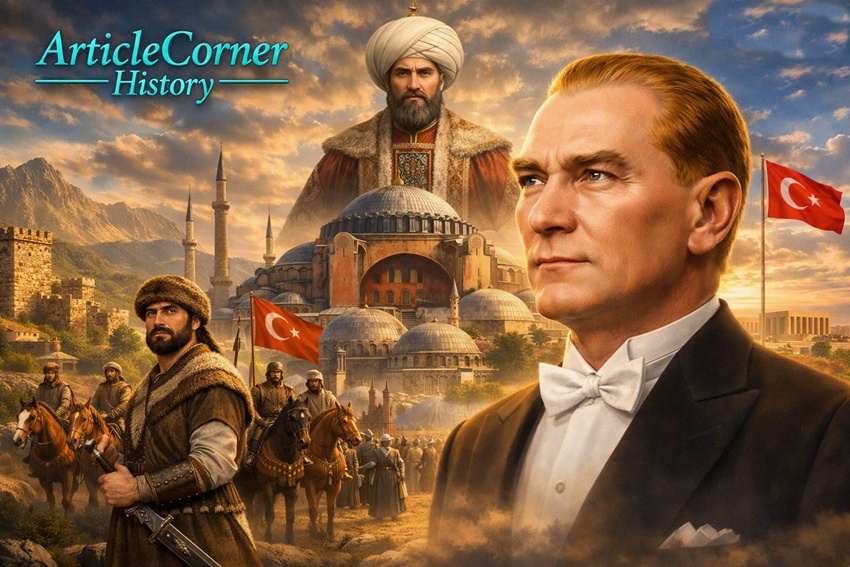
ArticleCorner History - ArticleCorner.com
The Ottoman Empire: From Anatolian Beyliks to the Republic of Türkiye
There is a fascinating moment in history when an old world is disappearing and a new one has not yet fully arrived. Anatolia in the late thirteenth century was one of those places. The Seljuk order had weakened, political authority was fragmented, and numerous Turkish principalities, known as the Anatolian Beyliks, had emerged across the region. Cities, fortresses, trade routes and farming communities continued their lives, but the political landscape was constantly changing.
Among these small principalities was one that, at first glance, seemed no more important than the others: the small frontier principality of Osman Gazi. Yet from this modest beginning would emerge one of the longest-lasting empires in history.
Anatolia Before the Ottoman Empire:
To understand the Ottoman story, we should first look at Anatolia itself. After the Battle of Manzikert in 1071, Turkic peoples gradually established themselves across much of Anatolia, and the Seljuk Sultanate of became one of the region's major powers. But the thirteenth century brought enormous pressure.
Mongol expansion weakened Seljuk authority, and central political control gradually broke apart. By the end of the century, Anatolia was no longer dominated by a single powerful Turkish state. Instead, several independent or semi-independent beyliks appeared.
These principalities were not simply small states fighting endlessly among themselves; they were also vibrant communities that developed their own cities, armies, trade networks, and political traditions. The Karamanoğulları, Germiyanoğulları, Candaroğulları, Aydınoğulları, Menteşeoğulları, and other dynasties each played significant roles in shaping different parts of Anatolia.
Some controlled important ports, some dominated inland trade routes, and others expanded toward the Byzantine frontier. Anatolia was therefore not an empty stage waiting for the Ottomans. It was already a living and complicated political world.
And this is where the Ottoman story becomes especially interesting. The Ottomans did not suddenly appear in an already unified Turkey. They emerged from this fragmented Anatolian world and gradually transformed themselves from a frontier principality into a state capable of absorbing, negotiating with, and eventually dominating many of its neighboring powers.
Osman Gazi and the Birth of a New Power:
ArticleCorner History provides article-style information without getting bogged down in details. A total of 36 sultans ascended the throne in the Ottoman Empire. The first sultan was Osman Gazi (1299), the founder of the state, and the last was Sultan Mehmed VI (Sultan Vahdettin), who ruled from 1918 to 1922.
Osman Gazi ruled a small frontier principality in northwestern Anatolia around the end of the thirteenth and beginning of the fourteenth century. His territory bordered the Byzantine Empire, and this frontier position gave the emerging Ottoman state both opportunities and challenges. Raiding, settlement, alliances, marriages and military expansion all became part of the political environment.
The early Ottoman frontier was a meeting place of different peoples, religions and political traditions. Muslim warriors, Christian communities, Byzantine officials, merchants, farmers and migrants all existed within a constantly changing landscape. The Ottoman rulers gradually learned that survival required more than winning battles. They needed to build alliances, control land, protect trade and incorporate new populations into their political system.
Osman Gazi's successors inherited this expanding frontier state. What began as a relatively small principality was becoming something different. It was developing institutions, acquiring important towns and attracting people who saw opportunity in the growing power of the Ottomans.
Orhan Gazi and the Expansion into Europe:
Under Orhan Gazi, the Ottoman state expanded significantly. Bursa was captured in 1326 and became an important Ottoman center. The conquest was more than a military victory. Bursa became a political, economic and cultural base from which the Ottomans could organize their growing state.
The Ottomans soon crossed into Europe. The capture of Gallipoli in the mid-fourteenth century provided a crucial foothold in the Balkans. From this point forward, Ottoman history could no longer be understood as simply the history of a Turkish principality in Anatolia. The state was becoming a transcontinental power.
Murad I expanded Ottoman influence across the Balkans and established Edirne as a major center. Ottoman armies faced Serbian, Bulgarian, Byzantine and other regional powers, while diplomacy and dynastic politics often accompanied military campaigns. The Battle of Kosovo in 1389 became one of the important events in the Ottoman expansion into the Balkans.
The empire was beginning to take shape, but the road ahead was far from certain.
Bayezid I and the Shock of Timur:
Bayezid I, known as Yıldırım Bayezid, expanded Ottoman authority rapidly during the late fourteenth century. He strengthened Ottoman control in Anatolia and the Balkans and placed Constantinople under increasing pressure.
Then came one of the great turning points of Ottoman history.
In 1402, Bayezid I confronted Timur, one of the most formidable conquerors of the era, at the Battle of Ankara. Following his defeat and capture, the Ottoman political structure plunged into a deep crisis, triggering a fierce power struggle among his sons during the period known as the Fetret Devri (Ottoman Interregnum).
For a moment, the Ottoman state itself seemed to be in danger of disappearing.
But it survived.
Mehmed I reunited the territories and restored central authority. His successor, Murad II, continued the process of rebuilding Ottoman power. This recovery was crucial because it demonstrated something that would become a recurring feature of Ottoman history: the ability of the state to survive severe crises and reorganize itself.
Mehmed II and the Fall of Constantinople:
Then came 1453.
Mehmed II, later known as Mehmed the Conqueror, captured Constantinople after a carefully prepared siege. The Byzantine Empire, which had survived for centuries after the fall of the Western Roman Empire, came to an end.
But the significance of 1453 goes beyond the dramatic image of a city falling after a siege. Constantinople became the center of an expanding Ottoman empire. Mehmed II understood that ruling an empire required more than military power.
He strengthened the administration, reorganized institutions, encouraged trade and developed the city as a political and cultural capital.
The Ottoman state was no longer simply one of the Anatolian beyliks.
It had become an empire.
From Anatolian Beyliks to Empire:
The transformation of the Ottomans also changed the political map of Anatolia. During the fifteenth century, Ottoman rulers incorporated many of the other Anatolian beyliks into their growing state, sometimes through conquest and sometimes through political agreements, inheritance and negotiation.
This is an important part of the story because the Ottoman Empire did not emerge from nothing. It inherited and absorbed political, administrative and cultural traditions from the wider Anatolian world. The people, institutions and territories of the former beyliks became part of the expanding Ottoman political structure.
In this sense, the history of the Anatolian beyliks is not merely a preface to Ottoman history. It is part of the story of how the political landscape of Anatolia gradually moved from fragmentation toward larger-scale state structures.
Selim I and the Changing World:
At the beginning of the sixteenth century, Sultan Selim I dramatically expanded Ottoman power toward the Middle East. His victories against the Safavid Empire and the Mamluk Sultanate brought Syria, Egypt and the Hejaz under Ottoman rule.
The empire now stretched across three continents.
This expansion transformed the Ottomans into a major Islamic and Mediterranean power. Important cities such as Cairo, Damascus, Jerusalem and Mecca became connected to an enormous imperial political system. Trade routes, pilgrimage routes and cultural exchanges passed through Ottoman-controlled territories.
The empire was no longer simply an Anatolian-Balkan state. It had become a vast political world.
Suleiman the Magnificent:
If one name represents the height of Ottoman imperial power, it is Suleiman I, known in the West as Suleiman the Magnificent.
His reign in the sixteenth century was marked by military expansion, administrative development, architecture, law and cultural achievement. Ottoman armies advanced into Central Europe, while the empire competed with the Habsburgs for influence. In the Mediterranean, the Ottoman navy became a major force.
But Suleiman's importance was not only military. The period saw major architectural and artistic achievements, most famously associated with Mimar Sinan. Mosques, bridges, schools, markets and public buildings transformed Ottoman cities.
The empire had become a sophisticated imperial system connecting Europe, Asia and Africa.
And yet, history rarely allows an empire to remain forever at its peak.
An Empire That Had to Change:
After Suleiman's death, the Ottoman Empire continued for centuries. It experienced victories, defeats, economic difficulties, internal conflicts and periods of reform.
The world around the Ottoman Empire was changing.
European states were developing new military technologies, financial systems, maritime trade networks and political institutions. Global trade increasingly shifted toward routes dominated by European powers. The Industrial Revolution later transformed the balance of economic and military power even further.
The Ottomans responded in many different ways. Some reforms succeeded, others failed, and some created new problems. But the empire was constantly trying to adapt to a changing world.
The Age of Reform:
During the eighteenth and nineteenth centuries, Ottoman rulers increasingly recognized that the state needed major reforms. The period of the Tanzimat introduced changes in administration, taxation, education, law and military organization.
Mahmud II played an important role in centralizing the state and transforming its institutions. Later reforms attempted to create a more modern administrative structure and strengthen the empire against both internal and external pressures.
These changes were complicated. Modernization was not simply a matter of copying Europe. Ottoman society contained Muslims, Christians, Jews and many different ethnic communities, each with their own traditions and expectations. Reform therefore raised difficult questions about citizenship, equality, religion, political representation and the relationship between the center and the provinces.
The empire was trying to become something new while still carrying centuries of history on its shoulders.
The Last Century of the Empire:
The nineteenth century was increasingly difficult. Nationalist movements developed in the Balkans, European powers competed for influence, and the Ottoman Empire lost territories in a series of wars.
The Balkan Wars were particularly devastating. Large territories in southeastern Europe were lost, and enormous populations were displaced.
Then came the First World War.
The Ottoman Empire entered the war on the side of the Central Powers. The conflict placed enormous pressure on the state and its population. After years of fighting, the empire was defeated.
The Armistice of Mudros in 1918 effectively ended Ottoman participation in the war. Allied powers occupied strategic parts of the former empire, and the future of Anatolia itself became uncertain.
For the first time in centuries, the political structure that had dominated the region was approaching its final chapter.
From Empire to National Struggle:
But the story did not simply end with the defeat of the Ottoman Empire.
A new struggle began in Anatolia.
Mustafa Kemal and the Turkish National Movement organized resistance against the partition and occupation plans following the First World War. The Turkish Grand National Assembly was established in Ankara in 1920, creating a new center of political authority.
The Turkish War of Independence eventually resulted in the establishment of a sovereign Turkish state. The Treaty of Lausanne in 1923 internationally recognized the new Republic of Türkiye.
In 1922, the Ottoman Sultanate had been abolished.
In 1923, the Republic of Türkiye was proclaimed.
The transformation was extraordinary: a political order that had existed for more than six centuries was replaced by a modern republic.
From the Ottoman Empire to the Republic of Türkiye:
It is tempting to imagine the Ottoman Empire and the Republic of Türkiye as two completely separate stories. History, however, is rarely that clean.
The Republic emerged from the final years of the Ottoman world. Many people who became citizens of the new republic had lived under the Ottoman state. Cities, roads, buildings, traditions, institutions, cultural practices and family histories continued across the political transition.
At the same time, the Republic deliberately introduced a new political vision. The Ottoman sultanate was gone, and the new state was built around national sovereignty and republican institutions.
This was not simply the replacement of one flag with another. It was a profound transformation in the way political authority was understood.
The Long Journey of Anatolia:
Perhaps this is what makes the story of Ottoman history so fascinating.
If we stand in Anatolia in the late thirteenth century, we see a landscape divided among beyliks and surrounded by competing powers. We cannot know that one small frontier principality will eventually control lands stretching from Central Europe to the Middle East and North Africa.
If we stand in Constantinople in 1453, we can witness the birth of a new imperial age.
If we stand in Istanbul centuries later, we see an enormous empire struggling to adapt to a rapidly changing world.
And if we stand in Ankara in 1923, we see something completely different: a republic emerging from the ruins and transformations of an old imperial order.
The story is therefore not simply about the rise and fall of the Ottoman Empire. It is about change.
A small Anatolian beylik became an empire. An empire became a complex multicultural political world. That empire struggled with the transformation of the modern age. And from the final years of that world emerged the Republic of Türkiye.
The borders changed. The institutions changed. The political system changed. But the people continued their journey.
History does not always move from one world to another with a clean line between them. Sometimes the new world grows from the experiences, achievements, conflicts and memories of the old one.
That is why the Ottoman story is not only a story about the past.
It is also part of the story of how modern Türkiye came into existence.
ArticleCorner History: The Empire has fallen, but the story goes on.
Writer: articlecorner.com