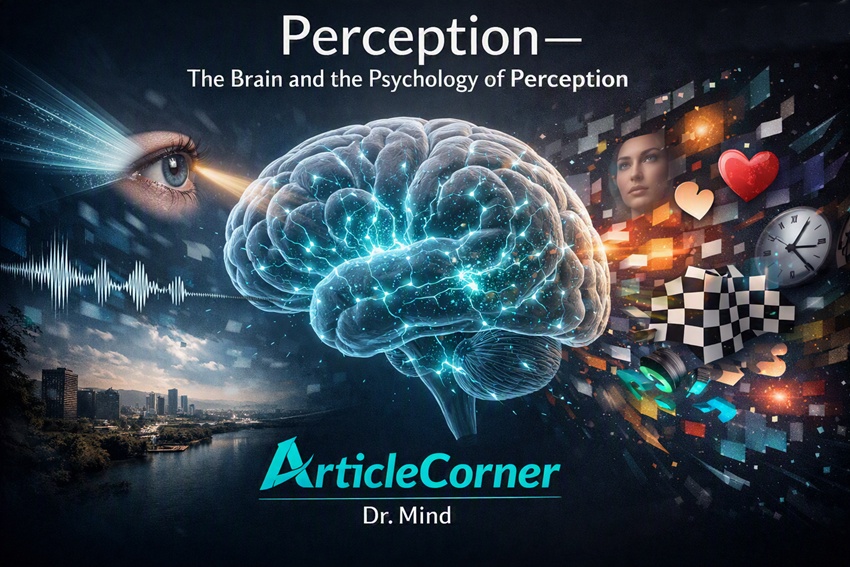
The Brain and the Psychology of Perception
Dr. Mind Explains:
There is a world around us, but we do not experience that world exactly as it is.
Light enters our eyes. Sound reaches our ears. Pressure touches our skin. We smell, taste, and feel the environment around us. But these signals are only the beginning. The brain must organize and interpret them before they become an experience.
This process is called perception.
Perception is the way the brain turns sensory information into something meaningful. It allows us to recognize a face, understand a voice, notice danger, enjoy music, or recognize a familiar place.
The brain does not simply receive information. It interprets it.
The Brain and Perception:
Our senses continuously send information to the brain. However, the brain receives far more information than it can consciously process at any given moment.
Because of this, the brain has to select what deserves attention.
When you walk through a crowded street, hundreds of sounds may reach your ears. You may hear conversations, cars, footsteps, music, and other noises. Yet you can focus on the voice of the person walking beside you.
Your brain is constantly filtering information.
This filtering is essential. Without it, everyday life would become overwhelming.
Perception therefore begins with sensation, but it does not end there. The brain combines sensory information with previous experiences, expectations, memories, and emotions.
What we experience is the result of this interaction.
Perception Is More Than Seeing:
We often use the word perception as if it simply means seeing something.
But perception involves much more.
Hearing a familiar song is not only about detecting sound waves. Your brain recognizes patterns, connects them with memories, and may even bring back a particular moment from your past.
Smelling a familiar perfume can suddenly remind you of someone.
Walking into an old house can create a feeling before you consciously remember why the place feels familiar.
The sensory information is real, but the experience created from that information is shaped by the brain.
This is why perception is not simply a window through which we observe the world.
It is an active process.
The Psychology of Perception:
Psychology has long studied how people interpret the world around them.
Two people can experience the same event and understand it differently. One person may see a difficult situation as a threat, while another may see it as an opportunity.
The event itself may be the same.
The perception is different.
Our expectations play an important role in this process. When we expect something to happen, the brain becomes more prepared to notice information that confirms that expectation.
Our previous experiences also influence perception.
A person who has experienced danger in a particular situation may become highly sensitive to similar situations in the future. Another person, without that experience, may not notice the same signals at all.
Attention also changes perception.
What we focus on becomes more prominent in our experience, while information outside our attention can become almost invisible.
This is one reason why two people standing in the same room can later remember different details.
They were not necessarily experiencing different worlds.
They were paying attention to different parts of the same world.
Perception and Emotion:
Emotion can also change the way we perceive things.
When we are frightened, an ordinary sound may suddenly seem threatening. When we are happy, the same environment may appear more pleasant.
When we are angry, a neutral expression can sometimes look hostile.
The brain does not separate perception from emotion completely. These systems constantly influence one another.
This does not mean that perception is imaginary.
It means that perception is personal.
The brain is trying to understand what sensory information means for us.
Is it safe?
Is it dangerous?
Is it familiar?
Is it important?
Should I pay attention?
These interpretations can happen extremely quickly, often before we consciously think about them.
When the Brain Gets It Wrong:
The brain is remarkably effective, but it is not perfect.
Optical illusions demonstrate this clearly.
We can look at an image and consciously know what we are seeing, while our brain continues to interpret it differently. Lines can appear longer or shorter. Shapes can seem to move when they are completely still. Colors can appear different depending on their surroundings.
These experiences reveal something important.
The brain does not simply copy reality.
It constructs an interpretation of reality.
Sometimes that interpretation is extremely accurate.
Sometimes it is wrong.
The same principle can appear outside visual illusions. We may mishear a word, misunderstand someone's expression, or interpret an ambiguous situation incorrectly.
The brain is constantly making predictions based on incomplete information.
Most of the time, this helps us.
Sometimes, it leads us astray.
Perception and Memory:
Perception is also closely connected to memory.
We do not approach every moment with an empty mind. We carry our previous experiences with us.
When we encounter something familiar, the brain can quickly compare the new information with stored memories.
This helps us recognize people, places, objects, sounds, and situations.
But memory can also influence what we perceive.
If we strongly expect something to look a certain way, our brain may interpret incomplete information according to that expectation.
This is one reason human perception is not completely objective.
We see the present through the influence of the past.
Do We See Reality as It Really Is?
This question takes us to the deepest part of perception.
There is an external world that exists independently of our thoughts. But the experience we have of that world is created inside the brain.
We do not experience light directly.
We experience what the brain creates from light.
We do not experience sound directly.
We experience what the brain creates from patterns of vibration.
The outside world provides information.
The brain turns that information into experience.
This distinction is important because it explains why perception can differ between individuals without meaning that reality itself has changed.
The same sunset can be seen by two people.
One may think about beauty.
Another may think about memories.
Someone else may barely notice it because they are worried about something else.
The sunset is the same.
The human experience of it is not.
The Brain and Our Personal Reality:
This is where neuroscience and psychology meet.
The brain provides the biological machinery for perception. Psychology helps us understand how attention, expectations, emotions, experiences, and interpretation shape what we experience.
Together, they show us that perception is not passive.
We are not simply recording the world.
We are continuously interpreting it.
Every moment, the brain receives information, compares it with what it already knows, predicts what might be happening, and creates a coherent experience.
That experience becomes what we call reality.
Not reality itself, but the reality we experience.
Perhaps this is one of the most fascinating characteristics of the human brain.
It does not merely allow us to live in the world.
It creates our experience of living in it.
Dr. Mind
We began with the brain.
We looked at neurons, thoughts, emotions, memory, and finally perception.
Each subject seemed different at first.
But they were never truly separate.
Neurons create the biological foundation.
Their activity contributes to thoughts.
Thoughts interact with emotions.
Experiences become part of memory.
And memory, emotion, attention, and expectation influence perception.
Together, these processes shape the experience we call consciousness.
The brain is not simply a machine that receives information.
It is an extraordinary system that continuously transforms information into experience.
Perhaps that is why understanding the brain is so difficult.
We are using the brain to study the very organ that allows us to think, remember, feel, and understand.
And perhaps we will never have a complete answer.
But that is not a reason to stop asking questions.
It is the reason we continue.
Because every question about the brain eventually becomes a question about ourselves.
We began this journey by looking at the brain.
We finish it by looking through the brain.
And perhaps the most fascinating thing about perception is not that the brain allows us to see the world, but that it gives us a way to experience it.
**The world exists outside us.**
**But the experience of that world is created within us.**
— **Dr. Mind**
Writer: articlecorner.com - ArticleCorner