ArticleCorner Science:
How Does a Piano Work?
Have you ever wondered what actually happens when you press a piano key?
You press one small key with your finger, and suddenly you hear a beautiful sound. But there is no speaker inside a traditional acoustic piano. So where does that sound come from?
The answer is a fascinating combination of movement, mechanics, vibration, and air.
What Happens When You Press a Key?
When you press a piano key, you are not directly hitting a string.
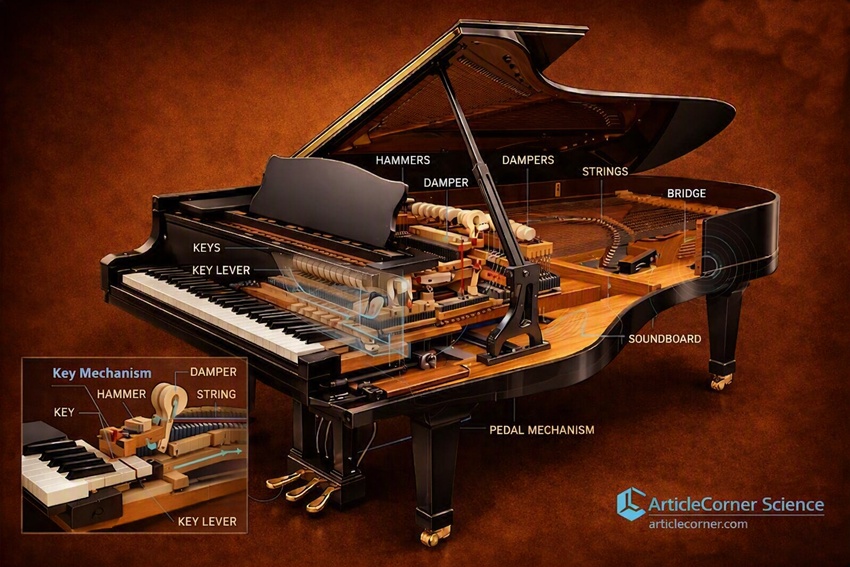
Instead, the key activates a small mechanical system inside the piano. This mechanism moves a small part called a hammer.
The hammer quickly moves toward a string and strikes it.
So the basic process looks like this:
Key → Mechanism → Hammer → String → Vibration → Sound
And all of this happens incredibly quickly.
How Does the String Make Sound?
When the hammer hits the string, the string starts vibrating.
That vibration moves the air around it. The moving air creates sound waves, and those waves eventually reach our ears.
But there is a problem.
A single piano string is actually quite small. By itself, it would not produce the powerful sound we expect from a piano.
This is where another important part comes in.
The Soundboard Makes the Sound Bigger
The vibrating string transfers some of its energy to the piano's soundboard through a part called the bridge.
The soundboard is a large wooden surface inside the piano.
It vibrates along with the strings and moves a much larger amount of air. This makes the sound much stronger and richer.
So the string creates the vibration, while the soundboard helps turn that small vibration into a sound we can easily hear.
Why Do Piano Keys Have Different Sounds?
Have you ever noticed that the keys on one side of the piano sound very deep, while the keys on the other side sound much higher?
That's because the strings are different.
The lower notes use longer and thicker strings. These strings vibrate more slowly, producing lower frequencies.
The higher notes use shorter and thinner strings. They vibrate much faster, producing higher frequencies.
So, in a way, the physical size of the strings helps determine the pitch we hear.
What Happens When You Press a Key Harder?
This is another interesting part.
If you press a key gently, the hammer hits the string with less energy.
If you press the key harder, the mechanism makes the hammer move faster, causing it to strike the string with more energy.
The string then vibrates more strongly, producing a louder and more powerful sound.
That's why a pianist can make the same note sound soft, strong, gentle, or dramatic simply by changing how they press the key.
Does the Hammer Stay Against the String?
No, and this is one of the cleverest parts of the piano mechanism.
The hammer hits the string and immediately moves away.
Why?
Because the string needs to vibrate freely.
If the hammer stayed against the string, it would stop or greatly reduce the vibration. By moving away immediately after the strike, the mechanism allows the string to continue vibrating.
This also allows pianists to play notes very quickly one after another.
What Do the Pedals Do?
The pedals at the bottom of the piano can change how the sound behaves.
One of the most commonly used pedals is the sustain pedal.
When you press it, the dampers that normally stop the strings from vibrating are lifted away.
The strings can then continue vibrating even after you release the keys.
That's why pressing the sustain pedal can make several notes blend together and create a longer, richer sound.
Does an Acoustic Piano Need Electricity?
No.
A traditional acoustic piano doesn't need electricity to produce sound.
The energy comes from your finger.
Your finger moves the key. The key activates the mechanism. The mechanism moves the hammer. The hammer hits the string. The string vibrates, and the soundboard helps amplify those vibrations.
It's basically a chain of mechanical energy:
Your finger → Key → Mechanism → Hammer → String → Soundboard → Air → Your ears
So, What Is a Piano Really Doing?
When you look at a piano, it may seem like a simple musical instrument.
But inside, it's actually a beautifully designed mechanical system.
A tiny movement from your finger can set a chain of mechanical events in motion, eventually creating a sound powerful enough to fill an entire room.
A piano turns the simple movement of a key into the complex beauty of sound.
ArticleCorner Science:
Where Physics, Meets Music.
Writer: articlecorner.com