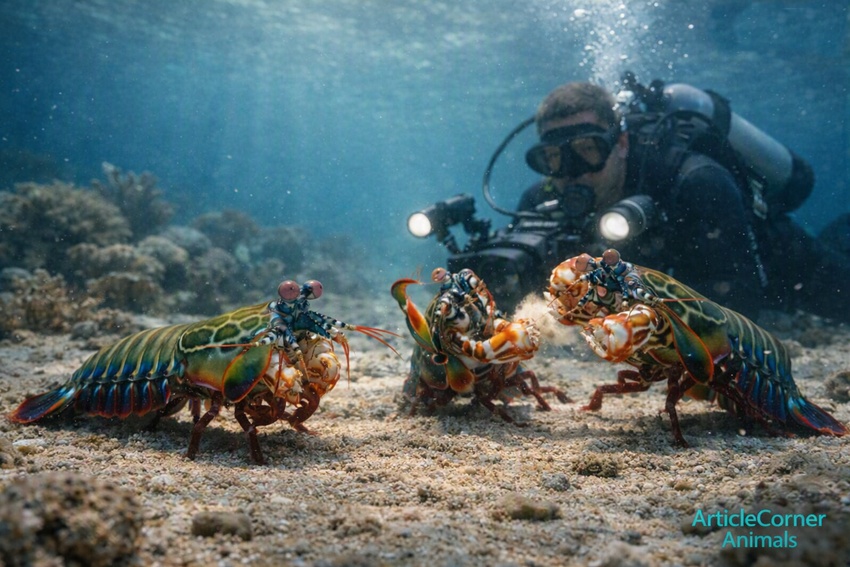
Mantis Shrimp — A Documentary Observation by Filmmaker Ahmet
As a documentary filmmaker, I have learned that the most fascinating animals are not always the ones that simply look impressive. Sometimes, what truly captures my attention is the way an animal behaves when no one is watching. The mantis shrimp is one of those animals.
At first glance, the mantis shrimp may look like an unusually colorful shrimp. But despite its name, it is not a true shrimp. It belongs to a completely different group of marine animals called stomatopods. Found mainly in tropical and subtropical seas, many species live around coral reefs, rocky seabeds, and sandy environments.
What makes the mantis shrimp remarkable is not only its extraordinary appearance or powerful strike. Its behavior reveals an animal that is highly specialized, observant, and remarkably precise.
Most mantis shrimps live in burrows that they carefully maintain. Some construct their shelters in sandy or muddy seabeds, while others use spaces among rocks and coral rubble. I have watched individuals repeatedly remove pieces of debris from their burrows, returning again and again to keep their shelter in order. It is a small behavior, but when you observe it closely, the burrow begins to look less like a hiding place and more like a carefully maintained territory.
Territorial encounters can be just as fascinating. When two mantis shrimps meet, the first response is not necessarily an attack. They may raise their bodies, display their appendages, and use visual signals to communicate. These ritualized displays can help the animals assess one another before a confrontation becomes physical.
Watching such encounters through a camera changes the way you see them. What may appear to be aggression from a distance can actually involve communication, assessment, and boundary setting. The animals are not simply reacting. They are signaling.
Courtship reveals another side of their behavior. Depending on the species, males may use visual displays and carefully coordinated movements to attract females. These interactions are very different from the image of the mantis shrimp as a solitary hunter. Here, movement becomes a language.
Reproduction can reveal an even quieter side of their lives. In some species, mating pairs may remain together for extended periods, and certain species are known to form long-term pair bonds. After spawning, females of many species carefully tend their eggs, keeping them clean and moving water across them. This helps protect the developing embryos from harmful growth and poor water conditions.
During this period, caring for the eggs becomes an important part of the animal’s behavior. The female's attention is no longer focused only on feeding or defending territory. She is protecting the next generation.
In some mantis shrimp species, males also contribute to reproduction and parental care. Their roles can include guarding the burrow or helping protect the eggs. These observations are important because they remind us that even among powerful marine predators, behavior is not defined by aggression alone.
The mantis shrimp is certainly a formidable hunter. Its specialized appendages can deliver an extraordinarily fast strike, making it one of the most remarkable predators in the ocean. But when you spend time observing one, another picture begins to emerge.
There is the animal that hunts, but also the animal that maintains its home. There is the territorial defender, but also the partner during courtship. There is the powerful predator, but also the parent carefully tending its eggs.
For me, this is what makes filming animals so rewarding. A camera does not simply record what an animal looks like. If we are patient enough, it can reveal how that animal lives.
And the mantis shrimp has a fascinating story to tell: beneath its extraordinary strength is a world of communication, territory, reproduction, care, and remarkable precision.
Perhaps the greatest lesson from watching animals is that we should never judge them by a single characteristic. The mantis shrimp may be famous for its incredible power, but its real story begins when we stop watching the strike and start watching the animal.
ArticleCorner Animals: The Knockout Artist of the Ocean: Mantis Shrimp.
Writer: articlecorner.com