Why Do We Dream?
Dr. Mind Explains:
There is a strange moment that happens to almost everyone. You wake up, and for a few seconds you are still somewhere else. A place that does not exist. A conversation that never happened. A person who may be far away, or perhaps no longer part of your life. Then the experience begins to disappear. Within minutes, parts of it may already be gone.
That strange experience is a dream.
Dreams have fascinated human beings for thousands of years. Long before modern neuroscience, people tried to understand them through religion, mythology, philosophy, and superstition. Some believed dreams carried messages from another world. Others saw them as predictions of the future. Today, science gives us a very different way of looking at dreams, but many questions remain.
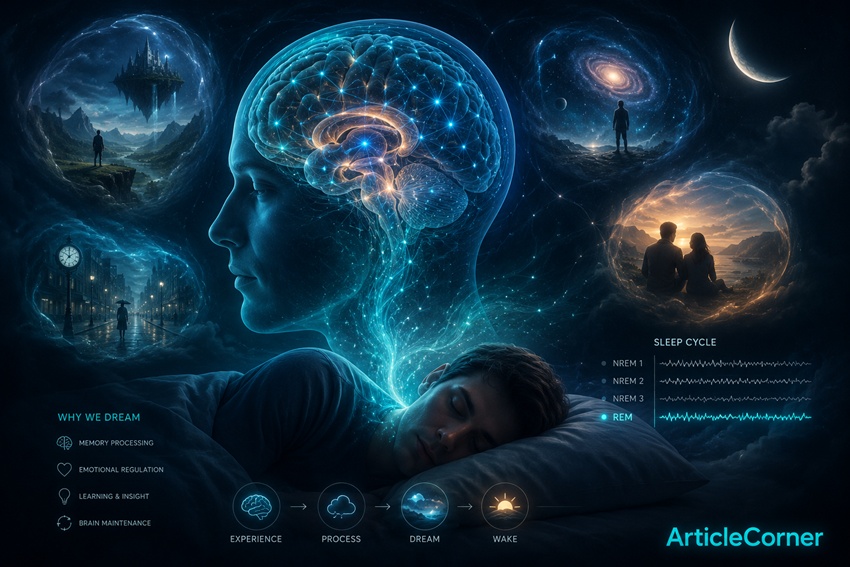
We now know that dreaming is closely associated with sleep, particularly with a stage called **REM sleep**, which stands for rapid eye movement sleep. During REM sleep, the brain can become highly active, while most of the body's large muscles remain temporarily inhibited.
This unusual combination creates a fascinating state: the brain is active enough to produce vivid experiences, while the body is largely prevented from physically acting them out.
But dreams are not limited exclusively to REM sleep.
Dreaming and dream-like mental experiences can occur during other stages of sleep as well. REM sleep is simply the stage most strongly associated with the vivid, complex and often bizarre dreams that people commonly remember.
And bizarre is a very appropriate word.
In a dream, you can suddenly find yourself in a place you have never visited. Someone from your childhood can appear beside a person you met yesterday. You can be walking through your old school and, without noticing anything strange, suddenly discover that the building has become a completely different place.
While awake, your brain usually tries to maintain a relatively stable model of the world.
During dreaming, that stability can become much more flexible.
One reason dreams can feel so real is that many of the brain systems involved in perception, emotion, memory, and imagery remain active during sleep. The brain can generate an experience without receiving the same amount of information from the outside world that it receives while you are awake.
You are not necessarily seeing the dream with your eyes.
Your brain is generating the experience internally.
This is an important distinction.
When you are awake and looking at a tree, light reflected from the tree enters your eyes and information travels through the visual system. Your brain processes that information and you experience the tree.
During a dream, there may be no tree in front of you at all.
Yet your brain can construct the experience of seeing one.
This tells us something profound about perception. The brain does not require the physical presence of an object to create a mental representation of it. It can generate images, sounds, emotions and situations from internally produced activity.
Dreams provide a remarkable example of this ability.
But why does the brain do it?
This is where we need to be careful.
Science does not currently have one universally accepted explanation for why humans dream. Several theories have been proposed, and different aspects of dreaming may serve different functions. Dreams may be related to memory processing, emotional regulation, learning, brain development, and the way the sleeping brain organizes internally generated information.
Some researchers have suggested that dreaming may emerge partly from the brain's attempt to make sense of internally generated activity during sleep. Other research has explored connections between dreams and memory consolidation, particularly the processing of experiences and information acquired during waking life.
The important point is that we should not pretend there is a single final answer.
We are still investigating.
What we do know is that sleep itself is not a period in which the brain simply switches off.
The sleeping brain remains highly active.
During sleep, the brain participates in processes important for learning, memory, emotional regulation, metabolism, and the maintenance of normal brain function. Different stages of sleep are associated with different patterns of neural activity, and the brain moves through these stages repeatedly during a normal night.
Dreaming is therefore part of a much larger biological process.
Now let's return to memory.
You may have noticed something strange about dreams: they can seem incredibly vivid while you are experiencing them, yet disappear almost immediately after waking.
You may remember an entire story one moment and struggle to recall even the basic details a few minutes later.
Why?
Part of the answer may involve how memory systems operate during sleep. The brain is not necessarily encoding dream experiences in exactly the same way it encodes ordinary waking experiences. Changes in brain activity during sleep may make some dream content more difficult to preserve and retrieve after waking.
This is why keeping a notebook beside your bed can be useful if you want to study your own dreams. Writing down what you remember immediately after waking can capture details that might otherwise disappear very quickly.
And even then, you are not necessarily recording the entire dream.
You are recording what remains accessible to you after waking.
That distinction matters.
Dream memory is itself a reconstruction.
The dream you remember may already be different from the dream you experienced.
This brings us to one of the most fascinating features of dreams: emotion.
Dreams can produce powerful emotional experiences. You can wake from a dream feeling frightened, relieved, sad, excited, or deeply moved, even though nothing actually happened to you in the physical world while you were asleep.
The emotional systems of the brain remain active during sleep, and this can contribute to the intensity of dream experiences.
A dream does not need to be logical to feel emotionally convincing.
In fact, dreams often ignore logic completely.
You may know that something impossible is happening, yet accept it without question. You may find yourself speaking to someone who died years ago, flying over a city, or walking through a house that changes shape from one room to the next.
While awake, you would probably notice the contradictions immediately.
In a dream, the brain can accept them as part of the experience.
This suggests that the systems involved in evaluating reality and maintaining logical consistency may function differently during dreaming. The result is an unusual mental environment in which images, memories, emotions, and expectations can combine in ways that would rarely occur during ordinary waking consciousness.
Dreams can therefore be strange without being meaningless.
But we should be cautious about interpreting them.
There is no scientific rule saying that a particular dream symbol always has one universal meaning. Dream interpretation has a long cultural history, but the idea that every dream contains a hidden message with a fixed meaning is not supported by strong scientific evidence.
A dream about falling does not automatically mean one particular thing.
A dream about water does not automatically reveal one particular psychological truth.
Context matters.
Your personal experiences matter.
Your memories matter.
Your emotional state matters.
The same dream image could mean something completely different to two different people.
This is another reason the brain is so interesting. It does not process information in isolation. It continually connects new experiences with previous experiences.
And dreams may reflect some of those connections.
A person you have not consciously thought about for years may suddenly appear in a dream. A place from childhood may return in a completely unfamiliar form. A recent conversation may become mixed with an old memory.
The brain can combine fragments of experience into something new.
This ability is not limited to dreaming.
It is fundamental to imagination itself.
During waking life, the same brain that remembers the past can also construct possibilities that have never happened. Dreaming may reveal just how powerful this internal generative ability can be when external sensory information is reduced.
There is also something remarkable about the relationship between dreams and creativity.
Throughout history, people have described dreams that seemed to provide unusual ideas, images, melodies, or solutions. It would be too strong to claim that dreams are a special source of guaranteed creativity, but sleep can influence how memories and information are reorganized, and this may sometimes contribute to new associations or insights.
The sleeping brain is not simply resting.
It is still working with information.
And perhaps that is the most useful way to think about dreams.
Not as supernatural messages.
Not as meaningless noise.
But as experiences emerging from a brain that remains active while our relationship with the outside world changes dramatically.
When you fall asleep, your senses become less engaged with the environment. Your body enters different physiological states. Your brain changes its patterns of activity. Memories and emotional information continue to interact with neural systems.
And somewhere within that changing landscape, a dream can appear.
Sometimes it lasts for what feels like hours.
Sometimes it is little more than a fragment.
Sometimes you remember it for years.
Sometimes it disappears before you even get out of bed.
We still do not know exactly why the brain creates the particular stories, images, and experiences that appear in dreams. There is no complete theory that explains every dream.
But perhaps we should not be surprised.
We are trying to understand one of the most private experiences a human being can have: a world generated by the brain while the body lies still in darkness.
And when you wake up, something extraordinary has happened.
For a while, your brain created a world without requiring the ordinary world around you.
You experienced places that did not exist.
You saw people who were not there.
You felt emotions caused by events that never physically happened.
And then you opened your eyes.
The world returned.
The dream began to fade.
But the brain continued.
And that brings us to something even more fundamental.
If the brain can create thoughts, memories, emotions and entire dream worlds, then perhaps we should ask how it creates something even more basic:
**our experience of reality itself.**
That is where we are going next.
**Next time, let's explore perception — how the brain takes signals from the world and turns them into the reality we experience.**
— **Dr. Mind**
Writer: articlecorner.com - ArticleCorner