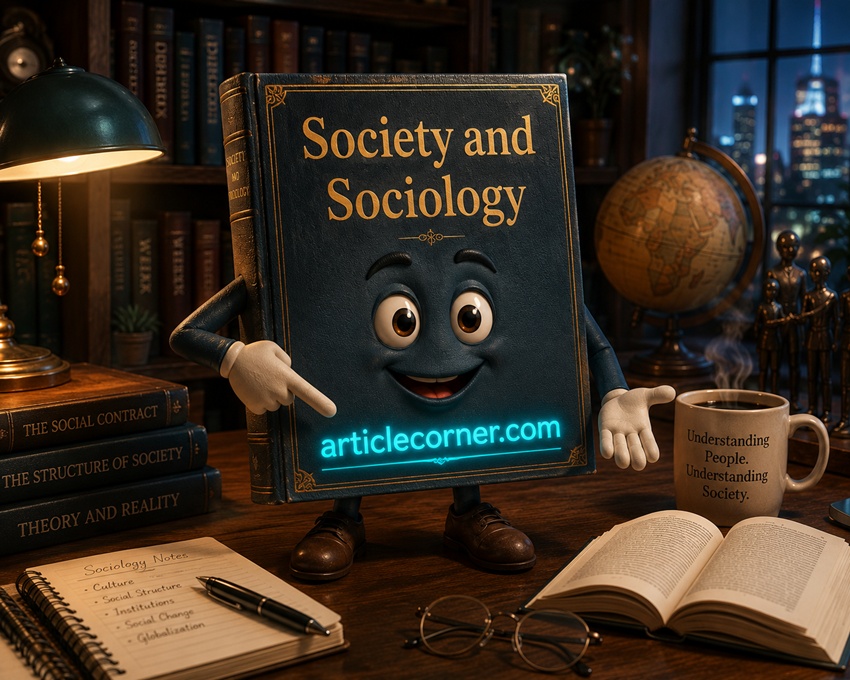
The Sociology Book Explains
I am a Sociology book.
Welcome. Before you open my pages, allow me to introduce myself. I have watched humanity for thousands of years, and today I will briefly summarize the story I have been telling from the very beginning.
Human society has never stood still. Every generation has inherited ideas, traditions, and struggles from those who came before. From the first small villages to today's towering cities, people have searched for safety, belonging, purpose, and meaning. My role has always been to explain this journey and remind readers that although civilizations change, the fundamental needs of human beings remain remarkably similar.
My earliest chapters begin with ancient communities. Life was deeply connected to nature, family, and cooperation. Survival depended on helping one another. Work was shared, celebrations united communities, and knowledge was passed carefully from one generation to the next. A person's value was measured more by relationships than by possessions.
Life was difficult, but many communities possessed something that cannot easily be manufactured today: genuine social connection.
As you continue reading me, you witness civilizations expanding. Cities rise, trade flourishes, governments emerge, and institutions become stronger. These developments create remarkable opportunities, yet they also introduce inequality.
Then comes the Industrial Revolution, where factories reshape everyday life. Productivity reaches extraordinary levels, but countless individuals become small parts of vast economic systems.
My modern chapters reveal another transformation. Capitalism drives innovation, scientific progress, and economic growth. Millions enjoy higher standards of living than previous generations. Yet alongside these achievements, another force quietly grows.
Consumption becomes more than an economic activity. It gradually becomes a lifestyle. Businesses no longer simply sell products. They begin selling dreams, identities, status, and emotional satisfaction.
Then technology enters almost every moment of daily life. Smartphones accompany every conversation. Social media never sleeps. Algorithms learn your preferences. Advertisements become increasingly personal. Every notification competes for your attention. Success slowly becomes associated with visibility, possessions, followers, and endless productivity.
Information spreads faster than ever before, but so do comparison, anxiety, and unrealistic expectations. Many people begin running toward a finish line that constantly moves farther away.
As you read these pages, you may notice something important. Modern consumer culture often whispers that happiness is always waiting behind the next purchase. Every advertisement suggests that something is missing. Every trend encourages another upgrade. Every new desire replaces the one before it.
Satisfaction arrives briefly, then quietly disappears, inviting the cycle to begin again.
This is one of the questions I ask my readers. Are your choices entirely your own, or have invisible influences quietly shaped them? Marketing, digital platforms, and social pressure do not merely reflect society. They participate in creating it.
Without realizing it, many people begin following paths designed by systems whose greatest goal is to keep their attention for as long as possible.
Eventually, many reach a destination they never intended to find. Exhaustion. Despite remarkable technological progress, countless people feel overwhelmed, emotionally tired, and disconnected from themselves and from others.
They own more than previous generations, yet often experience less peace, less time, and fewer meaningful relationships. Burnout quietly becomes one of the defining experiences of modern society.
Fortunately, my story does not end there.
Near my final chapters, another idea appears. Minimalism. It is not about rejecting progress or abandoning comfort. It is about choosing intentionally. It asks a simple question that every generation eventually faces. What truly adds value to your life?
By owning less, consuming more consciously, reducing digital noise, and investing in genuine human relationships, many people rediscover clarity, gratitude, and emotional balance.
After thousands of years of observing humanity, I have learned one lesson above all others. Human fulfillment has never depended entirely on material abundance. Across every civilization, the strongest societies have always been built upon trust, purpose, compassion, creativity, and meaningful relationships. These treasures cannot be purchased, downloaded, or delivered overnight.
They grow slowly through attention, shared experiences, and authentic human connection.
I am only a Sociology book, but if I could leave you with one final thought, it would be this. The story of society is not simply the story of economic growth or technological innovation. It is the story of remembering what it truly means to live well.
In a world that constantly asks you to want more, perhaps the greatest freedom is discovering that enough has always been enough.
ArticleCorner.com Perspective
The world constantly encourages us to own more, consume more, and become more. Yet lasting fulfillment rarely comes from accumulation.
Sometimes the richest life begins when we choose less, focus on what truly matters, and make room for peace, purpose, and meaningful human connection.
Writer: articlecorner.com