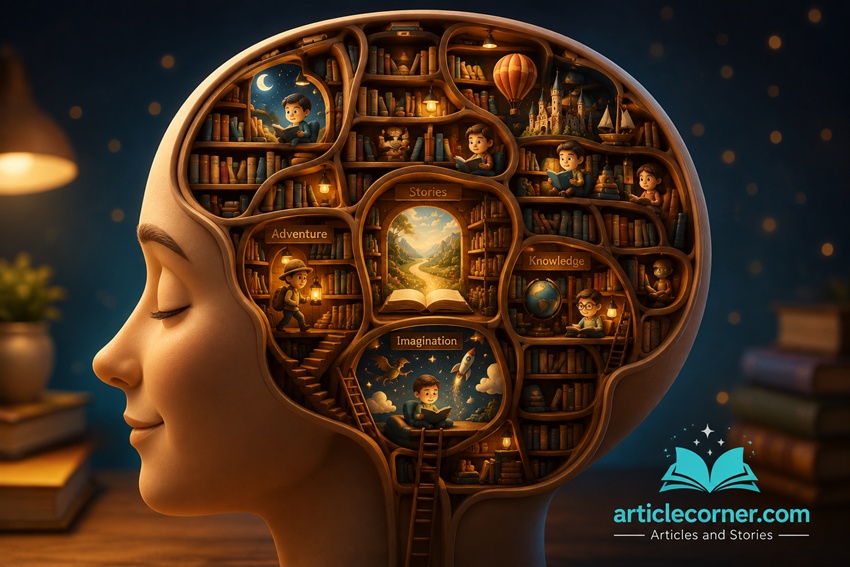
Why Do We Need Stories?
We have been telling stories for thousands of years.
Long before books, newspapers, television, or the internet, people sat around fires and told each other stories. They talked about journeys, love, loss, courage, mistakes, strange places, and people they would never forget.
But why?
Why have humans always needed stories?
Perhaps because a story can say something that ordinary words sometimes cannot.
When someone tells us, “Life can be difficult,” we understand the sentence. But when we read about a person who loses everything and still finds a reason to continue, we feel it differently.
A story does not simply give us information.
It gives information a heartbeat.
Stories help us understand other people. We can enter the life of someone who grew up in another country, lived in another century, or experienced a life completely different from ours. For a few minutes, we see the world through someone else's eyes.
That may be one of the greatest things a story can do.
It can make a stranger feel familiar.
Stories also help us understand ourselves.
Sometimes we read about a character and suddenly recognize something in ourselves. A fear we never talked about. A dream we forgot. A mistake we once made. A feeling we thought belonged only to us.
And we realize that perhaps we are not as alone as we imagined.
Children understand this naturally.
They listen to stories about brave heroes, talking animals, distant planets, mysterious forests, and magical worlds. They know these things may not be real, but they don't need them to be real.
They need to imagine.
Imagination is not something we should leave behind when we grow up.
Adults need it too.
We need imagination when we create something new, solve a difficult problem, understand another person, or imagine a better future.
Stories keep that part of us alive.
Today, we have more information than any generation before us. With a few taps, we can learn what happened on the other side of the world.
But information and understanding are not the same thing.
Information tells us what happened.
A story can help us understand what it felt like.
That is why stories still matter in a world filled with screens, algorithms, artificial intelligence, and endless streams of information.
A story asks us to slow down.
To listen.
To imagine.
To feel.
And sometimes, simply to wonder.
Maybe that is why we never really outgrow stories.
We only change the stories we need.
When we are children, we may need stories about adventure.
When we grow older, we may look for stories about love, loss, courage, identity, or hope.
And sometimes, when life becomes confusing, we simply need a story that reminds us that someone else has walked a difficult road before us.
Stories connect generations.
A grandmother can tell a story to a child.
A writer can speak to a reader who was born hundreds of years later.
A forgotten diary can suddenly make a person from the past feel alive again.
A simple story can travel farther than its writer ever imagined.
Perhaps that is the real magic of storytelling.
We tell stories because we want to be heard.
We read stories because we want to understand.
And we remember stories because, somewhere inside them, we often find a small piece of ourselves.
So, why do we need stories?
Maybe because life happens only once, but through stories, we get the chance to experience it many times.
And perhaps every good story quietly reminds us of something important:
We are all living a story.
ArticleCorner : Articles to inspire the mind. Stories to awaken the imagination.
Writer: articlecorner.com