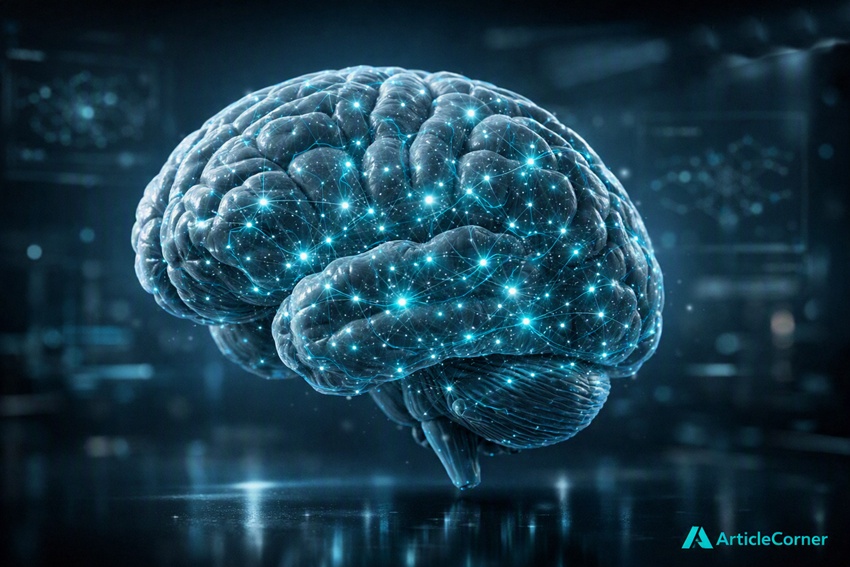
What Is the Human Brain?
Dr. Mind Explains:
Let’s begin with something that seems surprisingly simple: **What exactly is the human brain?**
You carry it with you every second of your life. You do not have to think about breathing, remembering your name, recognizing a familiar face, or deciding whether you like the sound of a particular song.
Your brain is working continuously, even when you are asleep. It receives information from the world, processes that information, stores some of it, ignores much of it, creates predictions, controls your body, and somehow gives you the experience of being *you*.
And yet, despite everything we have learned about it, the brain remains one of the greatest scientific mysteries we have ever encountered.
The human brain is the central organ of the nervous system. It is protected by the skull and connected to the rest of the body through the spinal cord and an enormous network of nerves. Physically, it is not especially large compared with the rest of the body.
In an average adult, it weighs roughly 1.3 to 1.4 kilograms. But size alone tells us very little.
What makes the brain remarkable is the extraordinary complexity of its structure and the constant communication taking place within it.
At the heart of this communication are **neurons**, specialized cells that can receive, process, and transmit information. The human brain contains billions of neurons, and each neuron can communicate with many other cells. These connections form enormously complex networks.
Some of these networks help you move your hand, others help you recognize a face, remember a conversation, understand language, regulate your heartbeat, or respond to danger. The brain is not simply a collection of isolated cells. It is a living network in which countless signals are constantly being exchanged.
And here is where things become particularly interesting.
Your brain does not simply receive the world like a camera recording whatever happens in front of it. It actively interprets what it receives. Light enters your eyes, sound waves reach your ears, and signals arrive from the rest of your body. But what you actually experience is the result of the brain processing and interpreting those signals.
In other words, your experience of the world is not created by your eyes or ears alone. **Your brain constructs your perception of that world.**
Think about the simple act of recognizing someone you know. You see a face, but your brain is doing far more than identifying shapes and colors. It compares what you are seeing with information stored from previous experiences.
It may recognize the person's voice, remember conversations you have had with them, predict how they might react, and even produce an emotional response before you consciously analyze what is happening. All of this can happen remarkably quickly.
This is one reason the brain is so fascinating. It is both an organ of the body and the place where our conscious experience seems to emerge. Your memories, thoughts, emotions, intentions and imagination are deeply connected to the activity of your brain.
When you remember your childhood, imagine tomorrow, solve a problem, feel frightened, fall in love, or wonder about your own existence, your brain is involved.
But we should be careful here.
Science has learned a tremendous amount about how different parts of the brain function, how neurons communicate, how memories are formed, and how brain activity changes during different mental states. Yet we still do not have a complete explanation of consciousness itself.
We can observe brain activity. We can identify patterns. We can study what happens when particular brain regions are damaged or stimulated.
But explaining **why brain activity is accompanied by a subjective experience of being conscious** remains one of the deepest questions in science and philosophy.
So when we talk about “the brain,” we are really talking about several things at once. We are talking about a biological organ, a communication system, a prediction machine, a learning system, and the physical foundation of many of our mental abilities.
We are also talking about the mysterious relationship between physical processes inside the skull and the private world of thoughts and experiences that each of us knows from the inside.
And perhaps that is what makes the human brain so extraordinary.
The brain is the object we use to study the brain.
Think about that for a moment.
When scientists examine memory, the brain is doing the examining. When philosophers ask what consciousness is, the brain is producing the thoughts behind the question. When you read these words and try to understand them, your own brain is quietly processing every sentence.
In a sense, we are using the mystery to investigate the mystery.
Of course, the brain is not a perfect machine. It can make mistakes. It can forget important information and remember things that never happened exactly as we believe. It can be influenced by emotion, expectation, experience, and the surrounding environment. Sometimes it can even convince us that our interpretation of reality is correct when it is not.
That does not make the brain defective. It makes it biological.
The brain evolved to help an organism survive, adapt, learn, and interact with its environment. It was not designed to provide us with a perfectly objective picture of reality. Its extraordinary ability to predict, simplify, and respond quickly is part of what makes intelligent behavior possible.
But those same abilities can sometimes lead to illusions, biases, mistaken memories, and surprising decisions.
There is another remarkable feature of the brain that is worth remembering: **it can change.**
The brain is not completely fixed after childhood. Throughout life, experience and learning can alter neural connections and influence how different networks function. This capacity for change is often referred to as **neuroplasticity**.
Every time you learn something new, practice a skill, or repeatedly experience something, your brain is participating in a process of adaptation.
So perhaps the human brain should not be thought of as a finished object.
It is more like a continuously changing landscape.
Your experiences leave traces. Your habits influence your behavior. Your learning changes the way you respond. Your memories become part of the story you tell yourself about who you are. And while biology places important boundaries on what the brain can do, the relationship between the brain, the environment, and experience is extraordinarily complex.
Now let me ask you something.
You can see your hands. You can hear your voice. You can feel your heartbeat. But you cannot directly see the thoughts occurring inside your own brain.
Yet those thoughts shape almost everything you experience.
So where does the “you” inside your brain actually begin?
Is it your memories?
Your personality?
Your thoughts?
Your emotions?
Or is the feeling of being “you” something the brain continuously creates from all of these processes?
We don't have a final answer.
And that is exactly where our journey begins.
You can continue your journey by clicking the Dr. Mind link.
Writer: articlecorner.com - ArticleCorner