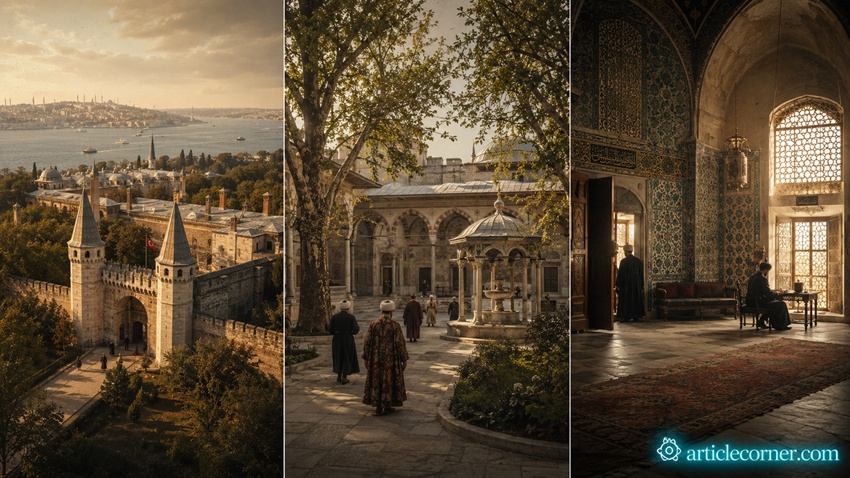
ArticleCorner Istanbul - Topkapi Palace
Where an Empire Lived
Have you ever wondered what it would feel like to walk through the gates of a palace where an empire was once governed?
Topkapi Palace is far more than just a historical building. Behind its walls lived monarchs, their spouses, and their children, officials, servants, and countless others whose lives became woven into the very fabric of Istanbul's history.
Today, the voices are gone, but the courtyards remain.
So let us walk through those gates together and imagine the people, decisions, hopes and secrets that once filled this remarkable place.
This is the story of Topkapi Palace.
A Palace at the Edge of Two Worlds:
After the conquest of Constantinople in 1453, Istanbul became the center of the Ottoman Empire.
Sultan Mehmed II, known as Mehmed the Conqueror, understood that the new imperial capital needed a new center of power.
The first Ottoman palace in Istanbul was built at Beyazıt. But Mehmed II later chose a more extraordinary location for a new imperial palace.
It was the historic promontory overlooking the Golden Horn, the Bosphorus and the Sea of Marmara.
From here, almost all of Istanbul seemed to unfold before the eyes.
Construction of Topkapi Palace began in the 15th century.
It would gradually become one of the most important places in the Ottoman world.
A Palace Unlike European Palaces:
When we imagine a palace, we often picture one enormous building.
Topkapi is different.
It grew as a collection of courtyards, gardens, pavilions, chambers, kitchens, treasury buildings, religious spaces and administrative areas.
Instead of one massive palace dominating the landscape, Topkapi developed almost like a small world within the city.
Its courtyards were connected by gates.
Each gate marked a transition.
As you moved deeper into the palace, you moved further away from the ordinary life of Istanbul and closer to the private and political heart of the empire.
The First Gate:
The Imperial Gate was the main entrance between the palace and the city.
Imagine standing here centuries ago.
Outside were the streets of Istanbul.
Merchants were working.
Travelers were arriving.
People were moving through the capital.
Inside the gates was a different world.
The palace was both a residence and a center of government.
From these grounds, decisions could travel far beyond Istanbul.
A document written here could concern a distant province.
A decision made here could affect a war.
A meeting here could change the life of an empire.
The First Courtyard:
The First Courtyard was the most public part of the palace complex.
It was a place of movement.
Officials, soldiers, servants and visitors passed through.
The palace was not isolated from the city. It was connected to it through a constant flow of people.
And perhaps this is something easy to forget when looking at Topkapi today.
It was once busy.
People were not standing quietly behind museum glass.
They were working.
Carrying messages.
Preparing food.
Moving supplies.
Waiting for appointments.
Serving the palace.
Living their lives.
Topkapi was a workplace, a residence and a center of power all at once.
The Gate of Salutation:
The second major entrance was the Gate of Salutation, also known as the Middle Gate.
Passing through it meant entering a more restricted part of the palace.
The atmosphere changed.
This was closer to the heart of imperial administration.
The Divan, the imperial council, was located here.
Important officials gathered to discuss the affairs of the empire.
The grand vizier and other senior statesmen could debate military campaigns, finances, diplomacy and administration.
The sultan did not necessarily need to sit among them.
The system of government had its own structure.
Yet everyone knew where the ultimate authority rested.
Where Decisions Were Made:
Imagine a meeting taking place centuries ago.
The participants are discussing a military campaign.
Maps are spread out.
Reports have arrived from distant provinces.
Messages have come from foreign rulers.
Someone is concerned about the treasury.
Someone else is worried about an army.
Outside, Istanbul continues its ordinary life.
People buy bread.
Ships enter the harbor.
Children play in the streets.
Most of them have no idea what is being discussed inside the palace.
But the decisions being made here may determine what happens to their lives.
That contrast is one of the most fascinating things about Topkapi.
Ordinary life and imperial power existed only a short distance apart.
The Imperial Council:
The Divan was one of the most important institutions of the Ottoman government.
It was where senior officials discussed the affairs of the state.
Diplomacy, justice, finance and military matters could all come before the council.
The famous Tower of Justice rises above this part of the palace.
Its position was symbolic.
Justice was supposed to stand above the affairs of government.
Whether history always lived up to that ideal is another question.
But the symbol itself tells us something about how the Ottoman state wanted power to be understood.
The Imperial Treasury:
Behind the palace walls were treasures accumulated over centuries.
Gold and silver objects.
Jewelry.
Weapons.
Ceremonial items.
Manuscripts.
Gifts from foreign rulers.
Objects associated with the sultans.
Some pieces are so famous that they have become almost legendary.
But there is something interesting about seeing these treasures today.
A jewel may look beautiful behind glass.
Yet once, it had a purpose.
It may have been worn during a ceremony.
Presented as a diplomatic gift.
Carried during a royal procession.
Or kept as a symbol of authority.
The object remains.
Its original world is gone.
The Harem:
Few parts of Topkapi have captured the imagination of visitors more than the Harem.
The word itself often creates romantic images.
But the reality was far more complicated.
The Harem was part of the private world of the Ottoman palace.
It was home to members of the imperial family and the people who served them.
Women of the dynasty lived here.
The Valide Sultan, the mother of the reigning sultan, held an important position within this world.
Şehzades grew up here.
Relationships were formed.
Children were raised.
Rules governed everyday life.
There was privilege, but there were also restrictions.
There was affection, but there could also be rivalry and uncertainty.
Behind the beautiful tiles and decorated rooms were real human lives.
The Sultan's Mother:
One of the most influential figures in the palace could be the Valide Sultan.
She was not simply the mother of the ruler.
In certain periods, she could possess considerable influence within the palace and beyond it.
Imagine the position.
Your son is the ruler of a vast empire.
Foreign ambassadors arrive.
Officials compete for influence.
Şehzades are growing up around you.
The future of the dynasty is always present in the background.
The Harem was therefore not merely a private residential area.
It was also a place where family, politics and power could intersect.
The Şehzades:
Topkapi was also a place where Ottoman şehzades grew up.
From childhood, they were aware that the future of the dynasty could depend on them.
They were educated in religion, administration, literature, military skills and statecraft.
They lived in a world very different from that of ordinary children.
But they were still children.
They played.
They learned.
They made friendships.
They experienced fear.
They wondered what their future would become.
Some would become sultans.
Most would not.
Behind the formal history of the Ottoman dynasty were young people trying to understand a world that had already decided much of their future for them.
The Kitchens of Topkapi:
There is another side of the palace that tells us something surprisingly human:
the kitchens.
A palace housing thousands of people needed an enormous organization to provide food.
The kitchens were constantly active.
Meals had to be prepared.
Ingredients had to be stored.
Servants had to be organized.
Special dishes had to be prepared for the imperial household.
The kitchens remind us of something simple.
An empire may be governed by grand political decisions, but people still need to eat.
Behind the ceremonies and politics was a huge daily operation.
Topkapi was a living institution.
The Palace and the Bosphorus:
Perhaps one of the most beautiful things about Topkapi is its relationship with the sea.
From the palace grounds, the Bosphorus opens before you.
Ships have been passing these waters for centuries.
The same sunlight still touches the water.
The same winds still move across the gardens.
Stand there today and look toward the Bosphorus.
It is easy to imagine a sultan standing somewhere nearby centuries ago and seeing almost the same horizon.
The city has changed.
The ships have changed.
The skyline has changed.
But the water remains.
A Palace Full of Silence:
The Ottoman court was once filled with voices.
Today, Topkapi is often remarkably quiet.
Visitors walk slowly through the courtyards.
They stop to look at tiles.
They read descriptions.
They photograph the view.
And perhaps, without realizing it, they are walking through spaces where people once hurried because something important was happening.
A messenger might have crossed the courtyard.
A servant might have carried a tray.
An official might have been waiting nervously for an audience.
A şehzade might have walked through these same gardens.
History has a strange way of doing this.
It turns busy places into silent places.
The Tulip Garden:
The palace gardens offered another world.
Flowers, trees, fountains and views toward the sea created spaces away from the formal business of government.
The tulip became especially associated with Ottoman culture and the famous Tulip Era of the early 18th century.
But gardens were not merely decoration.
They offered moments of escape.
Even people living inside an imperial palace needed somewhere to breathe.
Perhaps a sultan walked through these gardens after a difficult meeting.
Perhaps someone sat beneath a tree and looked toward the sea.
We cannot know every private moment.
But the gardens allow us to imagine them.
The Sacred Relics:
Topkapi also became the home of important sacred relics associated with Islamic history.
These objects gave the palace another dimension.
It was not only the center of political power.
It was also a place connected to faith and religious tradition.
For many visitors, these relics were among the most meaningful objects in the palace.
They remind us that Ottoman rulers understood their role not simply through political authority, but also through religious identity and responsibility.
The Last Centuries:
As the Ottoman Empire entered its later centuries, Istanbul changed.
The empire faced wars, political challenges, economic pressures and the rise of new powers in Europe.
The center of imperial life gradually shifted.
New palaces were built.
Dolmabahçe Palace, on the Bosphorus, became the preferred residence of Ottoman sultans in the 19th century.
Topkapi no longer held the same central role it had enjoyed for centuries.
But it remained part of the story.
Its importance did not disappear.
It simply changed.
From Imperial Palace to Museum:
The Ottoman Empire ended after the First World War.
A new chapter began with the establishment of the Republic of Turkey.
Topkapi Palace eventually became a museum and opened its doors to the public in 1924.
The people who once lived behind its walls were gone.
The political system that had given the palace its purpose had disappeared.
But the buildings remained.
And now, instead of servants and statesmen, visitors began filling its courtyards.
The palace had become a place where history could be encountered rather than lived.
What Remains Behind the Walls?
Today, we can see the objects.
The buildings.
The courtyards.
The gardens.
The weapons.
The manuscripts.
The treasures.
But the most interesting things are the ones we cannot see.
The conversations.
The arguments.
The private celebrations.
The fears.
The decisions.
The dreams of people who lived here.
Those things disappeared with them.
Perhaps that is why historical places can feel strangely emotional.
We can see where people stood.
But we can never hear exactly what they said.
Topkapi and Istanbul:
Topkapi Palace is impossible to separate from Istanbul.
It was built because the city became the Ottoman capital.
It developed as the empire expanded.
It changed as Istanbul changed.
And it eventually became one of the most important symbols of the city's Ottoman identity.
Standing on the palace terrace today, with the Bosphorus stretching toward the horizon, you can understand why this location mattered so much.
The city is all around you.
The sea is beneath you.
And beyond the sea lies another continent.
Perhaps there could hardly have been a more powerful place from which to govern an empire.
If Topkapi Could Speak
If the palace could speak, perhaps it would tell us that power is never as simple as it looks.
It would remember rulers who seemed powerful but were also human.
She would recall family lineages that did not know what the future held.
It would remember women whose influence was often hidden behind palace walls.
It would remember servants whose names disappeared from history.
It would remember celebrations and difficult days.
It would remember an empire at its greatest height.
And it would remember the day that empire finally ended.
But perhaps it would also say something simpler:
“I was here.”
And that may be enough.
A Palace, A City, A Memory:
Topkapi Palace is not simply a place where sultans lived.
It is a place where an entire system of life once existed.
Government.
Family.
Faith.
Art.
Education.
Food.
Ceremony.
Ambition.
Love.
Fear.
Everything that makes human life complicated could be found somewhere behind those walls.
That is why walking through Topkapi today feels different from simply looking at an old building.
You are walking through the remains of a world.
A world that once believed its future would continue forever.
But history has a way of reminding us that nothing remains unchanged.
Empires disappear.
Palaces become museums.
People become memories.
And cities continue.
The Story Continues:
Today, Topkapi Palace looks toward a very different Istanbul.
Modern ships cross the Bosphorus.
Skyscrapers appear beyond the historic skyline.
Millions of people move through the city every day.
Yet the palace remains on the same historic peninsula, watching over the city as it has done for centuries.
Perhaps that is the quiet beauty of Topkapi.
It does not need to tell us that it was once the center of an empire.
The walls already know.
The gardens know.
The Bosphorus knows.
And if we slow down enough to look around, perhaps we can feel a little of what they remember.
Topkapi Palace is not simply where the Ottoman rulers lived.
It is where an empire left its human story behind.
ArticleCorner Istanbul: More Than a Palace: The Memory of Istanbul — Topkapi Palace.
Writer: articlecorner.com