ArticleCorner Science:
How Does a Television Create an Image?
When we look at a television screen, we simply see a moving picture. A movie, a football match, a news program, or a cartoon appears right in front of us.
But the television does not actually receive a ready-made picture and simply display it. Behind that simple image, millions of tiny pixels, electrical signals, digital data, processors, and light sources are working together.
So, how does a television actually create the picture we see?
First, the Picture Becomes Data
Before a picture reaches your television, it has to be converted into digital data.
Whether you are watching satellite television, cable television, or a video from the internet, the information arriving at your TV is essentially a stream of data.
Your television receives this information and processes it. The processor figures out what each part of the picture should look like and sends the necessary instructions to the screen.
In other words, the TV is constantly asking:
Which color should this pixel show? How bright should it be?
And when should it change?
And it does this millions of times.
So, What Is Actually Inside the Screen?
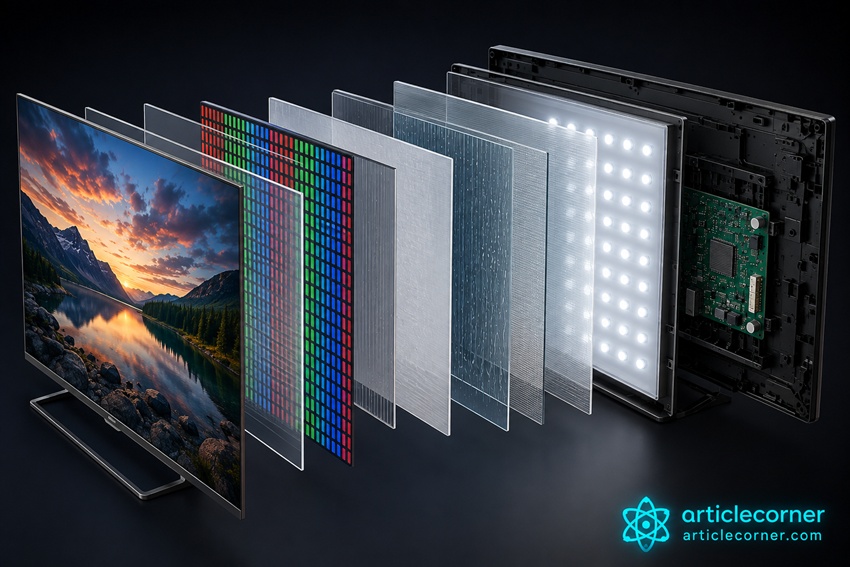
The screen is made up of millions of tiny points called pixels.
You cannot normally see each pixel individually because they are extremely small. Together, however, they create the pictures we see.
Each pixel can produce different colors by controlling three basic color components:
Red, green, and blue.
These are commonly known as RGB.
By changing the intensity of these three colors, a pixel can create a huge range of different colors.
For example, when red and green light are combined, we can see yellow. Different combinations and brightness levels create all the other colors we see on the screen.
So when you look at a beautiful sunset on your TV, that image is actually being created by millions of tiny pixels, each doing its own little job.
How Does an LCD TV Produce Light?
In a traditional LCD television, the pixels themselves do not produce the light.
There is a light source behind the screen called a backlight.
The light passes through several layers, including liquid crystal elements and color filters. These components control how much light passes through each pixel and what color it appears to be.
By controlling millions of pixels independently, the television creates the final image.
What About LED TVs?
You may have noticed that many televisions are called LED TVs.
This can be a little confusing.
Most LED TVs are actually LCD screens that use LEDs as their backlight.
The LEDs provide the light behind the LCD panel, while the LCD technology controls the image.
This combination makes it possible to build televisions that are relatively thin and energy efficient.
And What Makes OLED Different?
OLED technology works in a different way.
With an OLED display, individual pixels can produce their own light. There is no traditional backlight behind the entire screen.
This creates an important advantage.
When an OLED pixel needs to display black, it can simply turn itself off. Because there is no light coming from that pixel, the screen can produce extremely deep blacks and very high contrast.
That is one reason OLED screens can look so impressive.
How Does a Still Picture Become a Moving Picture?
Here comes one of the most interesting parts.
Your television is not actually showing one continuously moving picture.
Instead, it shows a series of individual frames very quickly.
Imagine looking at a series of photographs:
Picture → Picture → Picture → Picture → Picture
If they change quickly enough, your visual system perceives them as continuous movement.
For example, a television displaying 60 frames per second is showing 60 individual images every second.
The changes happen so quickly that we perceive a smooth moving scene rather than separate pictures.
How Does the TV Know Which Color Each Pixel Should Show?
This is where the television's processing system becomes important.
The incoming video contains information about the image. The TV's processor interprets this information and determines the color and brightness values that need to be sent to the pixels.
Imagine a blue sky on the screen.
Millions of pixels representing the sky receive instructions telling them how much red, green, and blue to produce and how bright they should be.
Then the same process happens for the clouds, buildings, people, trees, cars, and everything else in the scene.
And all of this happens extremely quickly.
What About the Sound?
The television is also receiving audio data along with the picture.
The TV separates and processes the audio information and sends it to its speakers.
Inside a speaker, electrical signals are converted into physical vibrations. These vibrations move the air around them, creating sound waves.
Those waves reach our ears, and we hear voices, music, sound effects, and everything else that accompanies the picture.
So the TV is doing two things at the same time:
It creates light patterns for our eyes and sound waves for our ears.
The Amazing Part
The next time you watch television, take a closer look at the screen.
That person you see, that blue sky, that football, or that beautiful landscape is actually being created by millions of tiny pixels working together.
Each pixel receives instructions about color and brightness. The pixels change rapidly, frame after frame, while the television simultaneously processes sound.
And our eyes and brain put all of this information together.
What looks like a simple picture on the screen is actually the result of an incredible amount of technology working behind the scenes.
A television doesn't simply show a picture. It creates one, pixel by pixel, frame by frame.
ArticleCorner Science:
Technology, Simply Explained.
Writer: articlecorner.com