ArticleCorner History
The Vikings: A Journey Through the Medieval North
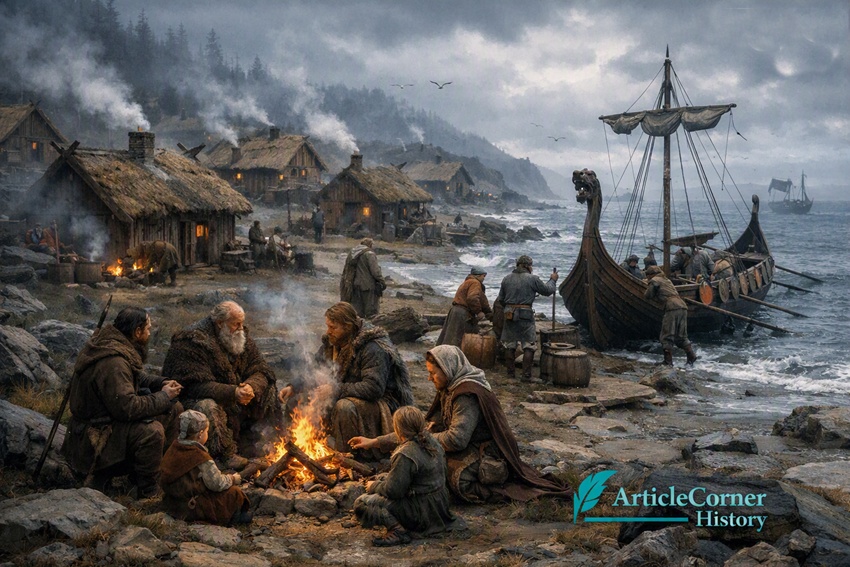
Imagine for a moment that we could leave the modern world behind. No cars, no airplanes, no crowded streets, no glowing screens in our hands. Instead, let us travel back more than a thousand years, to a cold northern shore where the sea stretches toward the horizon and the wind moves across a small settlement. Smoke rises from wooden houses, people gather around a fire, and somewhere near the water, a long wooden ship is being prepared for a journey.
This is the world of the Vikings, one of the most fascinating peoples of the European Middle Ages. Their story is often told through battles and raids, but the Viking world was much larger than that. They were sailors, traders, farmers, explorers, craftsmen, settlers, and storytellers who lived in a world where the sea was not a barrier, but a road.
The Viking Age began in the late eighth century and continued for roughly three hundred years. During this period, groups from Scandinavia traveled across the seas and rivers of Europe, reaching places that seemed unimaginably distant from their northern homes. They sailed west toward Britain, Ireland, Iceland, Greenland, and eventually North America. Others traveled eastward through the rivers of Eastern Europe, reaching the Black Sea, the Byzantine world, and the lands connected to the great trade routes.
When we look at a modern map, these journeys may appear almost ordinary.
But imagine making them without engines, satellites, modern maps, or weather forecasts. A wooden ship, a changing wind, the stars above, and the experience of the sailor were often all that stood between the traveler and the unknown.
And perhaps this is where the Viking story becomes especially interesting. We often imagine a Viking standing with a weapon in his hand, ready for battle. But before a warrior could reach another shore, someone had to build the ship. Someone had to cut the timber, shape the wood, make the ropes, prepare the sail, preserve the food, repair the tools, and understand the sea. Behind every voyage was an entire community.
The Vikings were not simply men who appeared suddenly from the northern seas.
They belonged to societies with families, farms, laws, traditions, beliefs, craftsmen, merchants, and political leaders. Their world could be violent, but it could also be surprisingly organized and connected.
Their ships were perhaps their greatest advantage. Viking longships were designed to be fast, relatively light, and capable of traveling through both open water and shallow rivers. This gave them an extraordinary freedom of movement. A ship could cross the sea and then continue inland along a river where larger vessels could not go. The sea became a highway connecting distant communities.
A Viking sailor did not necessarily think of the ocean as an enormous empty space. To him, it could be a network of routes leading toward opportunity, trade, settlement, or adventure.
The Vikings were also traders. They exchanged goods such as furs, timber, amber, iron, walrus ivory, and other valuable products, while bringing back silver, silk, spices, glass, and objects from distant lands. Some Viking travelers reached the great city of Constantinople, the center of the Byzantine world. Others traveled through the rivers of what is now Russia and Ukraine toward the Black Sea and beyond.
Their world was therefore connected to much larger networks of exchange. A person living in Scandinavia could possess an object that had traveled thousands of kilometers before reaching his hands.
Then there were the settlements. The Vikings did not simply arrive somewhere, take what they wanted, and disappear. Many stayed. They established communities in Britain and Ireland, settled Iceland, and eventually founded settlements in Greenland. These places required farming, construction, cooperation, and adaptation to difficult environments.
Life in the North Atlantic was not easy. The climate was harsh, resources were limited, and a successful settlement depended on careful planning. The image of the Viking as nothing more than a raider becomes much harder to maintain when we imagine these people trying to build a permanent home in a distant and unfamiliar landscape.
And then comes one of the most remarkable chapters of the story. Around the year 1000, Norse explorers reached parts of North America, centuries before Christopher Columbus crossed the Atlantic in 1492. Archaeological evidence at L'Anse aux Meadows in Newfoundland confirms that Norse people established a settlement there.
Imagine the scene for a moment: a wooden ship approaching a coast that had never appeared on the maps of medieval Europe. The sailors step onto unfamiliar land, surrounded by forests, water, and an enormous continent stretching far beyond what they could understand. They had no idea that their journey would one day become part of one of history's most fascinating stories of exploration.
But the Viking world was not frozen in time. Like every society, it changed. Scandinavia gradually became more closely integrated with the Christian kingdoms of Europe. Political structures became stronger, Christianity spread, and the age of large Viking raids slowly came to an end. By the eleventh century, the Viking Age was fading. The people did not disappear.
They changed. Their descendants became part of the kingdoms and societies of medieval Europe, carrying elements of their language, traditions, technology, and culture into the centuries that followed.
So perhaps we should not imagine the end of the Viking Age as the sudden closing of a door. It was more like a ship disappearing over the horizon. We can still see traces of the people who sailed those ships in place names, archaeological remains, languages, stories, laws, and cultural traditions. Their world became part of the larger medieval world, and the medieval world continued to change long after the last great Viking voyages.
Now let us return to the present.
Today, we cross oceans in hours. We can look at almost any coastline from space, follow a ship on a digital map, and know tomorrow's weather before leaving home. A sailor from the Viking Age would probably find our world almost impossible to understand. The enormous sea that once demanded courage, experience, and patience has become something we can cross with engines, navigation systems, and precise maps.
Yet something important has remained the same. We still look toward distant places and wonder what lies beyond them. We still travel because we are curious. We still build better ships, search for new routes, explore unfamiliar places, and tell stories about those who dared to go farther than others. The technology has changed almost completely, but the human desire to discover has not.
Perhaps that is why the Vikings continue to fascinate us. Their story is not simply about warriors, ships, or distant battles. It is about people who stood beside a northern sea more than a thousand years ago and decided to sail toward a horizon they could barely imagine. They had limited technology, little knowledge of the world beyond their shores, and no way of knowing what awaited them.
Today, our world is very different.
We can see the entire planet from space, cross oceans in hours, and explore places with technologies the Vikings could never have imagined. Yet we still look beyond the horizon, searching for what remains unknown.
The Viking ships are gone, the wooden houses have disappeared, and the old northern settlements have become archaeological sites. But the idea of the voyage remains. Somewhere between the medieval shoreline and the modern world, the same human question continues to return: **What is beyond the horizon?**
ArticleCorner History: They Sailed Where Maps Ended-Vikings
Writer: articlecorner.com