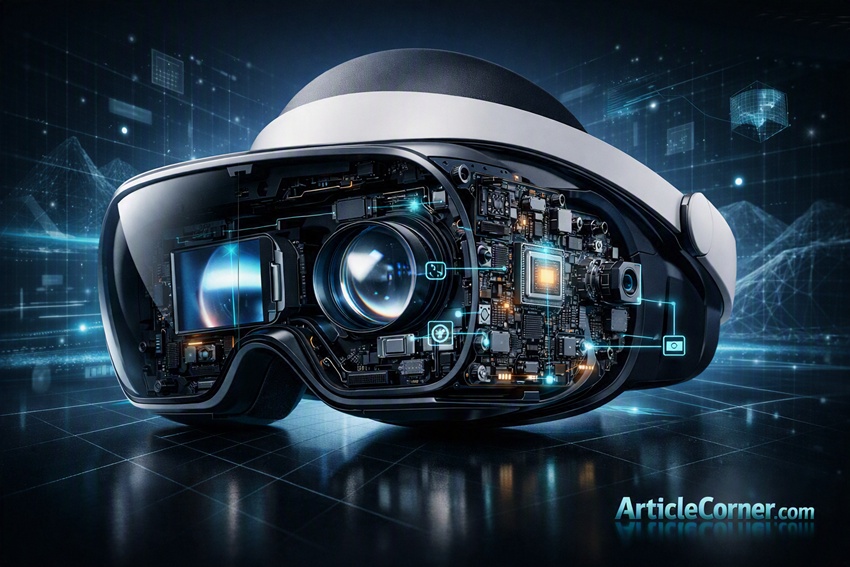
ArticleCorner: How Do VR Headsets Actually Work?
How technology creates the feeling of stepping into another reality.
Have you ever put on a VR headset and suddenly felt like you were somewhere completely different?
You may still be sitting in your room, but your eyes are seeing a completely different world. You can look around, move your head, reach out with your hands, and sometimes even walk through a digital environment.
That is the fascinating part of Virtual Reality.
But how does a small headset create such a convincing experience?
At ArticleCorner, we wanted to look behind the experience and understand what is actually happening inside a VR headset.
Two Eyes, Two Different Images
The first trick is actually something our own eyes already do every day.
Our eyes see the world from slightly different angles. Our brain combines these two images and uses the difference between them to understand depth.
VR headsets copy this process.
The headset provides a slightly different image for each eye. When your brain combines these two images, the digital scene begins to look three dimensional.
So when you see a virtual object in front of you, your brain is not simply looking at a flat picture. It is receiving visual information that resembles the way it normally receives information from the real world.
What Do the Lenses Do?
There is another important part between your eyes and the screens: the lenses.
The screens inside a VR headset are actually very close to your eyes. If you looked directly at them, the experience would not feel like looking into a distant world.
The lenses change the way the images reach your eyes.
They enlarge the image, adjust the light entering your eyes, and create the impression that the virtual environment is much farther away than the screen itself.
In other words, you are looking at a screen that is only centimeters away, while your brain receives visual information that makes the scene feel like it exists somewhere much farther away.
Pretty clever, isn't it?
Turn Your Head and the World Moves With You
Now comes one of the most important parts of the experience.
Turn your head to the left and the virtual world moves with you. Look up and you see what is above you. Look down and the digital environment changes accordingly.
This happens because the headset constantly monitors your head movements.
A VR headset can use several sensors to do this.
The gyroscope detects rotational movement.
The accelerometer measures changes in movement and acceleration.
The magnetometer can help determine orientation relative to Earth's magnetic field.
All of this information is processed extremely quickly. The system then changes the image on the screens according to your movement.
The goal is simple: when you move your head, the virtual world should respond almost immediately.
If there is too much delay, something strange happens. Your eyes tell your brain that you are moving, while your body senses something different. This mismatch can cause dizziness, nausea or discomfort.
It Is Not Just About Your Head
Modern VR systems can go much further than simply following where you are looking.
Some headsets can also understand where your body and head are positioned in the physical space.
Imagine leaning forward.
In a more advanced VR system, the virtual world can respond to that movement as well. You are no longer simply looking around a virtual world. You are physically interacting with it.
There are two main approaches.
Outside In tracking uses external cameras or sensors to monitor the headset and its position.
Inside Out tracking uses cameras built into the headset itself. These cameras observe the surrounding environment and help the headset understand where it is in the room.
This has made modern VR systems much easier to use because you do not always need external tracking equipment.
How Do You Touch Something That Isn't Really There?
Seeing a virtual world is only half of the experience.
What makes VR especially interesting is interaction.
You might reach out and pick up a virtual object, press a button, point at something or move your hands naturally.
Depending on the system, this can be done using handheld controllers, hand tracking, motion sensors or even eye tracking.
The technology is essentially translating your physical actions into digital actions.
You move your hand in the real world.
The software detects the movement.
Your virtual hand moves.
And suddenly, the object in front of you feels like something you can actually interact with.
The Invisible Enemy: Latency
There is one more factor that most people never think about when using VR: latency.
Latency is the delay between your physical movement and the moment the virtual world responds.
Imagine turning your head quickly. If the image takes too long to catch up, the illusion begins to break.
Even a small delay can make the experience uncomfortable.
That is why VR systems need fast processors, responsive sensors and high refresh rate displays. Many modern headsets use refresh rates of 90 Hz or higher to create a smoother experience.
The faster everything works together, the more convincing the virtual world becomes.
So, Is VR Really Creating Another Reality?
Not exactly.
The headset is not creating a real world. It is creating a carefully designed stream of visual and sensory information.
Screens create the images.
Lenses shape what your eyes see.
Sensors track your movements.
Cameras understand your position.
Controllers and tracking systems translate your actions.
Software brings everything together.
Your brain then does the most interesting part of all.
It takes this artificial information and interprets it as a world you can see, explore and interact with.
That is why VR is much more than a gaming technology.
The same principles can be used for education, medical training, engineering, architecture, simulations and many other fields.
At ArticleCorner, we think that is what makes VR so fascinating.
It is not simply about putting a screen in front of your eyes.
It is about discovering how technology can work together with the human brain to create the feeling of being somewhere that does not physically exist.
And perhaps the most interesting question is not “How does VR create a virtual world?”
Maybe it is this:
How far can technology go in convincing our brains that an artificial world is real?
ArticleCorner: Explore. Question. Understand.
Writer: articlecorner.com