A World Without Water
Have you ever stopped to think about the water flowing from your faucet?
Probably not.
Most of us wake up, brush our teeth, take a shower, make coffee, and pour ourselves a glass of water without giving it a second thought. Water has become such a normal part of our lives that we rarely notice it until something interrupts the flow.
Yet water is one of the greatest gifts we have. Every heartbeat, every tree, every harvest, and every living creature depends on it. Without water there would be no cities, no forests, no food, and no life as we know it.
Now imagine a different reality.
Imagine waking up tomorrow, turning on the faucet, and hearing only silence.
For millions of people, this is not imagination. It is everyday life.
In several African countries, finding clean water is still one of the biggest challenges of daily living. Many women and children begin their mornings by walking long distances under the hot sun carrying empty containers. Sometimes they walk for hours just to collect enough water for drinking, cooking, and washing. When they finally return home, the water they have gathered is not always clean. It may carry bacteria or parasites that cause diseases many of us rarely think about.
For these families, every drop matters.
A child who spends half the day collecting water has less time to attend school. A mother who cannot find clean water worries about much more than preparing dinner. Entire communities live with uncertainty, hoping the next well will not run dry.
Meanwhile, in many parts of the world, water quietly disappears down the drain.
A faucet is left running while someone brushes their teeth.
A leaking pipe drips day and night.
A garden is watered far longer than necessary.
These moments may seem small, but together they add up to an enormous amount of wasted fresh water.
The truth is that the value of water is often invisible to those who have never had to search for it.
Now let us imagine something even more unsettling.
What if the water stopped flowing everywhere?
Not for an hour.
Not for a day.
But for weeks.
Rivers begin to shrink. Lakes slowly disappear. Crops fail under a relentless sun. Food becomes scarce. Prices rise. Forests dry out and wildfires spread more easily. Animals leave their habitats in search of water, while others do not survive the journey.
Hospitals struggle.
Factories slow down.
Power production is affected.
Entire cities begin to change in ways no one expected.
In such a world, money cannot create water where none exists. Technology can help, but it cannot replace healthy rivers, reliable rainfall, and protected freshwater sources.
The good news is that this future is not inevitable.
Every repaired leak saves water.
Every shorter shower makes a difference.
Every river kept free from pollution protects countless lives.
Every child who learns to respect water grows into an adult who may help protect it.
No single person can solve the global water crisis alone. But every person can become part of the solution.
Perhaps the greatest mistake we make is believing that water will always be there simply because it was there yesterday.
Nature has never promised that.
The next time you fill a glass of water, pause for just a moment.
Think about the families who walked for hours to collect the same amount.
Think about the children who missed school because their first lesson of the day was finding water.
Think about a future where clean water may become one of the world's most precious resources.
Because the true value of water is not measured by the price on a utility bill.
It is measured by the lives that depend on every single drop.
ArticleCorner.com Perspective
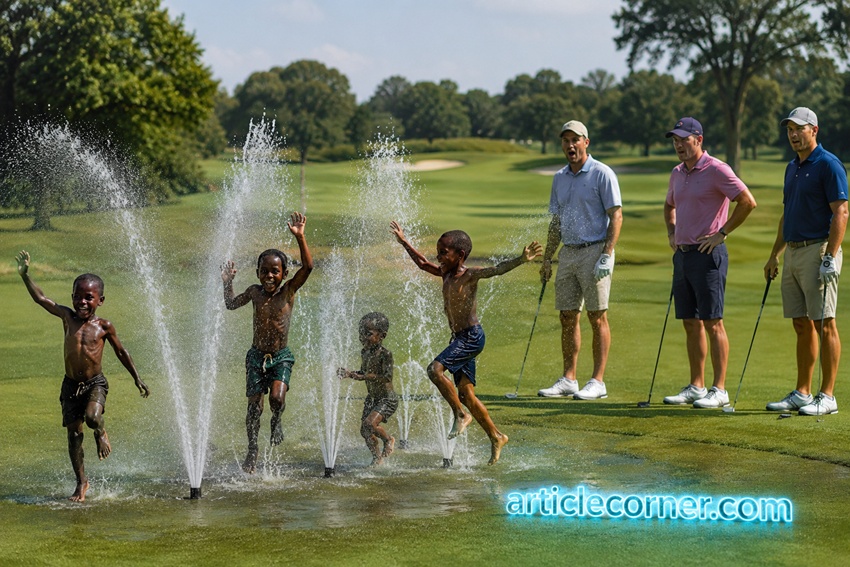
We spend vast amounts of water keeping thousands of acres of golf courses perfectly green for leisure and recreation, while millions of people are still struggling to access clean drinking water.
When children walk for hours carrying empty containers, every drop sprayed onto ornamental grass deserves to be questioned.
Luxury should never come before life.
If clean water is becoming one of Earth's most precious resources, perhaps it is time to ask ourselves a simple question.
What exactly are we watering?
Grass, or our indifference?
Writer: articlecorner.com